

Affordable Websites for Small Business: Start With the Right Budget
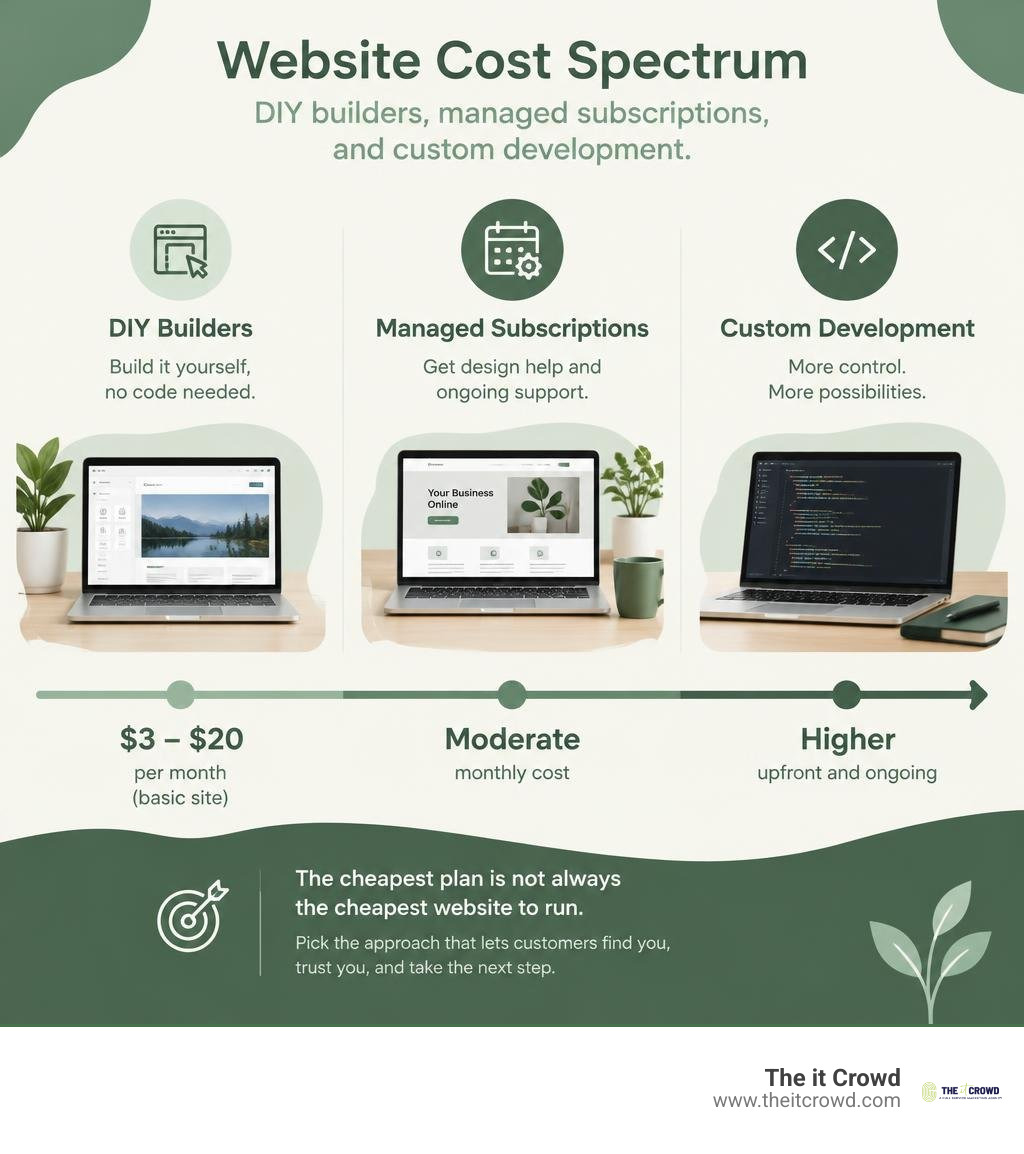
Affordable websites for small business usually start with a no-code builder, which can cost roughly $3 to $20 a month for a basic site. If you want help with design and upkeep, a managed website subscription may be a better fit. Custom development costs more but gives you greater control. Before choosing, check the renewal price and what you’ll pay for a domain, business email, and any tools you need.
The cheapest plan is not always the cheapest website to run. Pick the approach that lets customers find you, trust you, and take the next step.
I’m Lindsey Huettner, owner of The it Crowd. With more than 19 years in marketing and business ownership, I’ll help you weigh affordable websites for small business against the time, features, and ongoing costs each approach requires.
Must-know affordable websites for small business terms:
The Real Value of Affordable Websites for Small Business in 2026
About one in three small businesses still operate without a dedicated website, relying solely on social media pages, local directory listings, or word-of-mouth referrals. In November 2026, consumer behavior tells a very different story. Modern buyers rarely call or visit a business without conducting a quick digital verification check first. A standalone website proves that your company actually exists, operates professionally, and respects customer privacy and security.
Social media platforms are helpful distribution channels, but they are rented land. Algorithmic shifts, account lockouts, or policy updates can cut off your customer communications overnight. A company website serves as your permanent digital storefront, providing 24/7 visibility and complete authority over your brand narrative.

When establishing your presence, mastering the fundamentals of web design ensures that your site functions as an active lead generation engine rather than a static brochure. A well-structured website captures localized search traffic, educates prospects through clear service breakdowns, and channels visitors directly into booking calendars or quote inquiry forms. When paired with industry benchmarks like the U.S. SME Access and Use of Digital Tools report, the data clearly shows that small enterprises integrating dedicated web properties capture higher customer engagement and retain stronger pricing power.
Comparing the Best Low-Cost Website Approaches
Finding budget-friendly small business websites involves picking a development model that matches your available time, technical comfort level, and long-term business goals. Below is a comparison of the primary low-cost web design pathways available today:
| Model | Average Setup Time | Baseline Monthly Cost | Technical Skill Level | Scalability & Customization |
|---|---|---|---|---|
| AI-Driven Site Builders | 30 minutes to 3 hours | $2 to $16 / month | Beginner (No-code / Visual) | Moderate (Template constrained) |
| Self-Hosted CMS | 1 to 3 weeks | $4 to $25 / month | Intermediate to Advanced | High (Infinite plugin ecosystem) |
| Managed Subscriptions | 3 to 7 days | $40 to $60 / month | None (Done-for-you service) | High (Agency-maintained changes) |
AI-Driven Website Generators
AI-powered website builders allow business owners to create a small business website in minutes by answering basic prompts about their industry, services, and location. These tools instantly generate multi-section layouts, starter copywriting, color palettes, and stock imagery.
Most platforms operate on conversational or visual drag-and-drop systems. You can adjust typography, swap sections, and link payment gateways without touching a single line of CSS or HTML. Entry-level pricing is exceptionally low, often starting between $1.99 and $6 per month when billed annually. These plans frequently bundle free domain registration for the first year, integrated SSL certificates, and hosting infrastructure capable of handling routine traffic.
The trade-off lies in long-term flexibility. Visual builders keep you within structured layout grids. While this prevents beginner design errors, it can limit technical SEO adjustments, custom checkout sequences, or complex third-party software integrations down the line.
Self-Hosted Content Management Systems
Self-hosted platforms, such as open-source WordPress, offer total data ownership and complete development freedom. Rather than paying a closed-platform subscription, you purchase standalone web hosting and install the software for free. Baseline hosting often ranges from $3 to $10 per month, giving you control over server configurations, file structures, and database management.
Self-hosting excels in long-term scalability and organic search capabilities. You can implement granular schema markup, optimize page speed caching, and tap into thousands of free and premium plugins to expand functionality. However, open-source systems require active oversight. You are responsible for executing core software updates, resolving plugin conflicts, creating data backups, and configuring security firewalls. When technical roadblocks arise, seeking professional web design and development helps ensure your architecture remains stable, secure, and fast.
Managed Website Subscriptions
For business owners who want a hands-off experience without five-figure agency development invoices, Website-as-a-Service (WaaS) subscriptions bridge the gap. These hybrid models charge a predictable monthly fee (frequently between $45 and $55 per month) to design, launch, host, and maintain your digital footprint.
Under a managed arrangement, professional developers build your pages using tested, conversion-optimized layouts. Your monthly subscription covers high-speed hosting, ongoing security monitoring, software patches, and routine content modifications such as updating business hours, swapping images, or adding new service offerings. This eliminates technical maintenance while avoiding large upfront cash outlays.
Core Components and Total Cost of Ownership
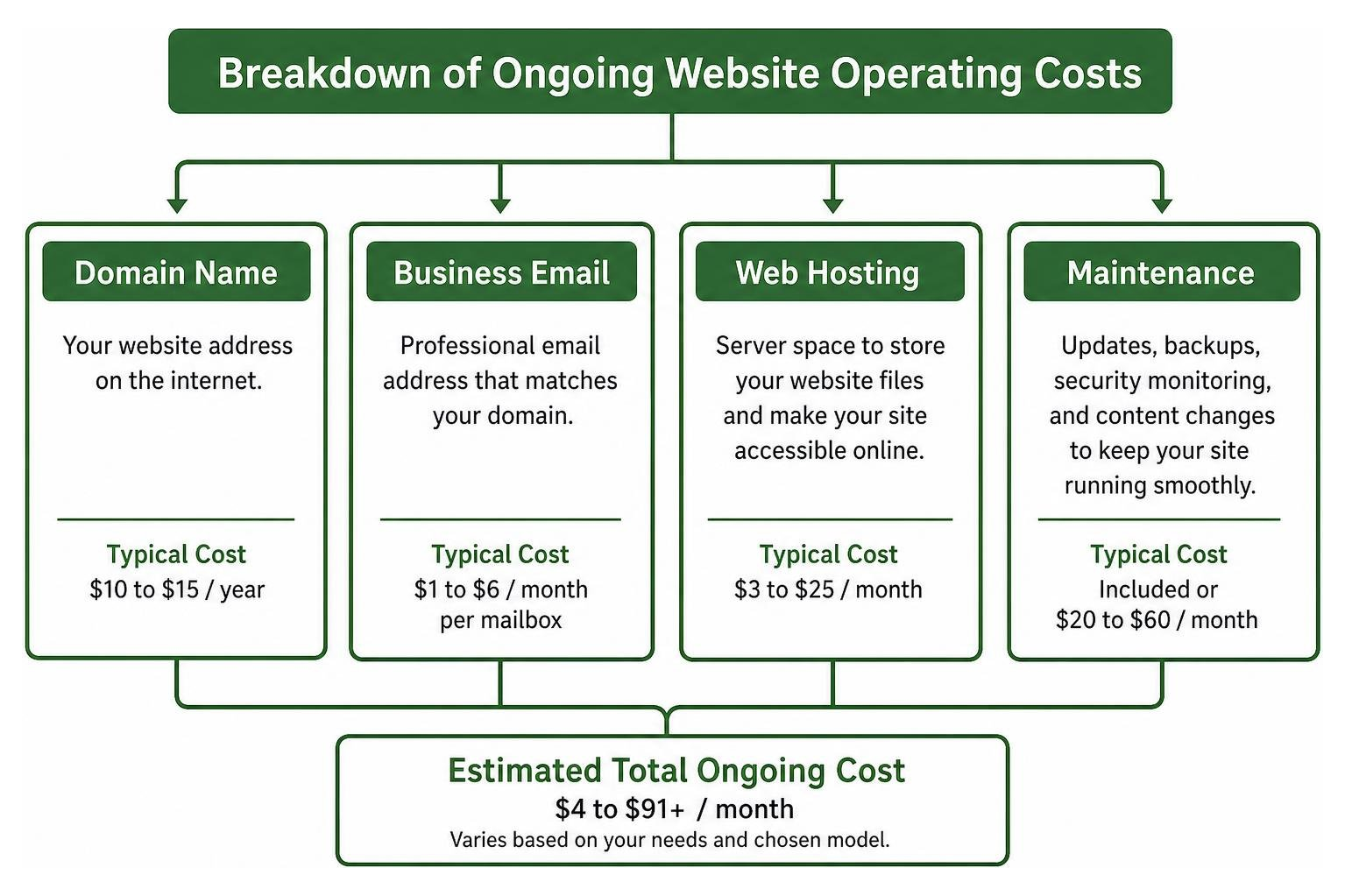
Evaluating website affordability requires calculating the Total Cost of Ownership (TCO) over a three-to-five-year operational window rather than just looking at the introductory checkout price.
Core Features of Affordable Websites for Small Business
A cost-effective website must perform reliably across every consumer touchpoint. Cutting corners on foundational features often leads to lost leads and higher rebuilding expenses later. Essential elements include:
- Mobile-Responsive Architecture: Layouts must adapt instantly to mobile, tablet, and desktop viewports, maintaining legible font sizing and clean button spacing.
- SSL Encryption & Fast Hosting: Secure Socket Layer certificates protect visitor data, maintain browser security trust badges, and prevent search engine penalties.
- Clear Conversion Channels: Click-to-call buttons, quote request forms, and integrated calendar booking widgets should guide users toward direct action.
- Brand Consistency: Clean typography, balanced negative space, and matching color schemes are vital for making a great impression on the web within the first three seconds of a visit.
Budgeting Ongoing Costs for Affordable Websites for Small Businesses
Initial setup expenses represent only one piece of your balance sheet. Keep these recurring operational costs in mind when budgeting:
- Domain Registration: Custom domains (.com, .net, .org) cost approximately $12 to $22 annually. While many site builders include a free domain for year one, renewals reflect standard retail rates.
- Domain-Level Business Email: Using a generic email address damages trust. Dedicated business inboxes matching your domain generally cost between $2 and $7 per user per month.
- Promotional Hosting Renewals: Introductory hosting rates frequently increase upon contract renewal. A plan starting at $2.99 per month may renew at $10.99 to $14.99 per month after your initial term expires.
- Payment Gateway Processing Fees: E-commerce transactions generally carry a standard processing fee of 2.9% plus $0.30 per transaction. Ensure your platform does not add proprietary platform surcharges on top of standard gateway rates.
- Technical Maintenance & Audits: Content optimization, link verification, and Core Web Vitals tuning are essential. Routine ongoing website optimization preserves search visibility and ensures your site continues running smoothly.
Evaluating DIY Builders vs. Professional Agency Services

Deciding between a DIY site builder and a full-service agency comes down to balancing sweat equity against commercial return.
DIY builders are an excellent starting point for new ventures testing a business model on a shoestring budget. However, business owners often spend dozens of hours troubleshooting styling quirks, writing marketing copy, and configuring integrations. If technical bottlenecks cause slow page loads or broken contact forms, those lost leads quickly outweigh your initial software savings.
A full-service digital agency builds with long-term revenue in mind. Rather than simply assembling pages, an agency integrates search engine optimization, persuasive copywriting, conversion-focused user journeys, and analytics tracking from day one. This strategic groundwork ensures your site drives measurable business growth while you focus on running day-to-day operations.
Frequently Asked Questions About Affordable Web Design
Can I launch a professional business website without coding skills?
Yes. Modern website platforms utilize no-code visual drag-and-drop editors and conversational AI engines. Business owners can customize page structures, update text, upload images, and configure contact forms without writing code.
How much does it cost to build and maintain a small business website?
A self-built site using an entry-level builder costs roughly $3 to $20 per month, plus an annual domain fee of $15. Managed subscription services generally range from $40 to $60 per month, while professional custom agency builds require a larger upfront investment but deliver tailor-made functionality, custom assets, and hands-off support.
How do affordable website builders handle search engine optimization?
Most reputable builders include foundational on-page SEO fields, such as custom page titles, meta descriptions, image alt tags, clean URL slugs, and automatic XML sitemaps. However, climbing search rankings in competitive local markets still requires keyword-targeted copy, fast server response times, structured schema markup, and high-quality local backlink profiles.
Conclusion
Affordable web design in 2026 is about maximizing your return on investment, not just finding the cheapest plan available. Whether you build your initial digital footprint using an automated AI tool, deploy a self-hosted content system, or partner with a managed service, your web presence should actively generate leads, build consumer trust, and support sustainable business growth.
When your business is ready to move beyond basic templates and scale into an integrated digital engine, our team at The it Crowd is here to help. Explore our full-service digital growth solutions to build a high-performing web presence backed by proprietary AI technology, advanced SEO, and data-driven marketing campaigns.

