
How to Improve Your Pressure Washing Rankings
SEO for pressure washing starts with a complete Google Business Profile and a website with separate pages for the services and cities you serve. Add real before-and-after photos, ask customers for honest reviews after each job, and make it easy to request a quote on a phone. Publish new pages before your busy season so they have time to gain visibility.
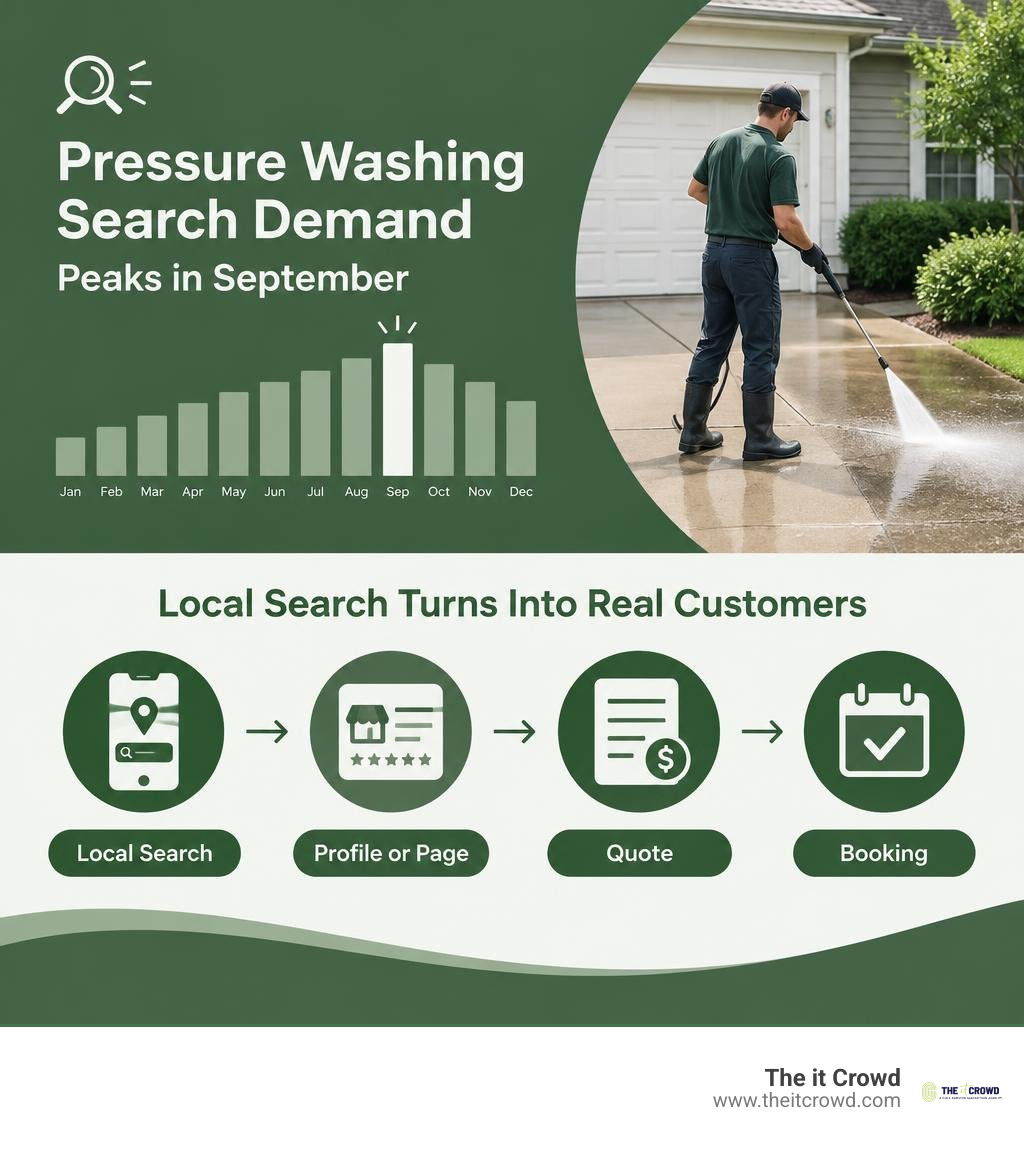
The opportunity is large, but demand changes through the year. Estimates put U.S. pressure washing searches at about 301,000 a month, including roughly 110,000 searches for “pressure washing near me.” A clear local presence helps your business stand out when nearby customers are ready to book.
I’m Lindsey Huettner, owner of The it Crowd, a Dallas digital marketing agency. I bring more than 19 years of marketing and business ownership experience to this practical guide to SEO for pressure washing.
Core Pillars of Effective SEO for Pressure Washing Companies
Search engine optimization is not about tricking algorithms. It is about presenting clear proof of your work, your service areas, and your business credibility so search engines confidently recommend you. According to consumer search research, 84% of consumers searched online for a local business in the past three months. When property owners spot green algae climbing their siding or dark tire tracks coating their driveways, they do not flip through print mailers. They search on their phones.
Google calculates local search results based on three foundational signals:
- Relevance: How well your business profile and website content match what the user is typing.
- Distance: The proximity between your business or verified service radius and the searcher’s physical location.
- Prominence: How well-known, trusted, and verified your business is across the web, measured through customer reviews, reputable backlinks, citations, and engagement.
Home service companies often make the mistake of relying on generic five-page websites that group every service into a single bulleted list. To capture high-value property maintenance inquiries, your website architecture must reflect how search intent shifts across different surfaces, property types, and service methods. Our team explores these structural nuances in depth across various industries in our breakdown of SEO strategies for different industries.
Why Differentiating Soft Wash vs. Pressure Wash Expands SEO for Pressure Washing
One of the costliest oversights in exterior cleaning marketing is treating pressure washing and soft washing as interchangeable terms. They represent two entirely distinct search audiences with different buyer intents, risk tolerances, and price points.
High-pressure washing uses mechanical force (typically 2,500 to 4,000+ PSI) to blast dirt and moss from hard surfaces like unsealed concrete driveways, aggregate walkways, and stone retaining walls. In contrast, soft washing uses low pressure (under 500 PSI) combined with specialized, eco-conscious surfactant and sodium hypochlorite blends. Soft washing safely sanitizes delicate surfaces such as asphalt shingle roofs, cedar shakes, stucco, and vinyl siding without voiding manufacturer warranties or blasting water behind exterior walls.
Homeowners dealing with delicate roofs or expensive siding actively search for soft wash specialists. When roofs develop dark, unsightly streaks caused by Gloeocapsa magma (an airborne, photosynthetic cyanobacteria), informed property owners look for treatments aligned with Asphalt Roofing Manufacturers Association (ARMA) guidelines. Blasting an asphalt roof with high pressure strips away protective ceramic granules and destroys the roof’s lifespan.
Our industry audits show that operators maintaining dedicated soft wash service pages rank for 2.4 times more local search queries than businesses combining all exterior cleaning onto a single generic page.
| Cleaning Category | Typical Surfaces Cleaned | Primary Keyword Targets | Customer Intent & Concerns |
|---|---|---|---|
| High-Pressure Washing | Poured concrete, aggregate driveways, brick patios, curb lines | “driveway pressure washing”, “concrete power washing”, “commercial patio cleaning” | Removing deep oil stains, mud, tire marks; fast surface restoration |
| Low-Pressure Soft Washing | Asphalt shingles, tile roofs, vinyl siding, dryvit/stucco, painted wood | “roof soft washing”, “house washing service”, “safe exterior siding cleaning” | Eliminating Gloeocapsa magma, preventing shingle damage, warranty protection |
Beating Directory Dominance and Part-Time Weekend Operators
When you search for exterior cleaning services, national aggregator directories frequently occupy top traditional organic positions. However, these directories suffer from a major weakness: thin, automated content. A directory page is usually an automated index listing ten businesses with generic descriptions. By publishing rich, localized content loaded with real project photos, local environmental considerations, and transparent pricing factors, an independent operator can easily outrank static directory pages.
At the same time, pressure washing has a low barrier to entry. Every spring, new operators buy a pressure washer from a big-box store and flood local marketplaces. These part-time operators create crowded map packs early in the season, but they rarely maintain their digital assets. They fail to collect consistent reviews, neglect their Google Business Profiles, post no technical content, and vanish by autumn.
A disciplined, year-round search strategy turns seasonal volatility into an advantage. By maintaining consistent profile activity, gathering verified reviews, and building structured service landing pages, full-time professionals secure stable map pack rankings that part-time operators cannot shake.
Google Business Profile and Map Pack Mastery: Outranking Aggregators and Weekend Operators
The Google Local 3-Pack sits above standard organic search links, capturing the vast majority of direct phone calls and quote requests. Optimizing your Google Business Profile (GBP) is the single fastest lever for local lead generation.
First, select Pressure Washing Service as your primary business category. Do not choose generic categories like “Cleaning Service” or “Janitorial Service” as your primary classification, as doing so dilutes your relevance for high-intent exterior cleaning terms. If you offer complementary solutions, add secondary categories such as “Window Cleaning Service”, “Gutter Cleaning Service”, or “Deck Builder”.
Because Google does not offer an official primary category for “Soft Washing”, create custom service entries under your profile. Build distinct service listings for:
- House Soft Washing
- Roof Algae Removal & Soft Washing
- Concrete Driveway Cleaning
- Paver Sanding and Sealing
- Commercial Storefront Pressure Washing
Write 200 to 300 characters of descriptive copy for every custom service entry. Include your service city names naturally within these descriptions. Ensure your Name, Address, and Phone number (NAP) data matches your website footer and directory listings across the web. If you operate as a Service Area Business (SAB) without a retail storefront, follow standard best practices by hiding your physical residential address and setting a defined regional service radius. You can follow our complete step-by-step framework in this SOP for optimizing a Google Business Profile listing.
High-Converting Review Acquisition and Review Recency Signals
Review volume matters, but review recency and velocity are the true differentiators in competitive markets. Google’s algorithm rewards businesses that consistently generate authentic customer feedback over those that gathered fifty reviews two years ago and stopped.
In mid-size markets (250,000 to 750,000 population), local pack-ranking pressure washing companies hold an average of 35 to 60 reviews. In major metropolitan areas, that threshold increases to 75 to 120 reviews with a 4.8-star rating or higher. High review counts convert traffic: leads originating from the Google 3-Pack demonstrate an average close rate of 28%.
To build an automated review generation workflow:
- Send a direct SMS link within 60 minutes of job completion. Homeowners are most impressed right when they step outside and see their gleaming driveway or spotless siding.
- Guide their response naturally. Ask questions like, “What service did we complete for you today, and how did the property look when we finished?” This encourages customers to naturally include valuable search terms like “concrete cleaning” or “roof soft wash” alongside their neighborhood name.
- Respond to every review within 48 hours. Thank the client, reference the specific service provided, and mention the neighborhood. This adds natural geographic and topical context to your profile.
- Remain strictly FTC and Google compliant. Never offer discounts, gift cards, or free services in exchange for reviews. Incentivized reviews violate search engine policies and federal consumer protection regulations.
Consistent profile activity tells search algorithms that your business is open, active, and trusted. You can learn more about how regular profile maintenance influences map positions in our guide on how quality GBP updates boost local SEO.
Photo SEO and Before-and-After Image Optimization
Pressure washing is an visual trade. Unlike plumbers or accountants, exterior cleaning contractors have access to dramatic visual proof every time they clean a surface.
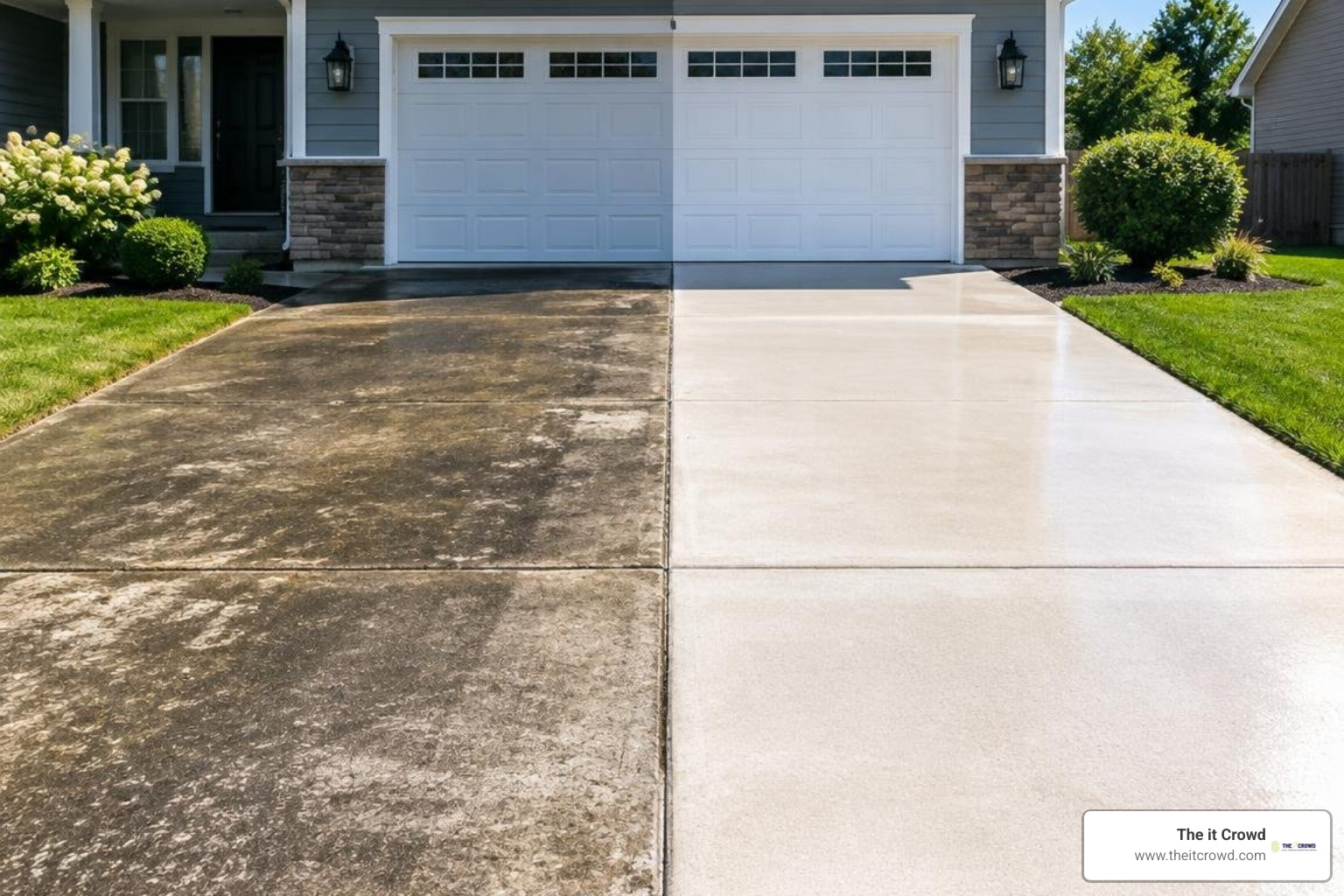
Benchmark analysis indicates that top pack-ranking pressure washing profiles maintain an average of 60 or more photos, compared to fewer than 15 for businesses outside the local pack. Profiles that upload fresh photos regularly generate higher user dwell time, click-through rates, and map pack interactions.
Aim to upload 3 to 5 original photos every week using this balanced visual mix:
- 60% Before-and-After Pairs: High-contrast split shots of concrete driveways, stained wood decks, or blackened siding.
- 25% In-Action Process Photos: Clean branded trucks, modern commercial trailer rigs, technicians wearing appropriate PPE, surface cleaners in motion, and property protection steps like taped electrical outlets and bagged landscaping.
- 15% Wide-Angle Property Highlights: Beautiful wide-angle shots of completed residential homes and commercial storefronts.
Optimize your images before uploading. Rename raw camera files from generic labels like IMG_0942.jpg to descriptive, localized names such as driveway-pressure-washing-lakewood-dallas.jpg or roof-soft-wash-highland-park.jpg.
Website Architecture: Structuring Surface, City, and Commercial Landing Pages
A well-structured website organizes content logically for both users and search engine crawlers. We recommend a flat website architecture where core service pages and regional service areas sit directly off the root domain rather than buried under nested folders.
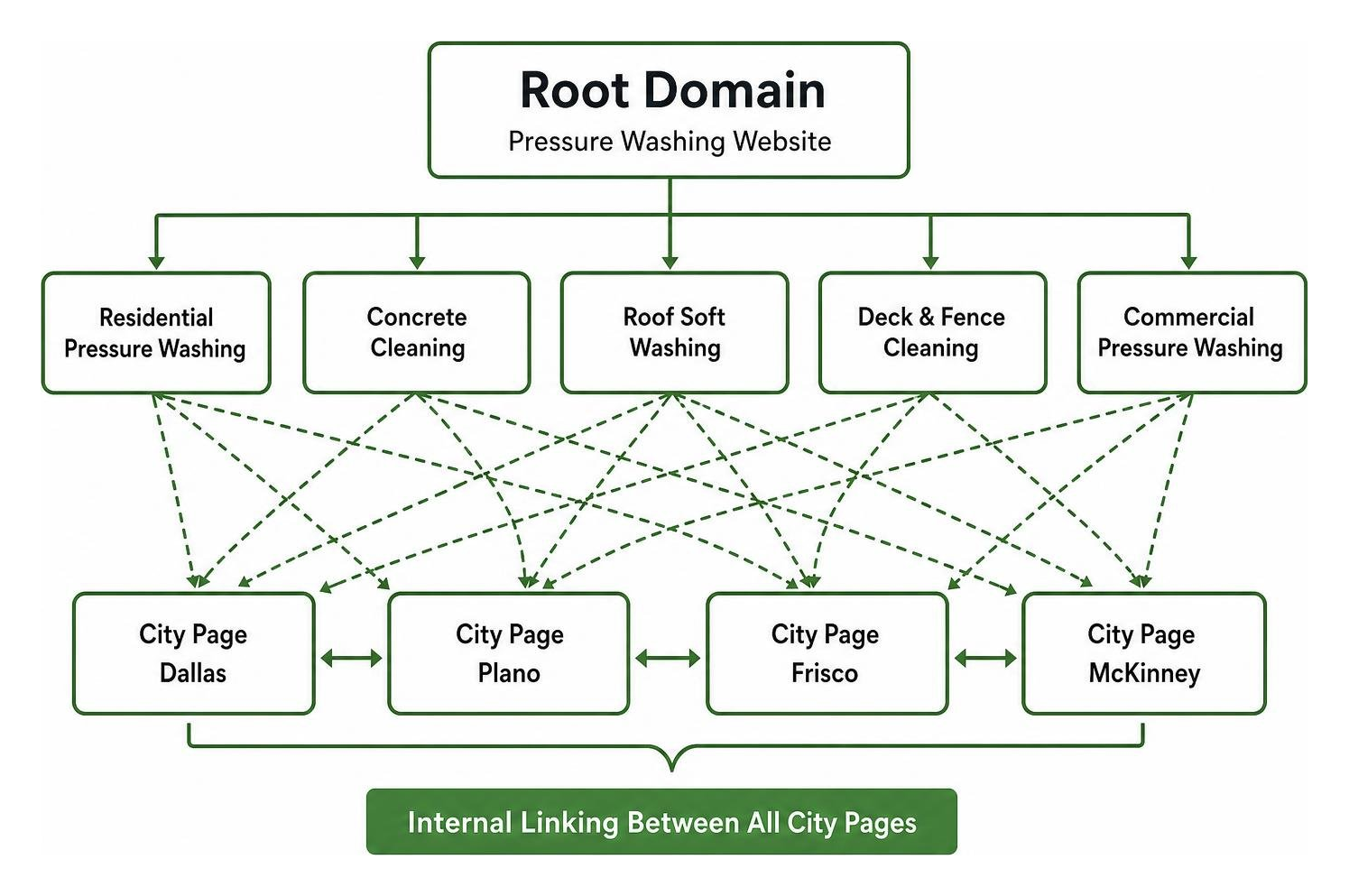
A flat structure distributes domain authority evenly across your primary service pages and location hubs. For deeper insights on optimizing your site’s architecture and layout, explore our specialized SEO and geo content optimization services.
Building Hyper-Local City and Neighborhood Landing Pages
To capture customers outside your immediate zip code, you need dedicated location landing pages. However, search engines easily detect and penalize thin, doorway city pages that simply swap city names across identical text blocks.
Each city and neighborhood page must deliver genuine local value:
- Specific Neighborhood Projects: Mention local communities, architectural styles, and common local surface stains (such as iron-rich red clay stains, live oak pollen buildup, or coastal salt air deposits).
- Embedded Local Reviews: Feature customer testimonials specifically from residents of that town.
- Localized Image Galleries: Display before-and-after projects completed within that municipality, complete with localized alt text.
- Accurate Map Embeds and Service Boundaries: Clearly outline the zip codes and sub-neighborhoods your crews cover.
A single well-optimized city or neighborhood page can rank within 90 days of indexing and generate regular inbound quote requests without paid ad spend. To evaluate the performance of these regional assets, track their growth using our framework for measuring key metrics for local SEO traffic.
Commercial Pressure Washing Pages and Wastewater Compliance
Commercial property managers, restaurant operators, and HOA boards have different priorities than residential homeowners. While a homeowner cares about curb appeal and garden safety, a commercial facilities manager prioritizes regulatory compliance, liability coverage, and minimal business disruption.
Your commercial pressure washing landing pages should address:
- Environmental & Wastewater Compliance: Explain how your team complies with the Clean Water Act and local municipal stormwater regulations (NPDES permits). Detail your wash water recovery, containment berms, vacuum reclaim systems, and legal sanitary sewer discharge practices.
- Flexible Operating Hours: Highlight overnight, early morning, and weekend scheduling designed to keep retail storefronts, drive-thrus, and office park walkways clear during business hours.
- Safety Protocols and Insurance: Display proof of commercial general liability coverage, worker’s compensation insurance, and OSHA safety compliance.
- Specialized Commercial Capabilities: Detail experience handling grease dumpster pads, multi-story building washing, parking garages, fleet washing, and gas station canopy cleaning.
Technical Optimization, Visual Signals, and Generative Engine Optimization (AEO)
Your website must load instantly on mobile devices. A potential client standing in their driveway searching for an exterior cleaning quote will not wait ten seconds for a bloated, uncompressed photo gallery to load.
Key technical optimizations include:
- Image Compression: High-resolution camera photos can easily exceed 8MB. Compress all images using modern compression tools and convert them to lightweight WebP formats to maintain visual clarity under 150KB per image.
- Mobile-First Experience: Ensure tap-to-call phone buttons and quote forms remain easily accessible on mobile screens without intrusive pop-ups.
- Core Web Vitals: Maintain fast Largest Contentful Paint (LCP) times by implementing modern caching and clean code. Explore our full suite of technical SEO and site optimization practices to strengthen your core technical foundation.
Implementing LocalBusiness, Service, and FAQ Schema Markup
Schema markup (structured data) provides structured context directly to search engine crawlers, clarifying your pricing, services, geographic reach, and business ratings.
Important schema types for pressure washing websites include:
- LocalBusiness / HomeAndConstructionBusiness Schema: Defines your official legal name, operating logo, phone number, physical or service area boundaries (
areaServed), and operating hours. - Service Schema: Applied to individual service pages (e.g., Roof Cleaning, Driveway Sealing) detailing the exact service type, service provider, and geographic availability.
- AggregateRating Schema: Connects your verified customer rating count and average score to display rich snippet stars in standard organic search listings.
- FAQPage Schema: Outlines common consumer questions and concise answers on your service pages, boosting your chances of winning expanded search real estate and featured snippets.
Optimizing for AI Search Tools, ChatGPT, and Google AI Overviews
Modern search extends beyond standard browser links. Consumer research shows that 23% of consumers used AI tools during their most recent search for a local business. Furthermore, search engines increasingly show conversational AI Overviews for exterior cleaning queries like “how to safely clean mold off stucco” or “average cost to pressure wash a driveway.”
To ensure conversational AI tools and answer engines cite and recommend your business:
- Provide Direct, Factual Answers: Structure blog posts and FAQ sections with immediate, direct answers to common questions within the first 50 words of each header before expanding into detailed explanations.
- Publish Transparent Cost Guides: AI engines favor websites that explain pricing models. Publish realistic pricing guides explaining how square footage, surface pitch, water access, and staining levels influence total costs.
- Maintain Consistent Digital Entities: Ensure your business name, licensing details, physical service areas, and service offerings are identical across your website, Google Business Profile, local chamber of commerce directories, and industry associations.
Execution Timelines and Pricing: Measuring the ROI of SEO for Pressure Washing
Search engine optimization is a compounding business asset, not an overnight expense. Unlike paid Google Ads—where pressure washing clicks range from $8 to $25 per click and vanish the second you pause your budget—organic search equity builds long-term value.
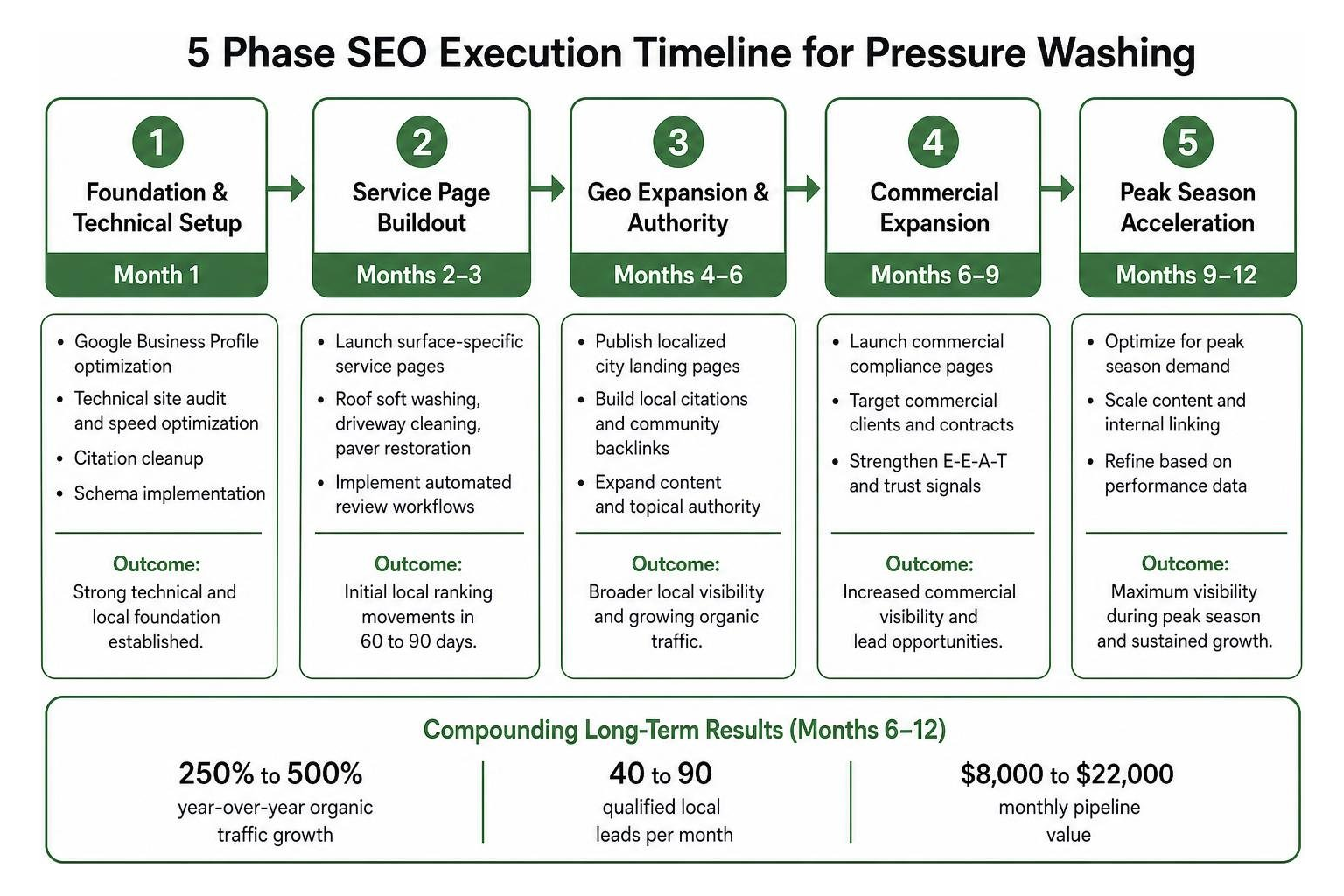
- Month 1 (Foundation & Technical Setup): Google Business Profile optimization, technical site audit, speed optimization, citation cleanup, and schema implementation.
- Months 2–3 (Service Page Buildout): Launching surface-specific pages (roof soft washing, driveway cleaning, paver restoration) and implementing automated review workflows. Initial local ranking movements typically appear within 60 to 90 days.
- Months 4–6 (Geo Expansion & Authority): Publishing localized city landing pages, building local citations, earning community backlinks, and launching commercial compliance pages.
- Months 6–12 (Compounding Growth): Established market authority yielding 250% to 500% year-over-year organic traffic growth, generating 40 to 90 qualified local leads per month and $8,000 to $22,000 in monthly pipeline value.
Seasonal timing is essential. Search volume for pressure washing experiences a 233% swing between late-fall lows (around 49,500 searches in November) and peak late-summer demand (reaching 165,000 monthly searches in September). The spring demand surge represents 35% to 45% of total annual search volume.
Because search engines require 6 to 12 weeks to index, test, and rank new digital pages, launching your SEO campaign before January ensures your website is fully ranked when spring property cleaning demand surges.
If you are looking to scale your exterior cleaning business with a custom organic search strategy, consider partnering with a dedicated local SEO agency to build and execute your campaign.
Frequently Asked Questions About Pressure Washing Search Visibility
How long does it take for a new pressure washing website to rank on Google?
Most new pressure washing websites experience their first meaningful local ranking improvements within 60 to 90 days of completing technical setup, profile optimization, and surface page publishing. Achieving competitive positions for high-volume city head terms and top-three Map Pack spots typically takes 4 to 6 months of steady review acquisition, content expansion, and local link building.
What is the single most important ranking factor for the Google Map Pack?
The most critical factor is having a properly verified Google Business Profile with Pressure Washing Service set as your primary category, combined with searcher proximity and consistent review recency. Even an established business with hundreds of historical reviews can lose map pack positions to an active competitor who consistently collects verified 5-star reviews and uploads fresh job photos every week.
Should pressure washing companies target ‘near me’ keywords directly on their pages?
No. You do not need to write awkward sentences like “we provide pressure washing near me in Dallas” on your website. Google determines proximity algorithmically based on the searcher’s physical location and your verified business address or service radius. Instead, focus on natural language targeting specific cities, neighborhoods, landmarks, and zip codes across your service area landing pages.
Conclusion
Dominating local search results for exterior cleaning requires an organized, consistent system. By differentiating delicate soft wash solutions from heavy concrete pressure washing, optimizing your Google Business Profile with rich before-and-after visual proof, structuring flat city landing pages, and publishing technical commercial content, your business can outrank directories and weekend operators alike.
Building organic search equity delivers predictable, high-margin booked jobs year after year without relying entirely on paid ad clicks. At The it Crowd, our team combines technical marketing expertise with proprietary AI infrastructure to help growing businesses own their local search markets. Start laying your digital foundations today, and secure top rankings before your busy season begins.

