

In 1958, a man in a bow tie stared out of McGraw-Hill’s business magazines and refused to be charmed. He sits hunched forward in a swivel chair, hands clasped, scowl fixed on whoever just walked into his office. The photo is black and white, yet you can almost hear the chair creak as he leans in. “I don’t know who you are,” the copy begins, and the list of what he doesn’t know keeps growing: your company, your products, what you stand for, your track record. Every line makes the same point. By the time a salesperson reaches that chair, the sale is already won or lost.
Nearly 70 years later, the man in the chair is still there. He just has a ChatGPT tab open now. Before he speaks to a single vendor, he has asked an AI assistant for options, skimmed the answers and ranked his favorites. By the time your sales team hears about the deal, he has practically picked a font for the purchase order.
That gap between the decision and the first conversation is where good B2B companies lose deals they never knew existed. Their pitch was fine. The buyer simply chose before hearing it, and their name wasn’t in the room. Closing that gap is what B2B brand awareness is for, and it is the work we do at The it Crowd for B2B owners and marketing leads: a clear position, content that buyers and AI tools can find, and a way to see whether any of it is sticking. It starts with knowing when the decision actually gets made.
The B2B Shortlist Is Written Before Anyone Calls
For three years, 6sense has asked B2B buyers when they choose vendors, and the answer keeps coming back the same: earlier than sellers think. In its 2025 Buyer Experience Report, the winning vendor was already on the buyer’s Day One shortlist 95% of the time, and the vendor the buyer favored before making contact still won four out of five deals. Buyers now reach out at about 61% of the way through their journey instead of 69%, but by that point the list is largely settled. Sales gets an earlier meeting, not an earlier say.
What has changed is who helps write that list. Among the 1,076 B2B software buyers G2 surveyed in March 2026, 51% now start their research with an AI chatbot more often than with Google, up from 29% a year earlier. Those chatbots are doing more than fetching links. Sixty-nine percent of the same buyers ended up choosing a different vendor than they had planned because the chatbot recommended it.
That shift changes what awareness has to accomplish. AI assistants don’t invent reputations; they summarize what has already been written. A company that is rarely named, reviewed or quoted gives them almost nothing to say. So B2B brand awareness now has two audiences: the people who will eventually buy, and the machines they ask first. And most of those people, as it happens, aren’t looking yet.

Why Most of Your Future Buyers Aren’t Buying Yet
Some of marketing’s most useful ideas come out of a lab. This one came out of a hangover.
Jon Lombardo, who led research at LinkedIn’s B2B Institute, has said he met Professor John Dawes of the Ehrenberg-Bass Institute in Australia while badly hungover. Dawes mentioned, almost in passing, that only about 5% of business buyers are in the market at any given time. Lombardo was stunned. Dawes shrugged and said everyone knew that. Two months later, he delivered the paper that turned the remark into what is now called the 95:5 rule.
The math behind it is deliberately rough. As Dawes explains, companies switch providers like their main bank or law firm about every five years. That puts roughly 20% of buyers in the market over a year, and around 5% in any given quarter. Categories where buyers switch more often will have a bigger slice in play, but the shape stays the same: at any moment, most of your future customers are busy with something else.
That makes the usual playbook a crowded one. Marketing only to buyers who are ready right now means fighting over the same small slice every competitor is chasing. The rest of the market will buy eventually, and when it does, it will buy from someone it remembers.
In Field of Dreams, a voice tells Kevin Costner’s character, “If you build it, he will come.” Plenty of B2B marketing plans run on the same faith: build a great product, and buyers will find it. That worked for a baseball diamond in an Iowa cornfield. For a mid-sized firm in a crowded category, being found depends on being remembered first.
B2B Brand Awareness Is About Memory, Not Reach
Being remembered is a different goal from being seen. Reach counts how many people came across your name. Memory decides whether any of them think of you when it counts. Professor Jenni Romaniuk of the Ehrenberg-Bass Institute calls those moments category entry points: the cues buyers use to search their memory when a buying situation comes up.
In B2B, category entry points sound like ordinary Tuesdays. “Our office lease is up next spring.” “We just lost our marketing manager.” “The board wants a new website before the funding round.” The brands that come to mind in those moments get the call. The rest never find out the moment happened.
It is tempting to think committees and procurement rules make business buying purely rational. Romaniuk’s research says otherwise: business buyers rely on the same memory processes as consumers, because “all buyers draw on the same brain.” Committees change the paperwork, not the psychology. Familiar vendors win because buyers pick what feels familiar.
The effectiveness data tells the same story from the budget side. When Les Binet and Peter Field analyzed B2B campaigns for the B2B Institute, they found that campaigns built to grow share of mind were the most effective, and the more famous they made the company, the better the business results.
That is why we push clients to swap one question for another. Instead of “How many people saw it?” we ask “Which moment will they remember us in?” The answer shapes what you say, where you say it and how consistently you say it, because a brand that changes its message every quarter asks buyers to start from zero every quarter. Choosing those moments is where the work begins.
How to Build B2B Brand Awareness: A 90-Day Start
Awareness compounds over years, but the first 90 days decide what it compounds around. Here is how we would spend them.
Days 1–30: Decide what you want to be remembered for
- Ask recent customers and a few lost prospects what was happening when they started looking. Their answers are your category entry points.
- Turn those answers into a one-sentence position and the three or four buying moments you want to own. This is the heart of our brand positioning work.
- Record where you stand today: branded search, direct traffic, how leads say they found you and what AI assistants say about your category. A competitor analysis shows how that compares with the firms you lose to.
Days 31–60: Show up where those moments happen
- Publish content that answers the questions buyers ask in those moments, structured so people and AI tools can quote it. That is the job of SEO and GEO content optimization.
- Carry the same ideas to one primary social channel (LinkedIn, for most B2B firms) and show up every week, rather than everywhere once in a while.
- Borrow someone else’s audience once: a podcast guest spot, a co-hosted webinar or a byline in a trade publication your buyers already read.
Days 61–90: Reinforce, then measure
- Repeat your strongest ideas in new formats instead of chasing new ones. Repetition is what turns a message into a memory.
- Compare your signals against the starting point, and put next quarter’s effort behind whatever moved.
If your brand has gone quiet since its launch, our post on why most B2B brands go invisible after year one explains how that silence creeps in and how to break it.

How to Measure B2B Brand Awareness Without a Big Budget
That last step is where most awareness efforts stall, on the belief that awareness can’t be measured. Brand awareness isn’t unmeasurable; it’s usually just unmeasured, and these five signals cost little or nothing to track:
| Signal | Where to check it | What a rise tells you | How often |
| Branded search | Google Search Console: queries that include your company name | More people are looking for you by name | Monthly |
| Direct traffic | Google Analytics 4: direct sessions | More people type your URL or have you bookmarked | Monthly |
| Self-reported source | “How did you hear about us?” on forms and in first sales calls | Which channels actually plant the memory | Every new lead |
| AI answers | Ask ChatGPT, Gemini and Perplexity the questions your buyers ask | Whether you get named before buyers know to ask for you | Monthly |
| Buying-moment recall | A short customer survey: “Who comes to mind when…?” | Whether you own the moments you chose to own | Twice a year |
Because awareness builds slowly, these signals are best read quarter to quarter, where the trend shows through the noise. If a chatbot names three competitors and not you, that is your shortlist problem in one screenshot.
B2B Brand Awareness FAQs
What is the difference between brand recognition and brand recall?
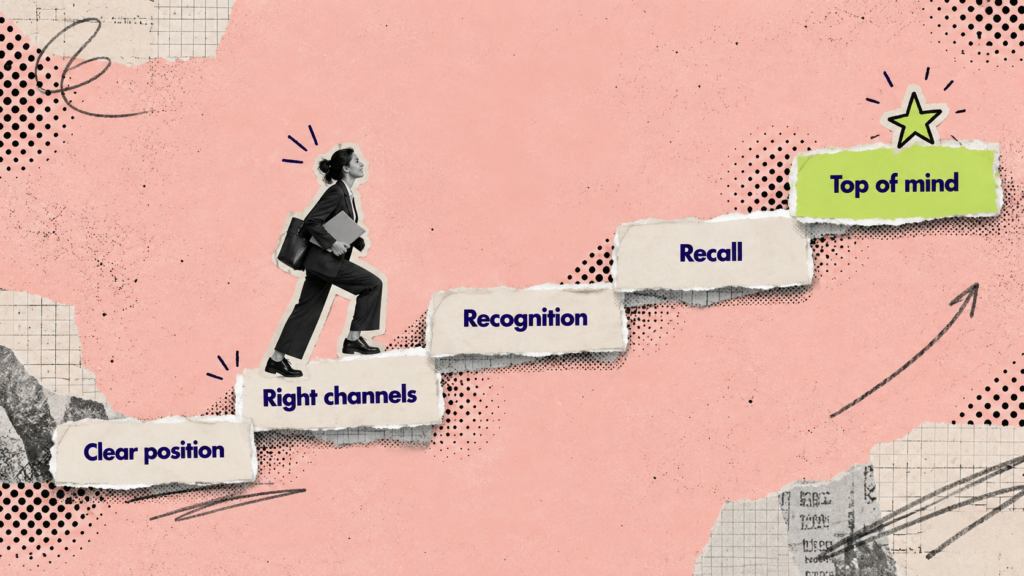
Recognition means a buyer knows your name when they see it on a list. Recall means they think of you without the list, when a need comes up. Recognition helps you through procurement; recall puts you on the shortlist, which is why it matters more in B2B.
How long does B2B brand awareness take to pay off?
That depends on how often buyers in your category switch providers. If they change every few years, the buyers you reach this quarter may not be in the market until next year or later. Awareness pays off when those future buyers arrive, so plan and measure it over quarters, not campaigns.
Is B2B Brand Awareness Worth the Money?
Skeptics have a famous patron. “Half the money I spend on advertising is wasted; the trouble is I don’t know which half” is a line commonly attributed to the department store pioneer John Wanamaker.
They have a point. Awareness is harder to attribute than a paid search click, and short-term activation genuinely works. Even Binet and Field recommend splitting B2B budgets roughly evenly between brand building and activation, rather than abandoning one for the other. Awareness doesn’t replace capturing demand.
But capturing demand only works on demand that already includes you. If the winning vendor is on the buyer’s Day One shortlist 95% of the time, the real question isn’t whether to invest in being known. It is whether you will be on that list when the man in the chair, or his AI assistant, starts writing it.
If you want to know where your brand stands today, talk to The it Crowd. We will help you get on the shortlist before the call.

