

How to Find the Best Brand Strategy Firms for Your Business
The best brand strategy firms depend on the job you need done. Choose a management consultancy for a board-level business case or complex brand structure, a strategy-led design firm for positioning and a new identity, or a sprint team when you need to make a focused decision quickly. Before you shortlist anyone, decide who must approve the work and who will turn the strategy into campaigns, content, and other assets.
I’m Lindsey Huettner, owner of The it Crowd, a Dallas digital marketing agency, with more than 19 years of experience in marketing and business ownership. When assessing the best brand strategy firms, I look beyond the pitch to how well a partner can connect a clear brand decision to the work that follows.
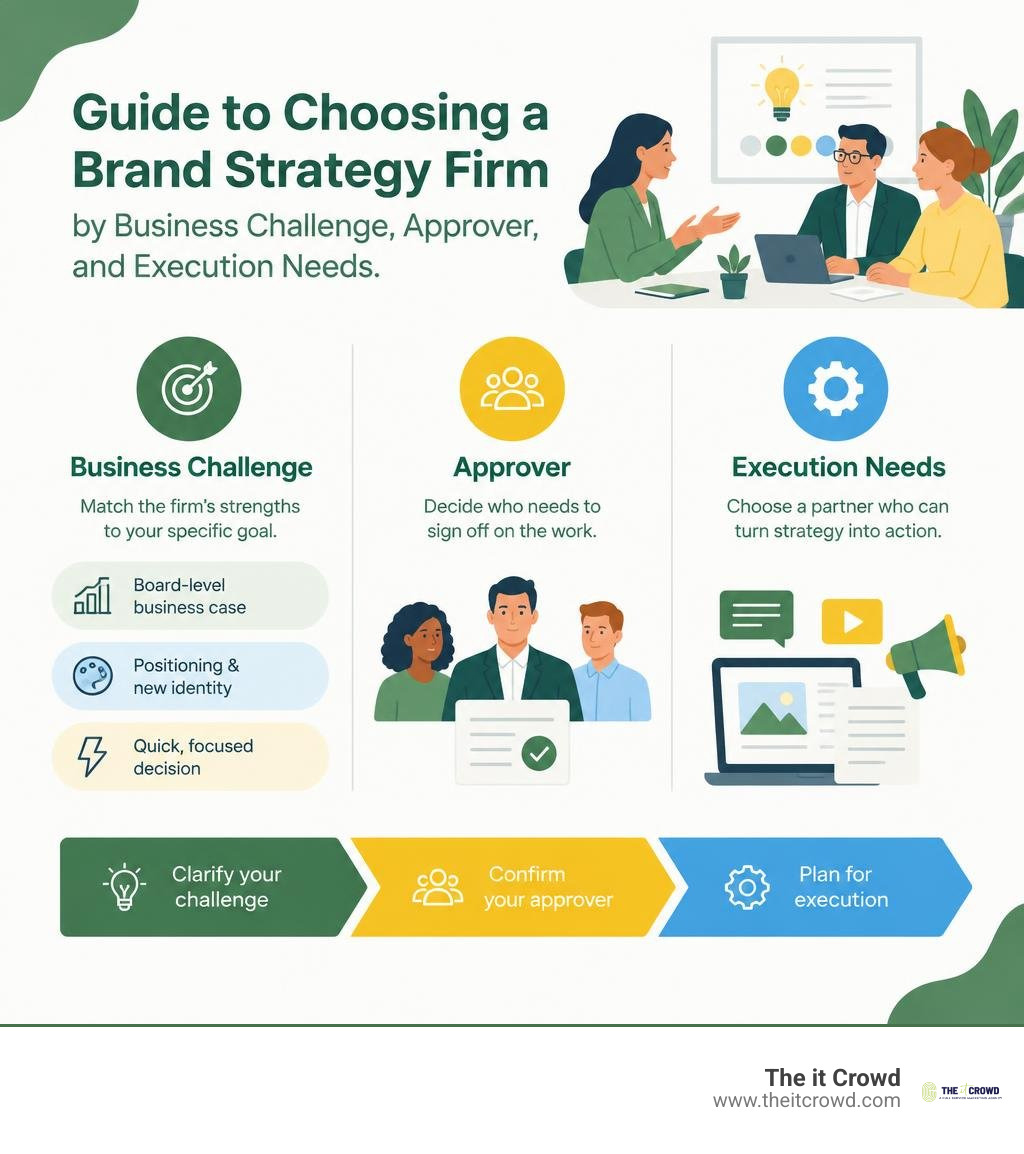
How the Best Brand Strategy Firms Differ by Delivery Model
Brand strategy is not a monolithic product. When business leaders set out to hire an outside consultancy, they often assume that every firm follows a standard playbook: conduct stakeholder interviews, run customer surveys, draft a purpose statement, and design a fresh logo.
In reality, the global advisory landscape divides into three distinct delivery models. Each model serves a different commercial objective, requires different resource commitments, and answers to different executive stakeholders.
| Delivery Model | Core Strategic Focus | Typical Timeline | Relative Investment | Primary Executive Approver | Key Deliverables |
|---|---|---|---|---|---|
| Management Consulting (Brand Lens) | Enterprise valuation, portfolio architecture, M&A rationalization | 4 to 9 months | High (Enterprise Tier) | CEO, CFO, Board of Directors | Economic modeling, portfolio governance, commercial risk analysis |
| Strategy-Led Design Consultancy | Category positioning, verbal framing, complete identity systems | 2 to 5 months | Moderate to High | CMO, Chief Brand Officer, Founder | Positioning manifesto, messaging matrix, comprehensive design system |
| Agile Strategy Sprint Team | Rapid venture positioning, go-to-market testing, immediate launch validation | 2 to 6 weeks | Accessible to Moderate | VP of Marketing, Product Lead, Early-Stage Founder | Strategic narrative sprint, core messaging guide, launch-ready asset direction |
Choosing the wrong model creates immediate friction. If an enterprise needs to consolidate sixteen regional acquisitions under a master brand architecture, an agile sprint shop will lack the econometric modeling required to satisfy the board. Conversely, if a venture-backed scale-up needs to establish a distinct market voice before a Series B funding round, engaging a legacy management consultancy will consume months of budget while producing theoretical decks rather than deployable positioning.
Management Consulting with a Strategic Brand Lens
Management consultancies approach brand strategy through the rigorous lens of enterprise economics, market capitalization, and corporate governance. These firms rarely begin with typography, color palettes, or taglines; they begin with the balance sheet.
When organizations undergo major mergers and acquisitions, divestitures, or fundamental business model pivots, they face complex architecture questions. Should the newly acquired entity retain its legacy equity as an endorsed brand, or should it be absorbed into a monolithic master brand? What are the financial risks of customer attrition during the transition?
To solve these high-stakes challenges, strategic advisors conduct exhaustive market research and competitor analysis. They analyze quantitative customer segmentation, calculate forward-looking brand value, and perform econometric modeling to prove how brand clarity directly influences customer lifetime value and talent acquisition costs. The primary output is a detailed business case that gives corporate boards and audit committees the empirical confidence needed to approve sweeping structural reorganizations.
Strategy-Led Design and Identity Consultancies
Strategy-led design consultancies sit squarely at the intersection of commercial logic and creative expression. They operate on a fundamental truth: a brilliant strategy that cannot be translated into an evocative visual and verbal language remains an invisible strategy.

These consultancies typically engage after the macro business model is set, but the company’s public-facing persona lacks distinctiveness or emotional resonance. Their work centers on translating deep competitive white space into proprietary corporate identity systems that transform how customers perceive the organization across every interaction.
Rather than stopping at static identity manuals, these firms specialize in modern brand experience design, ensuring that everything from digital product interfaces to physical environments reflects the core strategic narrative. By leveraging forward-looking visual identity trends for 2026, they build responsive design languages that stand apart across digital, spatial, and motion-first channels.
Agile Sprint Teams and Embedded Creative Partners
For fast-moving scale-ups, corporate innovation hubs, and mid-market companies launching new product lines, traditional multi-quarter engagements are often too slow. This reality has fueled the rise of agile strategy sprint teams and embedded creative partners.
These nimble teams rely on intensive brand discovery sessions that condense months of discovery into tightly facilitated, multi-day strategic sprints. Instead of generating abstract 150-page strategy decks, sprint firms focus on rapid prototyping, authentic founder storytelling, and immediate production alignment.
This model excels at establishing fast feedback loops. By establishing core messaging hypotheses and deploying them directly into active digital channels, businesses can validate their category positioning against real customer behavior rather than relying purely on theoretical focus groups.
B2B vs. B2C: Aligning Strategy with Buyer Decision Dynamics
One of the most frequent mistakes executive teams make when shortlisting consultancies is treating business-to-business (B2B) and business-to-consumer (B2C) branding as interchangeable disciplines. While both rely on fundamental cognitive principles—such as the psychology of brand memory to ensure mental availability—the underlying purchase mechanics could not be more different. Academic research on B2B branding challenges confirms that industrial and consumer markets require fundamentally different strategic frameworks.
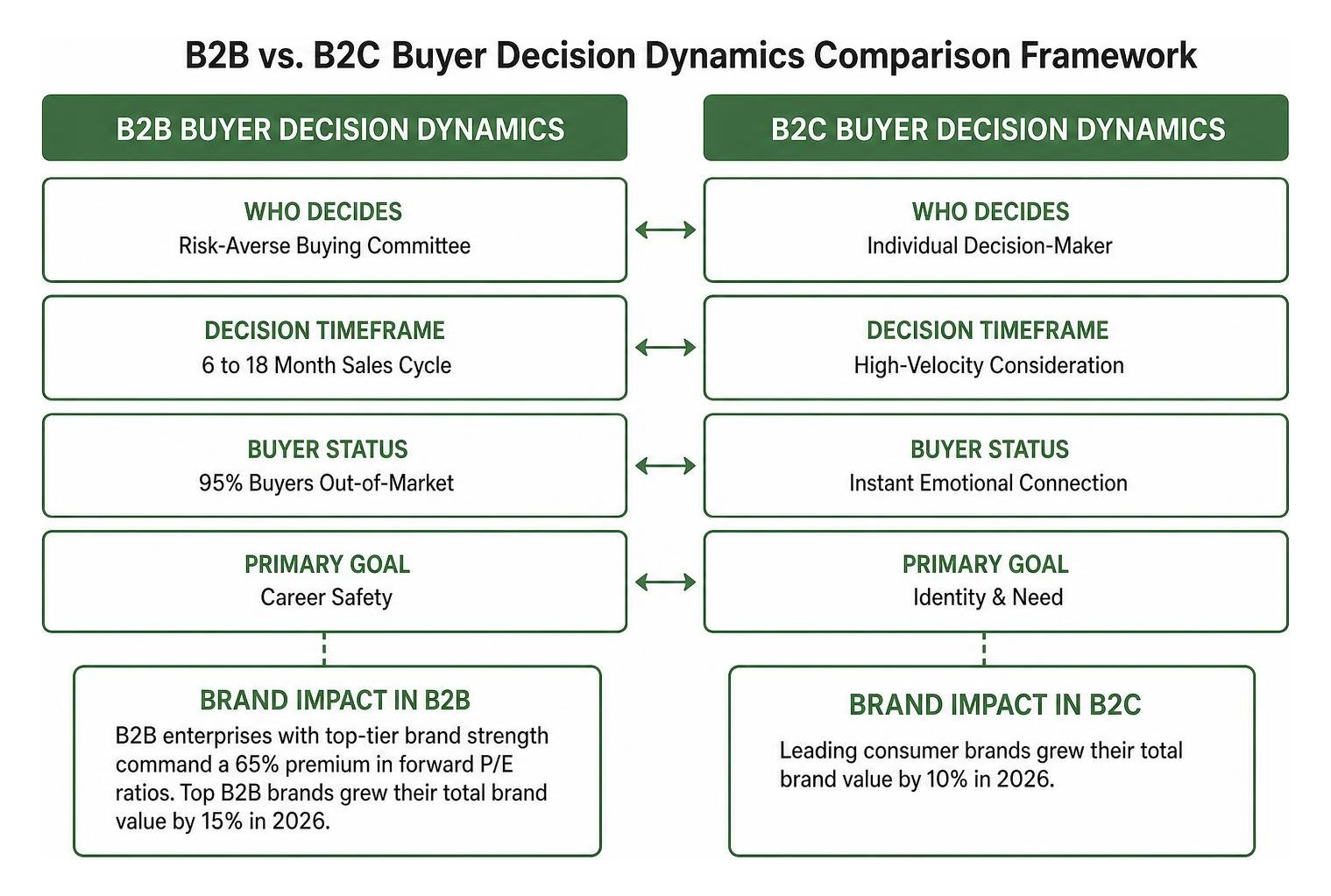
B2B Brand Valuation and Risk-Averse Buying Committees
In the B2B world, purchases are rarely made by solo buyers acting on impulse. High-value enterprise investments are vetted by cross-functional buying committees comprising finance, operations, IT, procurement, and executive leadership. In this environment, the primary psychological driver is not aspirational desire—it is enterprise risk mitigation. No procurement committee wants to stake its professional reputation on an unvetted vendor.
This dynamic explains why brand equity delivers immense enterprise value in the B2B space. Research across global markets reveals that B2B enterprises with top-tier brand strength command a 65% premium in forward price-to-earnings (P/E) ratios compared to their weaker-branded competitors. Furthermore, among global market leaders, top B2B brands grew their total brand value by 15% in 2026, outpacing the 10% growth rate observed among leading consumer brands.
Compounding this reality is the classic “95-5 Rule” of commercial buying: 95% of B2B buyers are not actively in-market at any given moment. They are not reading product feature comparison sheets or downloading technical whitepapers today.
When an urgent organizational need or budget window suddenly opens, buyers immediately build a shortlist from the two or three brands that already occupy prime mental real estate. A strategic brand consultancy builds the foundational messaging architecture that establishes commercial credibility years before a prospect ever submits a contact request.
B2C Emotional Resonance and High-Velocity Personalization
Consumer branding operates under fundamentally different decision velocity and emotional gravity. Where B2B brands must navigate risk-averse consensus, B2C brands must cut through overwhelming cognitive clutter to win immediate personal affinity.

Modern consumer markets demand intense personalization and unyielding authenticity. Across major global studies:
- 92% of consumers actively seek personalized experiences that reflect their distinct preferences and life stages.
- 63% of consumers explicitly state they will only buy from brands they trust, refusing to engage with businesses that feel extractive or opportunistic.
In high-trust consumer sectors such as healthcare, wellness, and financial services, these dynamics are even more pronounced. For instance, 90% to 92% of individuals turn to online evaluations before selecting a medical or wellness provider, while 62% of medical budgets are now directed toward digital channels to meet patients across their everyday digital routines.
Achieving meaningful scale in these competitive consumer environments requires sophisticated emotional branding frameworks paired with authentic values-based brand alignment. When consumer organizations successfully reframe their public narrative around authentic human connection—as demonstrated by healthcare innovators who achieved a 45% increase in regional users and a 70% increase in qualified leads following strategic repositioning—the commercial return is immediate and compounding.
Selecting a Partner: Evaluation Criteria and Executive Buy-In
Shortlisting consultancies is rarely just a marketing exercise; it is an exercise in internal consensus building. If the Chief Financial Officer views the brand engagement as a discretionary aesthetic expense while the Chief Marketing Officer views it as a market transformation, the project will stall before it ever reaches implementation.
To ensure long-term success, organizations must align their strategy selection with their broader complete marketing strategy integration and establish clear governance metrics across the C-suite.
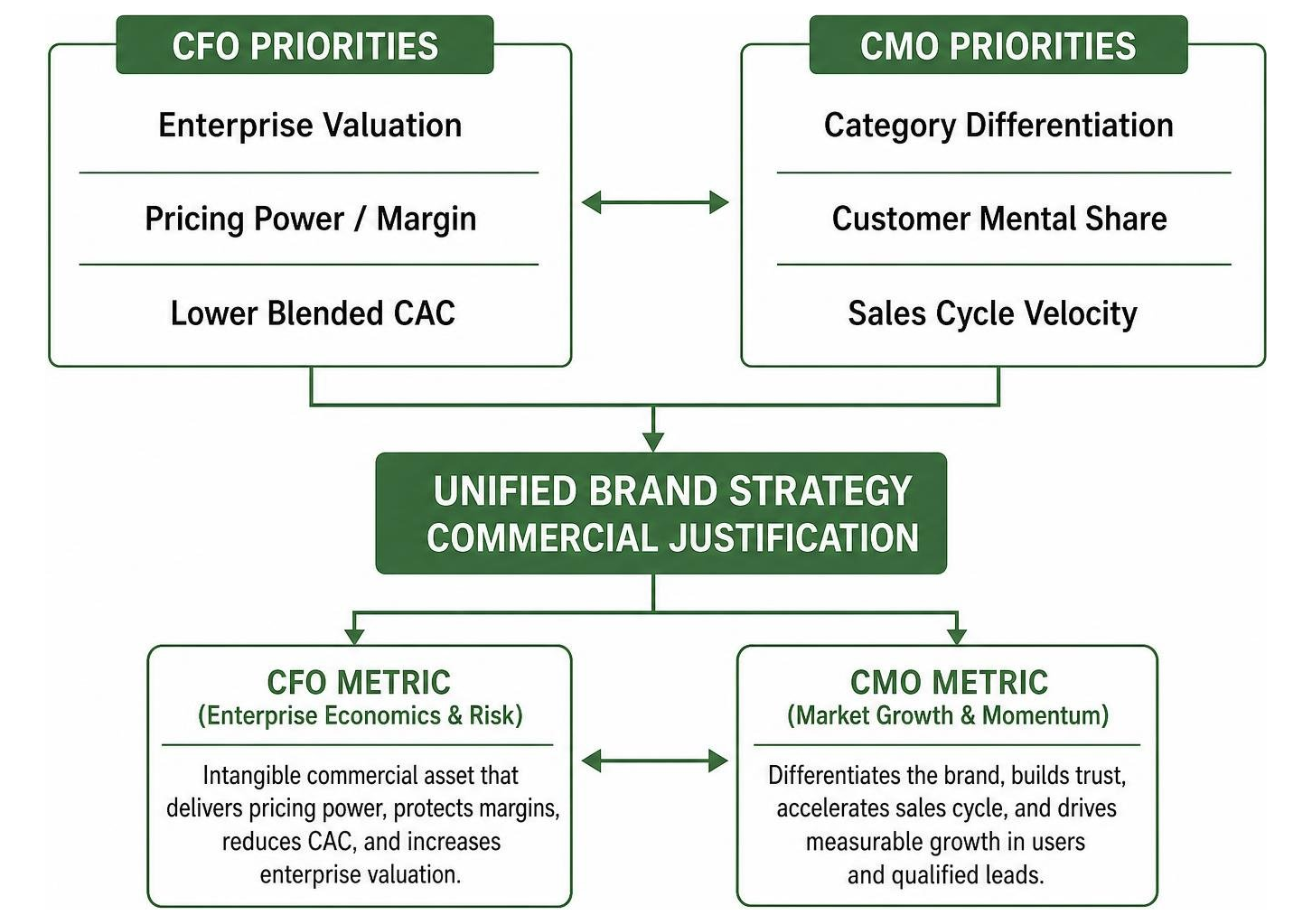
Aligning the Best Brand Strategy Firms with CFO and CMO Priorities
To gain universal executive support, the business case for brand strategy must bridge the traditional divide between financial governance and commercial growth:
- The CFO Metric (Enterprise Economics & Risk): For the finance department, brand strategy must be framed as an intangible commercial asset that provides sustainable pricing power, protects gross margins, and reduces long-term customer acquisition costs (CAC). A strong brand increases enterprise valuation and provides balance-sheet resilience during broader macroeconomic downturns.
- The CMO Metric (Market Relevance & Pipeline Velocity): For marketing leadership, brand strategy provides the foundational narrative that unlocks higher conversion rates across organic and paid channels, accelerates enterprise sales cycles, and drives sustained customer lifetime value.
By integrating rigorous digital strategy and analytics, leadership teams can measure both upper-funnel brand perception lifts and lower-funnel commercial performance, eliminating the false dichotomy between long-term brand building and short-term performance marketing.
Vetting the Best Brand Strategy Firms: Methodology and Reference Audits
Before signing a master services agreement with any strategic advisory firm, executive search committees should pressure-test prospective partners with a structured vetting protocol:
- Published, Repeatable Methodology: Does the firm have a documented strategic framework that has been tested across diverse market cycles, or are they improvising custom frameworks for every pitch?
- Account Staffing Seniority: Will the senior partners who presented during the pitch actually lead the discovery and strategy workshops, or will the day-to-day engagement be handed off to junior associates?
- Category and Complexity Experience: Can the firm demonstrate verified case studies solving structural challenges of similar complexity, whether that involves navigating multi-tiered B2B distribution models or high-volume direct-to-consumer ecosystems?
- Confidential Client Reference Audits: When speaking with past client references, ask candid questions: “Where did their strategic recommendations face the most internal friction, and how did their team help you operationalize the strategy across your sales and product teams?”
Bridging Strategy to Execution: Avoiding Failure Modes in 2026
The most common point of failure in brand strategy engagements does not happen during research or executive synthesis—it happens during handoff.
Too many organizations spend six months developing an inspiring brand book, only for that document to sit trapped inside a cloud drive while regional sales teams, product designers, and performance marketers continue using disconnected legacy materials. True market leadership requires closing the gap between high-level brand positioning execution and day-to-day tactical output.
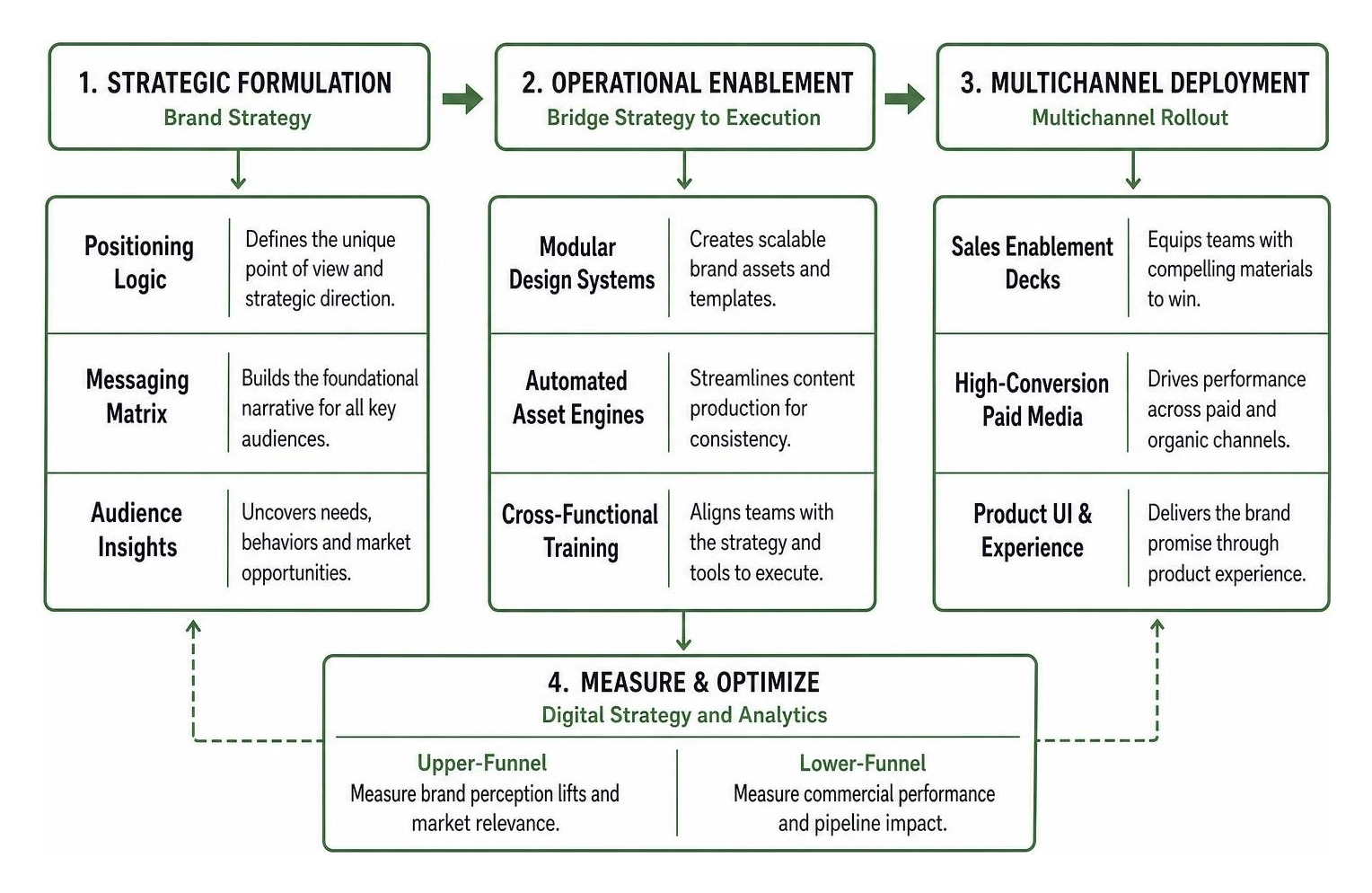
Integrating Human Creativity and AI-Driven Market Insights
In 2026, data intelligence is table stakes. Leading strategic teams regularly use artificial intelligence to synthesize massive volumes of competitive data, perform predictive sentiment analysis, and uncover emerging search trends. However, over-relying on automated outputs introduces significant strategic risk: algorithmic homogenization.
When consultancies rely entirely on synthetic market models, their strategic positioning inevitably defaults to category cliches. Building a truly unforgettable brand identity requires genuine human creativity in brand messaging to uncover non-obvious cultural insights, craft deeply empathetic buyer narratives, and establish a point of view that competitors cannot easily copy.
Operationalizing Brand Architecture Across Multichannel Touchpoints
To transform positioning into market share, strategic outputs must be directly translated into production-ready execution frameworks:
- Precision Creative Toolkits: Build comprehensive design briefs and actionable art direction specifications that give internal creative teams and external production vendors clear, unambiguous guardrails for visual and verbal execution.
- Sales and Commercial Enablement: Equip client-facing teams with updated pitch decks, objection-handling scripts, and customer-centric value calculators that reflect the new strategic positioning from day one.
- Ecosystem & Co-Marketing Governance: Create structured criteria for external brand partnership development to ensure that future co-marketing initiatives, sponsorships, and distribution alliances reinforce the company’s core market authority.
Frequently Asked Questions About Brand Strategy Agencies
What separates a strategic brand consultancy from a creative agency?
A strategic brand consultancy focuses on defining the underlying commercial logic, market positioning, competitive white space, and messaging architecture that guides a business’s growth. A creative agency or production studio primarily focuses on executing visual and promotional assets—such as advertising campaigns, digital collateral, logos, and video production—based on an already established strategic foundation.
How much do enterprise brand strategy engagements cost and how long do they take?
Engagements vary widely based on organizational complexity:
- Enterprise Management Consultancies: Typically range from $200,000 to over $1,000,000, requiring 4 to 9 months of comprehensive research, economic modeling, and global stakeholder alignment.
- Mid-Market Strategy & Identity Consultancies: Generally range from $50,000 to $200,000 across a 2- to 5-month timeline, delivering complete verbal, visual, and operational brand systems.
- Agile Sprint Engagements: Typically span $15,000 to $50,000 over 2 to 6 weeks, focusing on rapid positioning, category narrative, and launch validation for fast-moving businesses.
How do organizations measure ROI from a brand strategy engagement?
Return on investment is measured through both commercial efficiency and financial performance indicators:
- Commercial Metrics: Reductions in blended customer acquisition cost (CAC), accelerated sales cycle velocity, increased inbound demo conversion rates, and higher organic search demand.
- Financial Metrics: Measurable expansion in gross margin and sustained pricing power, improved employee recruitment velocity and retention, and higher valuation multiples during financing or acquisition events.
Conclusion
Choosing the right brand strategy partner is one of the most consequential decisions an executive team can make. A well-crafted brand strategy eliminates internal confusion, unites marketing and sales under a single commercial narrative, and builds enduring equity that insulates your business from market volatility.
Whether your organization requires complex portfolio restructuring, category-defining visual identity, or full-funnel digital execution, success ultimately comes down to turning strategic clarity into relentless market momentum. To avoid common pitfalls and ensure your organization establishes an enduring competitive advantage, explore our guide on mastering strategic branding dos and don’ts to lead your category with clarity.

