

How to Evaluate Ecommerce Development Solutions
The right ecommerce development solutions do more than make a store look good. They connect the storefront to the systems that handle products, orders, payments, and customer data. To compare your options, start with three questions: Can the solution support the way you sell today? Will it connect to the tools you already use? What will it cost to maintain as you grow?
A faster checkout means little if inventory is wrong or orders need manual fixes. This guide looks at the platforms, custom features, and development choices that can help you build a store that works for customers and your team.
I’m Lindsey Huettner, owner of The it Crowd. My 19-plus years in marketing and business ownership shape how I evaluate ecommerce development solutions alongside web development, SEO, and growth goals.
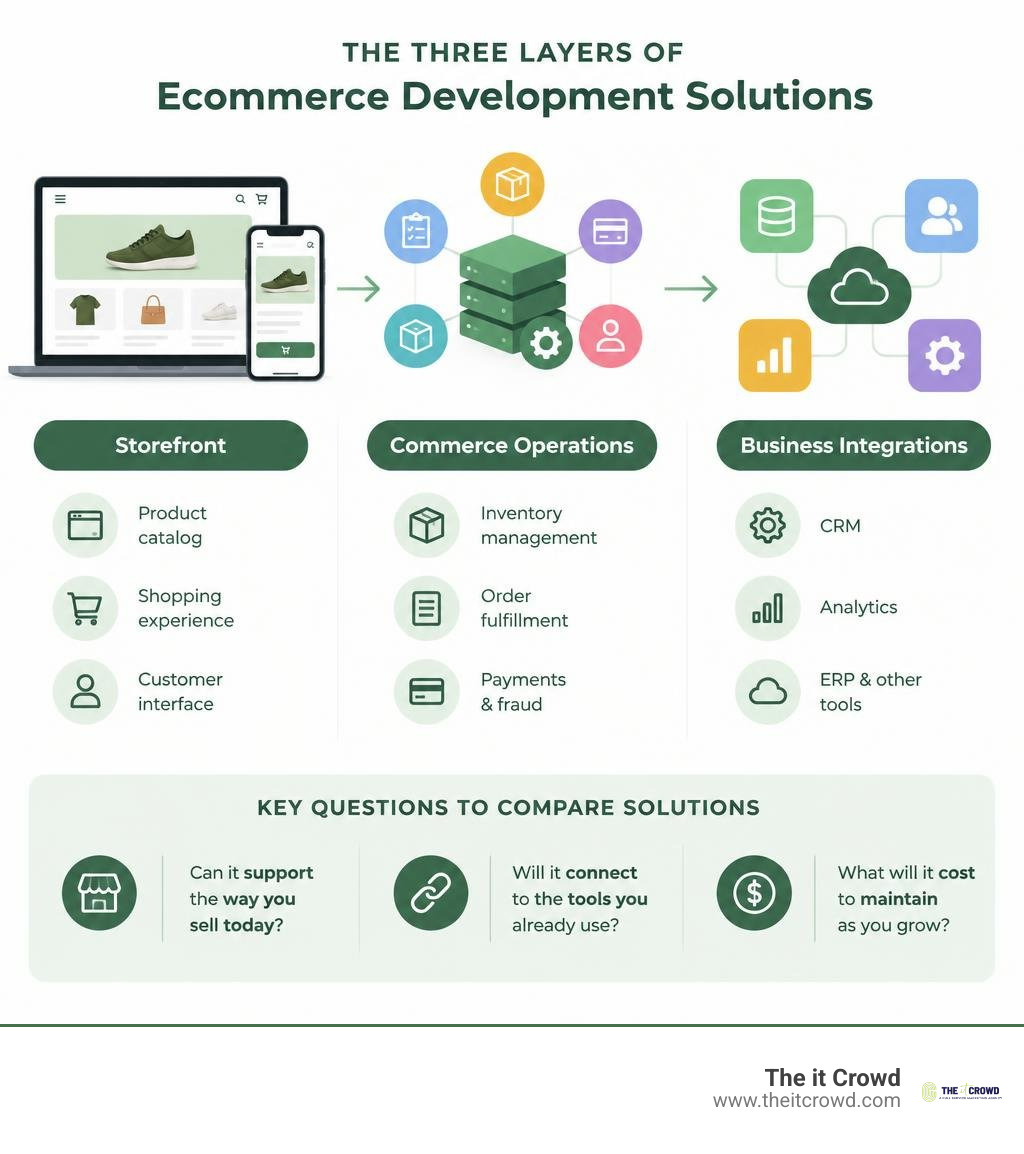
Architecture Breakdown: The Three Layers of Ecommerce Development Solutions
Your online store stopped being a simple website a long time ago. Once an operation handles serious transaction volume, it stops functioning as a digital brochure with a shopping cart and becomes a synchronized stack of distributed systems.
Modern enterprise commerce suffers heavily from application sprawl. The average enterprise runs 957 separate applications across its departments, yet research from Salesforce reveals that only 27% of those applications are connected. When your sales channels cannot talk directly to your warehouse management or accounting software, data silos form. Employees end up spending hundreds of hours manually keying data between spreadsheets and admin dashboards, leading to costly fulfillment errors.
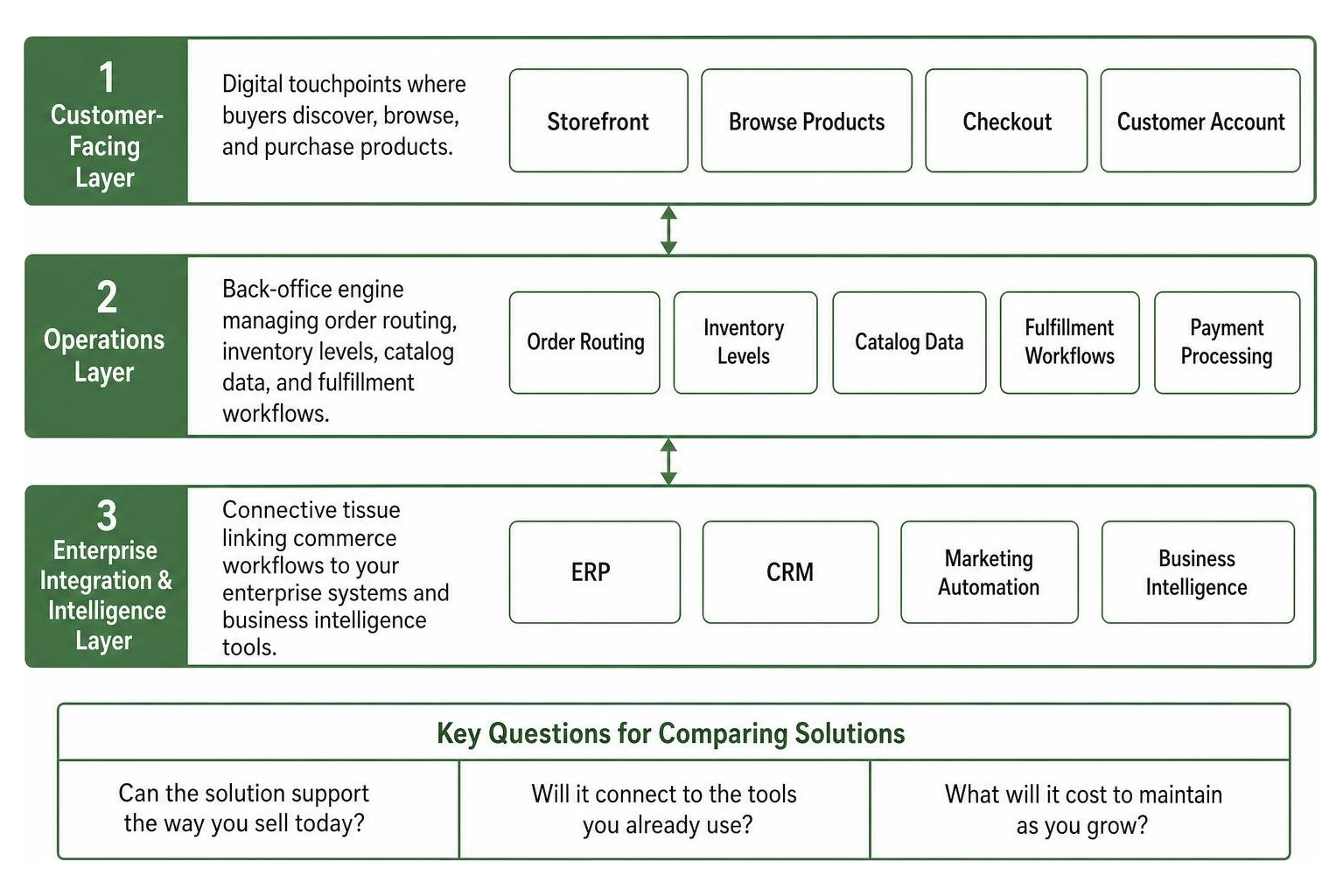
To solve these disconnects, we design modern online stores around three interconnected layers, creating cohesive ecosystems with our website design and development services:
- Customer-Facing Layer: The digital touchpoints where buyers discover, browse, and purchase products.
- Operations Layer: The back-office engine managing order routing, inventory levels, catalog data, and fulfillment workflows.
- Enterprise Integration and Intelligence Layer: The connective tissue linking commerce workflows to your ERP, CRM, marketing automation, and predictive business intelligence tools.
Customer-Facing Storefronts and Composable Headless Commerce
The front end of your store establishes the user experience, brand perception, and conversion rate. Today’s consumers jump between desktop browsers, smartphones, social commerce feeds, and native apps. If any part of that journey stutters, they abandon their carts.
To deliver smooth experiences across all screen sizes, many brands adopt headless commerce architectures and Progressive Web Apps (PWAs). By decoupling the frontend presentation layer from backend business logic, developers can build lightning-fast web experiences using frameworks like React, Vue, or Next.js. These frontends communicate with backend services entirely via lightweight APIs.
Applying foundational UI and UX design principles ensures that product discovery remains intuitive, page speed stays high, and checkout friction drops. You can explore versatile API services and tools using the E-commerce Integrations Directory to see how composable frontends integrate with modern web development stacks.
Back-Office Commerce Operations and Inventory Synchronization
Beneath the checkout button lies the operational engine that fulfills customer promises. Commerce operations handle:
- Order Management Systems (OMS): Routing orders from marketplaces, retail storefronts, and B2B portals to the correct distribution centers.
- Warehouse Management (WMS) & Inventory Allocation: Providing real-time stock visibility across physical stores, third-party logistics (3PL) partners, and central hubs.
- Product Information Management (PIM): Centralizing SKU details, media assets, localized descriptions, and technical specifications across digital channels.
- Automated Returns and Dynamic Pricing: Handling customer returns and adjusting catalog pricing based on real-time market signals.
When an apparel brand unified its inventory layers over its legacy infrastructure, it reduced out-of-stock incidents by 32% and accelerated planning cycles by 90%. Real-time inventory tracking eliminates overselling and keeps your back office running smoothly.
Enterprise Integration and Intelligence Systems
The deepest architectural layer unifies your commerce workflows with legacy infrastructure and enterprise data repositories:
- Enterprise Resource Planning (ERP): Keeping financial ledgers, wholesale procurement, and supply chain data aligned with retail sales.
- Customer Relationship Management (CRM): Connecting transaction histories to customer profiles for personalized support, which works hand-in-hand with structured CRM setup and pipeline management.
- Business Intelligence (BI) and Telemetry: Collecting event streams to analyze buying patterns, detect fraud, and track system health.
Middleware orchestrates these data flows, preventing fragile point-to-point connections so data moves reliably across all your tools.
Top Platforms and Tech Stacks for Ecommerce Modernization
Choosing the right technology stack determines how easily your team can adapt to new business opportunities. Selecting the wrong foundation leads to expensive replatforming projects just a few years down the road.
| Platform Type | Scalability & Traffic Handling | Customization & Code Control | Maintenance Overhead | Best Suited For |
|---|---|---|---|---|
| Monolithic / Open-Source | High (requires dedicated server orchestration) | Full source code access and database control | Moderate to High (self-managed security & patches) | Complex B2B catalogs, heavily customized business logic, .NET or PHP ecosystems |
| Cloud SaaS | Automatic auto-scaling managed by vendor | Limited to public API endpoints and theme layers | Low (vendor handles hosting, compliance, core updates) | Fast go-to-market, lean engineering teams, standard D2C models |
| Composable / Headless | Infinite edge scalability via microservices | Complete freedom over frontend and backend components | Moderate (requires API monitoring and orchestration) | Omnichannel enterprises, multi-brand global retailers, custom digital products |
Enterprise Monoliths and Open-Source Systems
Open-source and enterprise monolithic platforms give technical teams complete control over their database schemas, server infrastructure, and codebases. Rather than renting functionality from a closed-ecosystem vendor, you own the deployment outright.
A leading framework in the enterprise Microsoft ecosystem is nopCommerce, which powers over 60,000 active online stores worldwide and has recorded more than 3,000,000 downloads from its official site. Backed by a community of over 250,000 developers, the platform is built on modern, cross-platform .NET. It uses asynchronous methods throughout its architecture to deliver high performance, raw database throughput, and clean modular development.
For businesses with complex wholesale rules or proprietary manufacturing configurations, building on these open foundations with custom web design and development provides the flexibility needed to support unique business models without arbitrary API rate limits.
Cloud SaaS and Composable API-First Architectures
Cloud SaaS platforms offer fast time-to-market and low infrastructure overhead. For businesses seeking a balance between SaaS reliability and custom frontends, composable API-first architectures provide a modern alternative.
By integrating microservices for search, checkout, media storage, and content management, businesses can assemble a custom tech stack tailored to their exact requirements. If you outgrow a specific search engine or payment processor, you can swap that individual API service without rebuilding the entire online store.
Key Advantages of Custom Ecommerce Development Solutions
While off-the-shelf templates work well for basic storefronts, growing organizations quickly hit functional bottlenecks. Tailored development provides distinct competitive advantages:
- Lower Operating Costs: Eliminates manual data entry and reduces third-party app subscription fees by building direct integrations between internal software.
- Proprietary Business Logic: Implements custom tiered pricing matrices, multi-warehouse routing rules, and account-based B2B approval workflows that off-the-shelf tools cannot handle.
- Scalability Without Code Rebuilds: Modular architectures absorb major traffic spikes during holiday sales without slowing down.
- Uncompromising Security Control: Reduces dependency on unvetted third-party plugins that could expose customer data to vulnerabilities.
Advanced Technologies Transforming Modern Online Retail
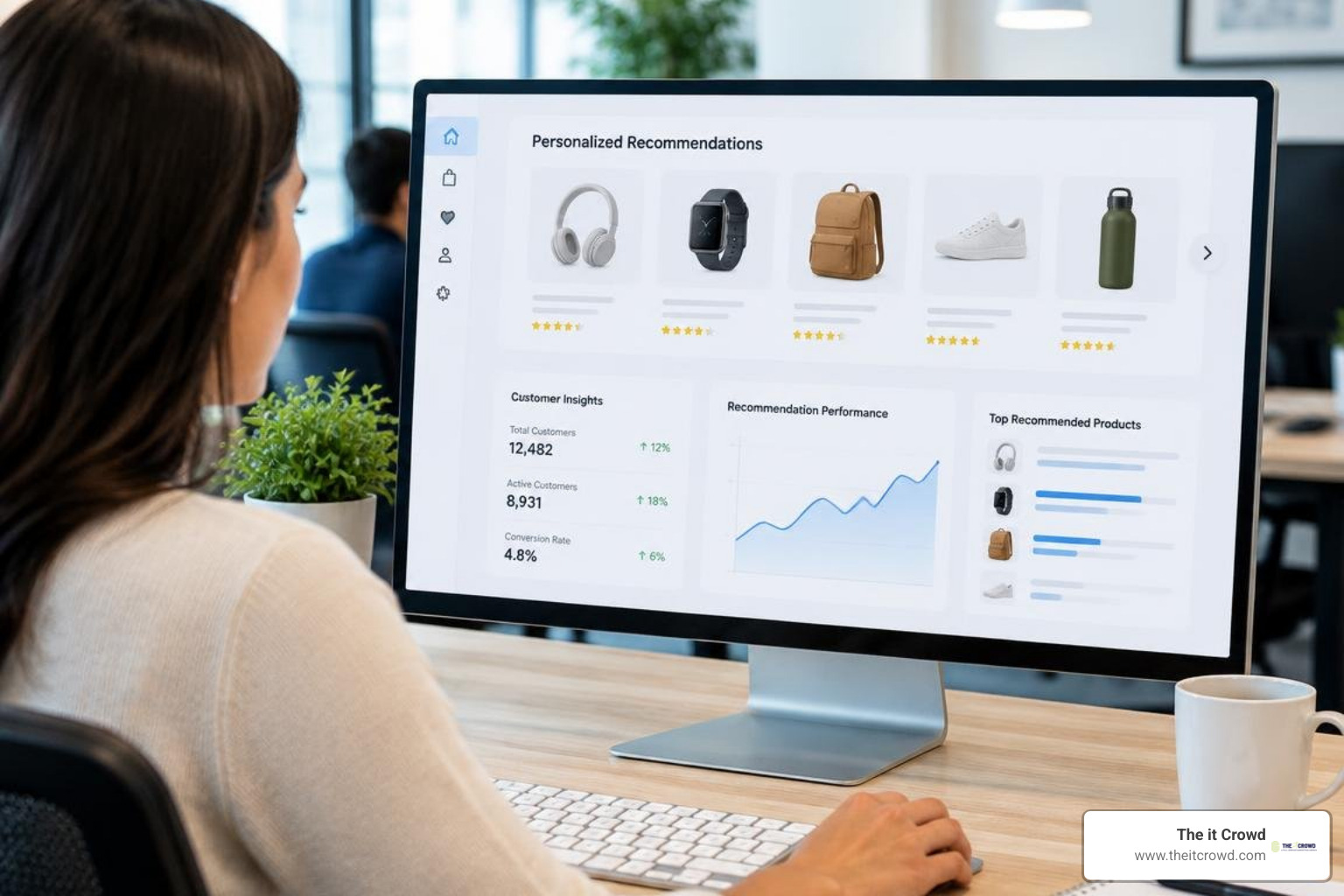
Modern ecommerce platforms leverage intelligent data layers and connected hardware to deliver smooth, responsive shopping experiences.
AI-Powered Personalization and Autonomous Automation
Artificial intelligence has evolved far beyond basic customer service chatbots. Modern ecommerce systems use machine learning to optimize the entire buyer journey:
- Predictive Product Discovery: Real-time recommendation engines analyze browsing habits and purchase histories to present relevant items, with some brands seeing an 8% increase in buyer conversion rates after deploying AI-driven retail intelligence platforms.
- Autonomous Catalog Merchandising: High-volume retailers use automated data pipelines to organize massive catalogs. For example, a luxury home goods brand built an automated engine that maps over 7 million SKU relationships in under an hour, eliminating weeks of manual data entry.
- Dynamic Pricing Engines: Algorithms adjust catalog prices in real time based on demand patterns, inventory levels, and competitor movements.
At The it Crowd, we implement these capabilities through our AI-ready web infrastructure and custom AI workflow design and automation, powered by our proprietary AI infrastructure, The Hive. This setup connects backend order flows directly to intelligent automation agents.
Immersive AR/VR and Smart Device IoT Integrations
Bridging the gap between physical retail and digital storefronts is key to boosting shopper confidence:
- Virtual Try-On & 3D Visualization: Web-based Augmented Reality (WebAR) lets customers preview products in their homes or try on apparel virtually, helping reduce return rates.
- IoT Inventory Tracking: Connected warehouse sensors and smart shelving update stock counts automatically across all digital channels the moment an item moves.
The Step-by-Step Ecommerce Development and Replatforming Lifecycle
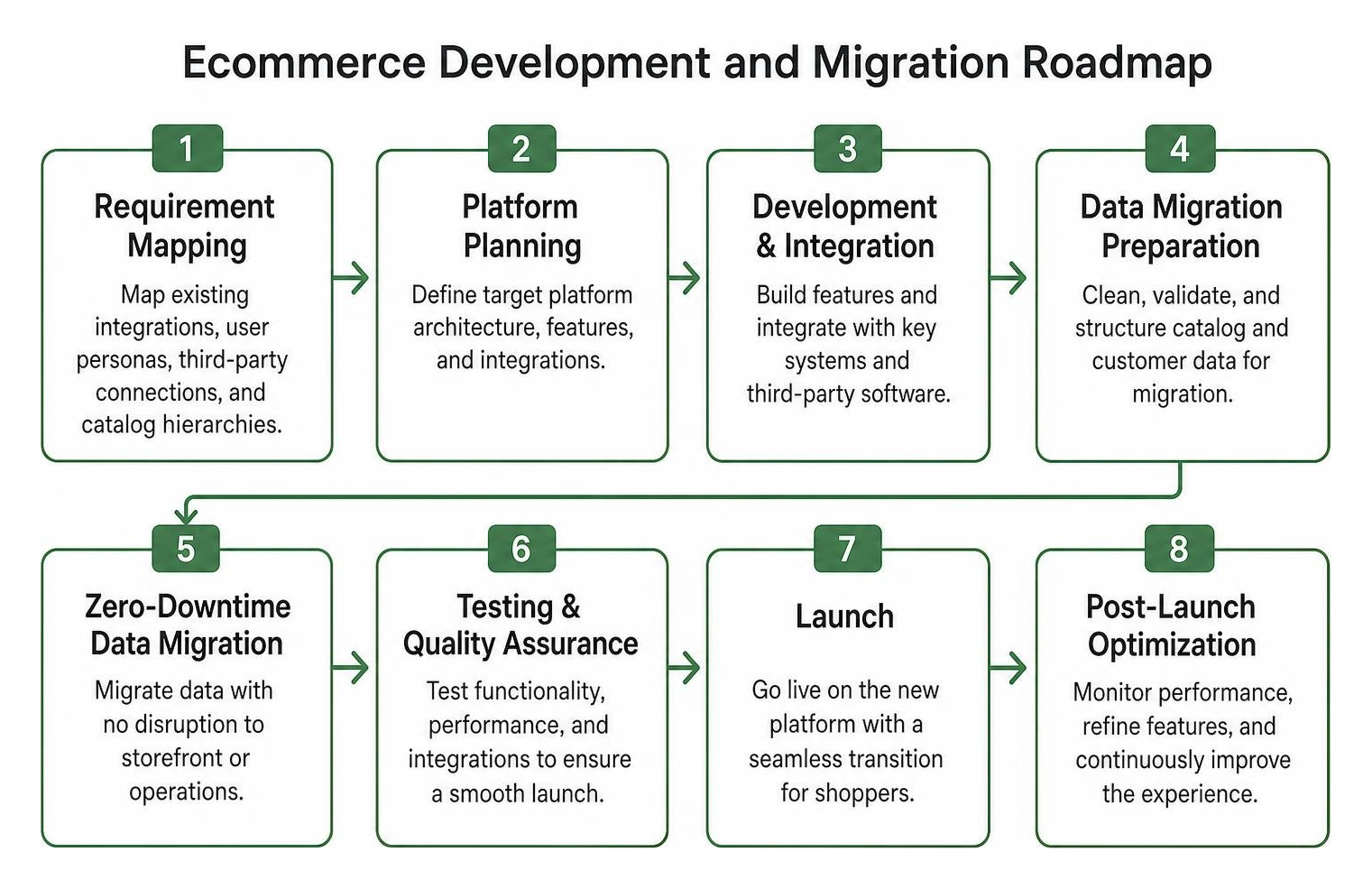
Building or replatforming an enterprise ecommerce store requires careful planning, risk management, and strong engineering practices to protect revenue and preserve search visibility.
Requirement Mapping and Zero-Downtime Data Migration
Every successful project begins with discovery. We map existing integrations, user personas, third-party software connections, and catalog hierarchies before writing any code.
During database migration, historical customer records, active orders, and product data must transfer cleanly without interrupting day-to-day sales.
Preserving search engine equity is equally critical. Replatforming often changes URL paths, category hierarchies, and metadata structures. Applying thorough technical SEO and site optimization ensures exact 301 redirect mapping, structured schema retention, and canonical link indexing, protecting the organic search visibility your brand spent years building.
Core System Development, API Middleware, and QA Load Testing
Once the foundation is set, our engineering team builds custom middleware connectors, configures headless endpoints, and sets up secure payment tokenization workflows that meet strict PCI-DSS and data privacy standards.
Before launch, the system undergoes rigorous quality assurance:
- End-to-End Functional Testing: Validating tax calculations, address verification APIs, multi-currency processing, and automated shipping workflows.
- Stress & Load Simulation: Testing how the infrastructure handles heavy traffic surges to ensure checkout remains fast and stable during flash sales.
- Core Web Vitals Optimization: Tuning server caching layers, image compression, and database queries through dedicated website optimization services. For example, modernizing storefront code has helped enterprise retailers achieve up to 5x faster page load speeds.
Budgeting and Cost Factors for Ecommerce Development Solutions
Ecommerce development costs vary based on project scope, architecture, and customization requirements:
- Platform Licensing & Hosting: Costs range from free open-source engines hosted on scalable cloud servers to enterprise SaaS tiers with revenue-share pricing.
- Integration Complexity: Custom middleware connecting legacy on-premise ERPs requires more engineering investment than pre-built SaaS webhook connectors.
- Catalog Size & Localization: Multi-currency, multi-language, and multi-brand catalogs require dedicated PIM structures and advanced data mapping.
- Ongoing Support & Maintenance: Continuous security patching, performance monitoring, and conversion rate optimization are essential to keep your store running at peak efficiency post-launch.
Frequently Asked Questions About Ecommerce Development
How do I choose between an out-of-the-box platform and custom ecommerce development?
Standard out-of-the-box platforms work well for straightforward catalogs with simple shipping rules and direct sales channels. However, if you manage complex wholesale pricing, custom product configurators, or high-volume ERP integrations, off-the-shelf templates will quickly slow you down. Custom development gives you full control over your business logic, eliminating recurring plugin fees and vendor constraints.
How can a business replatform without losing search rankings or sales?
Protecting revenue and rankings requires a detailed migration plan. Run the new store on a staging environment alongside the existing site while migrating data in the background. Audit all current URLs, map them one-to-one with 301 redirects, preserve header hierarchy and schema markup, and execute the final DNS cutover during low-traffic hours to prevent disruptions.
What is the typical timeframe to build an enterprise ecommerce solution?
A streamlined, template-based store can launch within a few weeks, but an enterprise custom build typically takes three to six months. This timeline accounts for custom middleware development, comprehensive ERP data synchronization, automated QA testing, and team training on back-office tools.
Conclusion
A modern online store is much more than a digital checkout counter—it is the operational hub of your business. By breaking down data silos, connecting your back office with custom middleware, and choosing an architecture built for long-term scalability, you build a store that delights customers and scales smoothly alongside your business.
At The it Crowd, our team unifies web engineering, search optimization, and automated workflows into cohesive marketing and technology solutions. Whether you are modernizing a legacy catalog or building a headless shopping experience from the ground up, we build digital storefronts designed for long-term growth.

