
How to Choose a Branding Agency That Fits Your Business
A branding agency helps a business decide what it stands for, who it serves, and how it should look and sound across every customer touchpoint. To choose one, start with the business problem you need to solve. Then look for a team that can explain its strategy process, show relevant work, name the people doing the work, and spell out costs, timelines, and ownership of the final assets.
That matters even more when your brand needs to work across your website, content, search, and ads. This guide will help you set a realistic brief, compare agencies, and know what to expect after you sign.
I’m Lindsey Huettner, owner of The it Crowd. I’ve spent more than 19 years in marketing and business ownership, helping businesses connect branding agency work with broader digital marketing goals.
Branding Agency vs. Marketing Agency vs. Design Studio
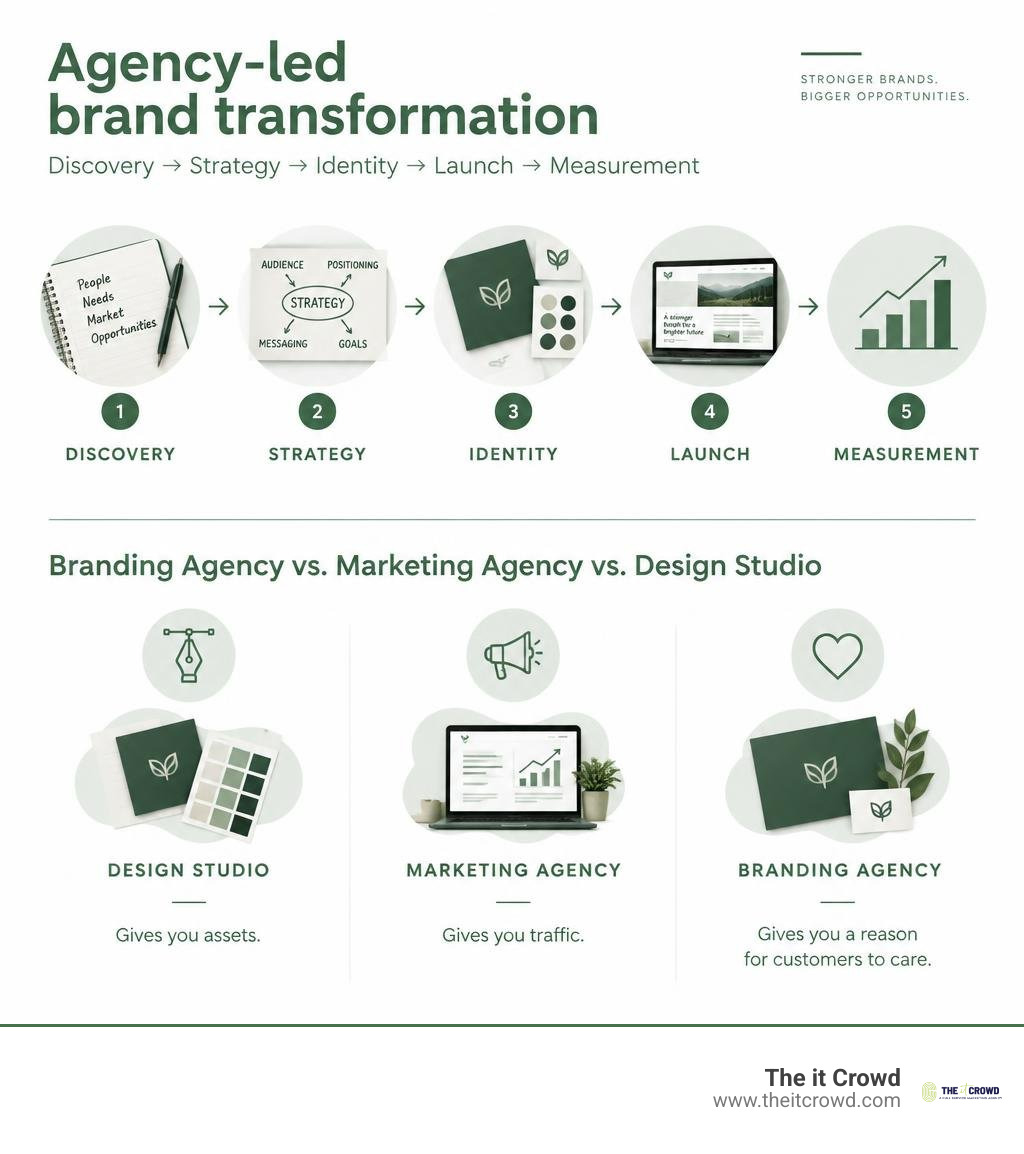
Business owners often use these titles interchangeably, but hiring the wrong type of agency leads to wasted budgets and missed expectations. A design studio gives you assets; a marketing agency gives you traffic; a branding agency gives you a reason for customers to care.
| Feature / Scope | Branding Agency | Marketing Agency | Design Studio |
|---|---|---|---|
| Primary Focus | Identity, positioning, long-term equity, and reputation | Demand generation, lead capture, campaigns, and short-term ROI | Visual aesthetics, graphic production, and interface layouts |
| Core Deliverables | Positioning strategy, messaging architecture, visual identity systems, brand guidelines | Paid ad campaigns, SEO, email funnels, conversion rate optimization | Logos, presentation decks, packaging mockups, website UI |
| Timeline Horizon | 3 to 10+ years (Foundational & enduring) | Months to quarters (Campaign-driven) | Project-by-project (Execution-driven) |
| Strategic Input | High (Deep market research, customer psychology, corporate vision) | Medium-High (Audience targeting, funnel mechanics, analytics) | Low-Medium (Brief-dependent aesthetic execution) |
| Success Metric | Brand recall, pricing power, customer lifetime value, market share | Cost per acquisition (CPA), conversion rates, pipeline velocity | Visual polish, asset turnaround speed, design consistency |
A design studio focuses primarily on visual craft. If you already have your exact target demographic, unique value proposition, and brand voice mapped out, a studio can execute beautiful graphics.
A marketing agency focuses on distribution and conversion. They excel at driving traffic through paid media, search engines, and automated nurture sequences. However, if your underlying message is weak or your positioning is muddy, pouring ad dollars into marketing campaigns simply amplifies a confusing story.
A dedicated branding firm builds the strategic engine that makes everything else work. At The it Crowd, we believe that brand strategy and marketing execution must be tightly integrated. Through our branding and corporate identity services, we create enduring visual and verbal foundations that flow seamlessly into search marketing, custom web design, and paid media.
Signs It Is Time to Hire a Branding Agency
How do you know when your internal team has hit a wall? The need for a strategic branding partner rarely happens overnight; it builds through friction in sales cycles and marketing performance.
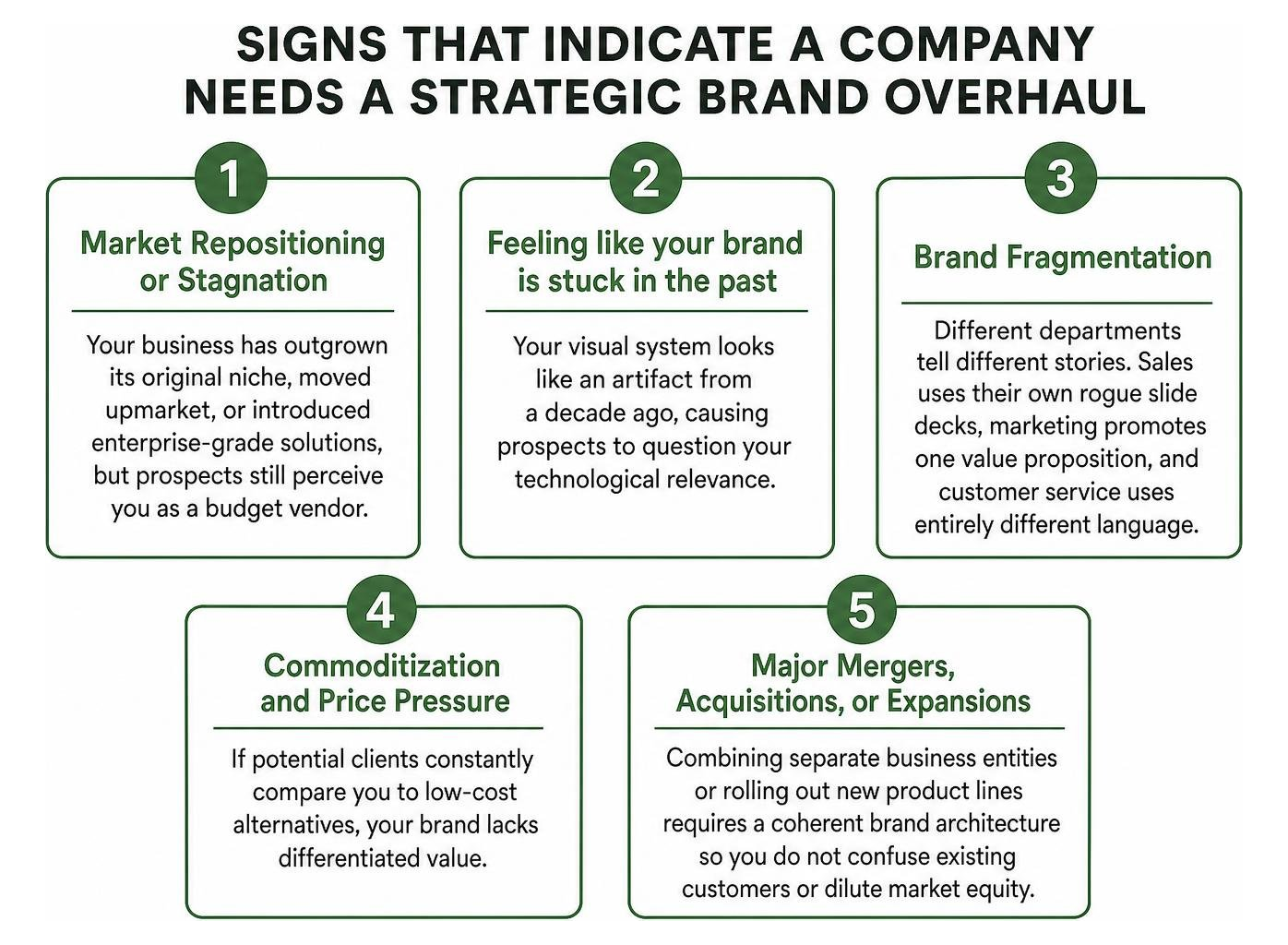
- Market Repositioning or Stagnation: Your business has outgrown its original niche, moved upmarket, or introduced enterprise-grade solutions, but prospects still perceive you as a budget vendor.
- Feeling like your brand is stuck in the past: Your visual system looks like an artifact from a decade ago, causing prospects to question your technological relevance.
- Brand Fragmentation: Different departments tell different stories. Sales uses their own rogue slide decks, marketing promotes one value proposition, and customer service uses entirely different language.
- Commoditization and Price Pressure: If potential clients constantly compare you to low-cost alternatives, your brand lacks differentiated value.
- Major Mergers, Acquisitions, or Expansions: Combining separate business entities or rolling out new product lines requires a coherent brand architecture so you do not confuse existing customers or dilute market equity.
Brand Refresh vs. Full Rebrand Scope
Before reaching out to agencies, determine whether you need a minor tune-up or a ground-up transformation.
- Brand Refresh (Evolutionary): A brand refresh preserves your existing brand equity while modernizing visual and verbal elements. It typically includes updating color palettes, refining typography hierarchies, modernizing an outdated logo, and polishing core messaging. A refresh typically costs 30% to 50% of a full rebrand and can be completed in 6 to 10 weeks. Most healthy brands undergo a minor refresh every 5 to 7 years.
- Full Rebrand (Revolutionary): A full rebrand completely redefines the company’s identity from the ground up. This involves renaming or repositioning, rewriting the foundational messaging architecture, overhauling visual identity systems, and rethinking go-to-market strategies. A complete rebrand is recommended every 10 to 15 years or following significant business pivots, mergers, or structural market disruptions.
Core Deliverables: What a Modern Branding Agency Actually Delivers
A comprehensive branding engagement is an extensive operational and strategic overhaul. It transforms internal vision into tangible, commercial assets.

Strategic Foundation and Messaging Systems
Strategy always precedes design. Before opening creative software, an agency conducts deep brand discovery and strategy sessions to unpack executive vision, interview core customers, and run competitive audits.
From this research, the agency builds structured brand positioning frameworks that define your market category, core differentiators, audience personas, and value propositions. This feeds directly into a complete messaging architecture, providing your sales, marketing, and leadership teams with:
- Mission, vision, and core purpose statements
- Brand voice and tone spectrums (e.g., how to sound authoritative without sounding rigid)
- Primary, secondary, and tertiary value messaging pillars
- Elevator pitches and boilerplate descriptions tailored to specific buyer personas
- Clear editorial standards for content creation
Visual Identity and Multichannel Activation
Once the strategy is locked, the agency translates those abstract values into an actionable visual system. Creating authentic visual branding requires human craft, cultural context, and strategic intent that automated tools cannot replicate.
Visual deliverables include:
- Logo Systems: Primary marks, secondary lockups, wordmarks, sub-brand marks, and responsive favicons.
- Color Systems: Accessible primary, secondary, and accent palettes with exact HEX, RGB, CMYK, and Pantone specifications.
- Typography Hierarchies: Licensed font pairings for digital products, print collateral, and web platforms.
- Graphic Devices & Art Direction: Custom iconography, photographic style guides, data visualization templates, and motion design guidelines.
- Brand Governance Guidelines: A comprehensive digital brand manual establishing clear rules for internal teams and external vendors.
Cost and Timeline Expectations for Branding Engagements
Branding investments scale with company size, operational complexity, and the number of stakeholders involved.
| Business Stage | Typical Annual Revenue | Investment Range | Typical Project Timeline | Core Scope of Work |
|---|---|---|---|---|
| Startup / Early Stage | Pre-revenue to $2M | $15,000 – $50,000 | 8 – 12 Weeks | Minimum viable brand, core positioning, primary logo system, basic color/type palette, foundational website design. |
| Growth Stage | $2M to $25M | $50,000 – $150,000 | 12 – 18 Weeks | Comprehensive stakeholder discovery, competitive landscape audit, messaging architecture, complete design system, marketing collateral templates, digital activation. |
| Established Business | $25M to $100M+ | $150,000 – $500,000 | 16 – 25 Weeks | Multi-market qualitative customer research, brand architecture modeling, enterprise-grade identity systems, comprehensive digital rollout, employee onboarding playbooks. |
| Enterprise | $100M+ | $500,000+ | 6 – 12 Months | Global brand architecture, multi-division rollout, custom proprietary typography, multi-agency orchestration, extensive international trademark validation. |
Discovery to Launch: The 12 to 25 Week Roadmap
A typical, focused brand identity project spanning strategy through guidelines takes 12 to 16 weeks, while a comprehensive rebrand with multi-channel activation runs 16 to 25 weeks. Enterprise projects with distributed stakeholder groups can extend to 6 to 12 months.
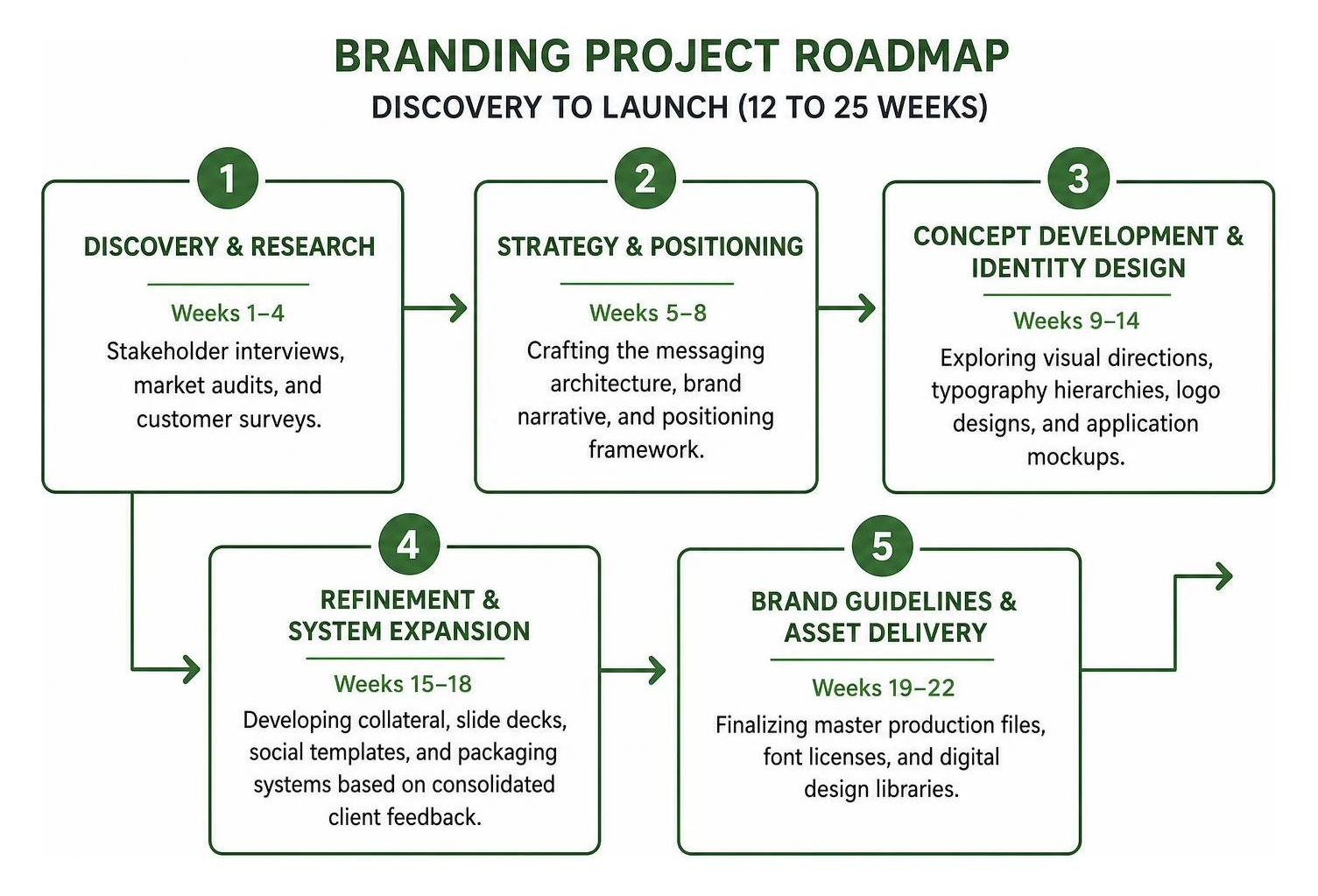
- Discovery & Research (Weeks 1–4): Stakeholder interviews, market audits, and customer surveys. Many agencies offer a standalone paid discovery or strategy sprint for $5,000 to $15,000 to define scope before signing a broader contract.
- Strategy & Positioning (Weeks 5–8): Crafting the messaging architecture, brand narrative, and positioning framework.
- Concept Development & Identity Design (Weeks 9–14): Exploring visual directions, typography hierarchies, logo designs, and application mockups.
- Refinement & System Expansion (Weeks 15–18): Developing collateral, slide decks, social templates, and packaging systems based on consolidated client feedback.
- Brand Guidelines & Asset Delivery (Weeks 19–22): Finalizing master production files, font licenses, and digital design libraries.
- Launch & Activation (Weeks 23–25+): Rolling out the new identity across web platforms, public relations campaigns, and internal teams.
Note on timelines: The most common cause of project delays is not agency production—it is slow internal client approvals and unaligned executive decision-makers. During discovery and strategy, client leaders should expect to dedicate 3 to 5 hours per week, tapering to 1 to 2 hours per week during visual design reviews.
Measuring Brand ROI and Value Creation
While performance marketing yields immediate numbers, a strategic rebrand delivers compounded commercial value over time. Understanding the psychology of brand memory shows that consistent, distinctive brand assets reduce buyer hesitation and anchor your business at the top of a customer’s mind.
Key metrics for measuring brand ROI include:
- Pricing Power and Margin Expansion: Premium brands command higher margins without losing volume.
- Customer Acquisition Cost (CAC) Efficiency: Distinctive branding lifts conversion rates across paid search and social campaigns, driving down blended CAC.
- Sales Cycle Velocity: Well-positioned brands build faster trust, shortening enterprise B2B sales cycles.
- Talent Attraction and Retention: A compelling corporate brand lowers recruitment costs and attracts higher-tier talent.
Step-by-Step Guide to Evaluating and Selecting Partners

Selecting an agency requires evaluating their strategic depth rather than just browsing flashy portfolio images. You can explore curated lists of the top 36 brand development companies (2026) reviewed by region, industry & budget to understand the global agency landscape.
When structuring your search:
- Shortlist Exactly Three Agencies: Reviewing more than three agencies leads to decision fatigue and diluted evaluations.
- Prioritize Strategic Depth Over Visual Flash: Any competent designer can create an attractive logo; ask why specific choices were made and how they resolved business challenges.
- Compare Agency Models: A focused boutique agency charging $40,000 to $80,000 often outperforms a $300,000 engagement at a large traditional consultancy because your account receives direct attention from senior strategists rather than junior associates.
Key Red Flags During Branding Agency Pitch Sessions
Watch for these warning signs during the discovery and pitch process:
- The Pitch-Team Bait-and-Switch: The senior partners pitch the account, but junior designers and interns execute the project. Always demand to meet the specific strategists and designers assigned to your day-to-day deliverables.
- No Strategic Pushback: If an agency nods along with every assumption in your brief without challenging your thinking, they are order-takers, not strategic advisors.
- Vague Intellectual Property Terms: Beware of contracts that bury licensing restrictions, retain design source files, or require additional fees to transfer final copyrights.
- Lack of Process Transparency: If an agency cannot clearly define their phase gates, revision limits, and stakeholder sign-off milestones, scope creep and missed deadlines are guaranteed.
Essential Governance, IP Ownership, and Handover Assets
A brand engagement is complete only when your internal team has total control over the resulting assets. Before making your final payment, ensure your agency hands over:
- Master Vector Source Files: Native AI, EPS, SVG, and high-resolution PNG files for all brand elements.
- Commercial Licensing Documentation: Clear ownership or perpetual commercial licenses for all custom fonts, photography, and illustration libraries.
- Living Brand Guidelines: A centralized manual (often hosted via a digital portal) that teaches internal teams how to apply the brand across presentations, documents, web pages, and product packaging.
- Post-Delivery Support Window: A defined 30-to-60-day window where the agency assists your internal marketing team or web developers with asset implementation questions.
Frequently Asked Questions About Hiring Brand Partners
Can a startup or small business afford a top branding partner?
Yes. Early-stage companies do not need an enterprise-tier brand architecture engagement. Many top boutique agencies offer phased sprint engagements, brand strategy workshops, or minimum viable brand packages ranging from $15,000 to $30,000. This provides professional positioning and visual assets without unnecessary corporate overhead.
Who owns the intellectual property and source design files?
You should. Ensure your contract explicitly states that upon final invoice settlement, all custom intellectual property, copyrights, trademarks, and raw source vector files transfer fully to your company. Ensure font licenses and third-party stock assets are properly registered in your business’s legal name.
What is the client time commitment required during a rebrand?
A successful rebrand requires focused leadership involvement. Plan for key decision-makers to invest 3 to 5 hours per week during the initial discovery, research, and strategy phases. As the project shifts into visual design, identity production, and asset rollout, executive time requirements drop to 1 to 2 hours per week for structured feedback and approvals.
Building an Enduring Brand for Measurable Growth
A successful brand identity is not a cosmetic coat of paint; it is the strategic foundation of your company’s entire commercial engine. When positioning, visual identity, and messaging work in unison, every marketing dollar spent works harder and yields higher returns.
At The it Crowd, we bridge the gap between high-level brand strategy and high-performance digital execution. As a full-service digital marketing agency, we combine brand positioning and visual identity with custom web development, content creation, advanced SEO, and paid media. Powered by our proprietary AI infrastructure, “The Hive,” and recognized as the best search engine marketing firm in Dallas, we help ambitious businesses build distinctive, modern brands engineered for measurable, long-term growth.
Ready to clarify your message, stand out in your market, and elevate your customer experience? Explore our practical guide on effective branding strategies to start refining your brand identity today.

