

It’s the quarterly leadership meeting, and your slide is up. Five posts a week, every week, for a year. You kept that streak alive through product launches, a reorg, and at least two holiday weekends.
The CEO studies the chart for a moment, then asks the question you’ve been rehearsing answers to all week: “So what did we get from it?”
The room goes quiet. Someone checks their phone.
You know the honest answer. Two hundred and sixty posts, and not one of them made a buyer pick up the phone. Your sales team still opens every first call by explaining who the company is.
That night, you type a question into Google: why isn’t our social media working? By morning, you have a plan, and it’s the one almost every marketing director lands on. Post more. Add video. Maybe try a new platform.
It’s the most natural response in marketing, and it’s the one that keeps the phone quiet.
A B2B social media strategy is a system for making your brand recognizable and trusted by the people who buy from you, long before they need you. Posting frequency is one setting inside that system. Turn it up without the rest in place, and you get more of what you already have.
What this article covers:
- Why a content schedule and a brand system do different jobs
- What brand equity means when your buyer has a procurement process
- How brand voice and visual identity work as one engine
- Seven practical steps for the first 90 days
- Key takeaways to bring to your next leadership meeting
A Content Schedule Keeps You Busy. A Brand System Makes You Known.
In January, every post has a reason. Each one ties back to a positioning decision, and someone asks whether it sounds like the brand before it goes live.
By August, the reasons have thinned out. Approvals have turned into defaults. The Tuesday tip runs because it’s Tuesday. LinkedIn gets three posts a week because it got three posts a week last quarter. Nobody decided to drop the strategy. The calendar simply outlasted it.
That drift is one of the quieter signs your marketing isn’t working, and it’s widespread. According to the Content Marketing Institute, only 29% of B2B marketers surveyed rate their content strategy as extremely or very effective.
Whether anyone remembers you depends on two things. The Ehrenberg-Bass Institute calls the first one distinctive assets: “colours, logos or characters that uniquely signal the brand.” The LinkedIn B2B Institute calls the second one mental availability, meaning how easily your name comes to mind when a buyer’s need arrives. Both build up through the same signals, repeated in the same voice and look, over months.
What B2B Brand Equity Means When Your Buyer Has a Procurement Process
B2B brand equity is the head start your name gets before a sales conversation begins. It’s why one cold email gets a reply and an identical one from an unfamiliar company gets archived. When a prospect has been reading your thinking for six months, your outreach lands like a follow-up.
B2B buying gives that head start plenty of room to work. Cycles stretch across quarters. Decisions pass through committees, procurement, and at least one stakeholder who missed the first meeting. Most of the research happens quietly, on your website and your LinkedIn page, long before anyone fills out a form.
The calendar also works against the urge to convert. Research by the Ehrenberg-Bass Institute, published with the LinkedIn B2B Institute, estimates that only about 5% of B2B buyers are in the market in any given quarter. The other 95% will get there eventually, on their own schedule.
That defines social media’s job in a B2B cycle: stay recognizable to the 95% until they become the 5%. When the need arrives, the shortlist forms from memory, and the brands that have shown up consistently are already on it.
How The Storyteller and The Good Looks Work Together
Picture a VP of operations scrolling LinkedIn before her 8 a.m. call. Her thumb stops on a post before she’s read a word. The color, the type, the way the headline sits on the image: she knows whose post it is. Then she reads the caption, and it sounds like the person she heard on a panel last spring, dry, specific, and a little impatient with industry clichés. Two seconds, and your brand has another layer of memory.
Now picture two other companies in the same feed. The first invested in beautiful templates and fills them with captions like “Excited to share our latest insights!” The second writes sharp, opinionated copy and drops it into the same stock layout a hundred other firms use. She scrolls past both. One looks like someone, and the other sounds like someone, but neither registers as anyone in particular.
That gap is why we build voice and visuals together. The Storyteller decides what the brand says, to whom, and on which channels. The Good Looks makes sure the brand is recognizable before anyone reads a word. Both teams work from one brief, review each other’s work, and share the same definition of who the brand is. When the caption and the design come from the same decision, every post adds to the recognition the last one built.
What Happens in the First 90 Days of a B2B Brand and Content Engagement?
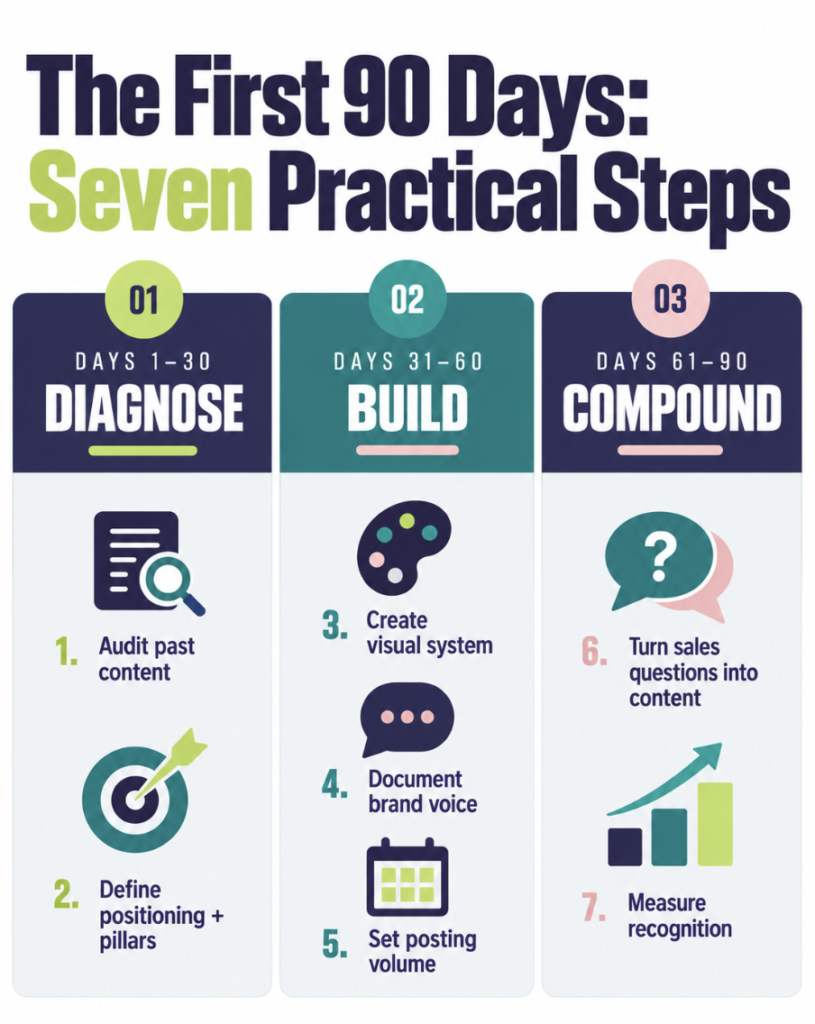
The first 90 days of a B2B brand and content engagement have three phases: diagnose (Days 1–30), build (Days 31–60), and compound (Days 61–90). By Day 90, the company has a positioning statement, a visual system, a voice guide, a sustainable posting volume, and a way to measure recognition. That is how a social media strategy for B2B companies gets built in practice.
Days 1–30: Diagnose What’s Already Working
- Audit six months of posts before adding new ones. Sort every post into two groups: posts that drew a response from a potential buyer, and posts that drew silence. A manufacturing company, for example, might find its most-liked post was a team birthday, while the only post that drew comments from plant managers was about the cost of downtime. The posts buyers responded to show where to start.
- Define what the brand should be known for. Write a one-sentence positioning statement and three content pillars that follow from it. A logistics software company might write: “We help regional logistics firms stop losing margin to manual processes.” Its pillars could be the hidden cost of manual work, automation at mid-size scale, and lessons from the warehouse floor. Every future post fits under one pillar.
Days 31–60: Build the Brand System
- Create a visual system that makes posts recognizable at a glance. At The it Crowd, this is the job of The Good Looks, our branding and design service. It sets the templates, color rules, and type standards. For example, quote posts always run on navy, data posts always run on light green, and every headline uses the same condensed typeface.
- Document the brand voice in a one-page guide. The Storyteller, The it Crowd’s content strategy service, writes a guide that lists the words the brand uses, the words it avoids, and three before-and-after rewrites. “We’re excited to announce our innovative new solution” becomes “We built this because our clients kept asking for it.”
- Set a posting volume the team can sustain at full quality. If five posts a week means two are filler, post three. When every post sounds like the brand, each one adds to recognition.
Days 61–90: Compound the Results
- Turn sales questions into the content backlog. Ask the sales team for the five questions prospects asked most that month, then answer each one in a post. “How long does implementation take?” becomes a post that walks through a real timeline.
- Measure recognition with five monthly signals. Recognition is whether people remember the brand after seeing a post, and it shows up in five places. Track them monthly: searches for the company name, profile visits, comments from people with relevant job titles, inbound DMs, and prospects who mention your posts on sales calls. By Day 90, the trend shows whether the system is working.
Key Takeaways
- Increasing post frequency multiplies whatever a brand’s social presence already communicates. When engagement stalls, the fix for a B2B social media strategy starts with positioning, voice, and visual identity.
- A brand system is what makes a company’s content recognizable. It sets positioning, voice, visual identity, and content pillars, and the posting schedule runs inside it.
- B2B brand equity is the head start a company’s name gets before a sales conversation begins. It builds slowly through consistent exposure, because only a small share of B2B buyers are in the market at any given time.
- Voice and visuals perform best when they come from the same brief. At The it Crowd, The Storyteller and The Good Looks plan together so every post is recognizable by its look and its words.
- The first 90 days of a B2B brand and content engagement move through three phases. The phases are diagnose, build, and compound, and success is measured by recognition signals like branded search, profile visits, and inbound DMs.
Where to Start If Your Feed Is Busy and Your Pipeline Isn’t
Go back to that leadership meeting for a moment. The fix for that slide starts with one finding: what your buyers respond to.
You can find it this week. Pull the last six months of posts and sort them into two groups: the ones that drew a response from a potential buyer and the ones that drew silence. Then look at what the first group has in common. That pattern is the start of your brand system, and finding it costs an afternoon. The next time the CEO asks what you got from social, you’ll have an answer.
If you’d like a second set of eyes on what you have, we’re happy to talk. The it Crowd’s B2B social media management starts with that same audit, and our Ascent case study shows where it can lead. Start a conversation here.

