

TL;DR
- Speed, crawlability, and status code problems set the ceiling on Q4 traffic. No campaign budget fixes a page nobody can load or find.
- Schema markup is the shared language search engines and AI systems both read, telling them what a page actually means instead of leaving them to guess. Most sites are only fluent in half of it.
- A pre-Q4 website audit takes a few focused hours before the season starts. Skip it, and you’re troubleshooting during the exact weeks you can least afford it.
Picture a lighthouse keeper in the last calm week before winter shipping season. All summer he’s repainted the tower and polished the brass until it gleamed. Ships have been sparse, so there has been no urgency.
Then the fog rolls in early, right as the harbor fills with vessels racing to unload before the season turns. He climbs the tower to light the lamp and finds the wick soaked through, the reflector caked with salt, the mechanism seized from months of nobody checking. The tower looks perfect from the shore, but it has never worked less.
Nobody notices a slow homepage until Q4. Nobody notices a missing schema tag until Q4. Nobody notices a blocked crawler until Q4. September is the last calm week. October is the fog.
As the saying goes, “An ounce of prevention is worth a pound of cure.” A pre-Q4 website audit buys you the ounce while it’s still cheap. Waiting until traffic arrives buys you the pound, usually while a prospect who typed a ten-word question into ChatGPT never sees you at all.
This is the audit worth running before the season turns: technical SEO, schema markup, and readiness for the AI systems now sitting between your buyer and their next click.
The Technical SEO Checklist: Crawlability, Speed, and Status Codes
Everything else in this audit rests on three unglamorous fundamentals: how fast your site loads, whether crawlers can reach it, and whether it says yes or 404.
Speed Is the Silent Tax
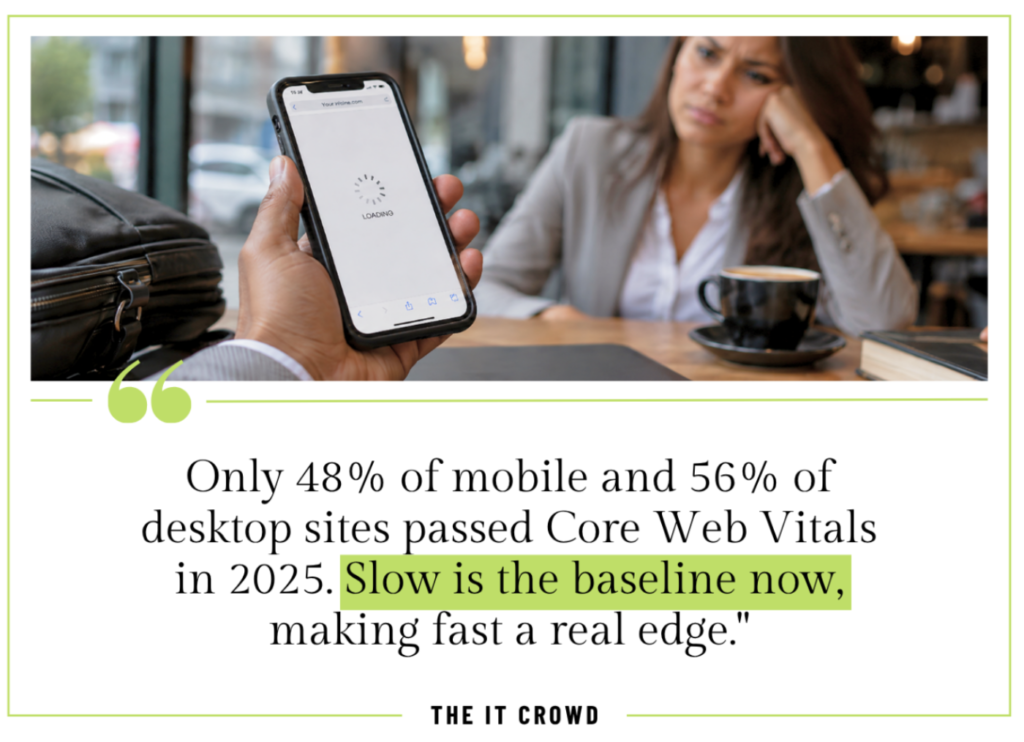
HTTP Archive’s 2025 Web Almanac found that only 48% of mobile sites and 56% of desktop sites delivered a good overall Core Web Vitals experience last year, and on home pages that number dropped to 45% and 47%. Slow has become the baseline, which is exactly what turns a fast site into a genuine competitive edge.
Most audits stop at the visible symptoms: a sluggish homepage, a laggy product page, a checkout that hangs a beat too long. The real cost sits underneath, in the seconds a visitor spends staring at a blank screen before anything loads.
Imagine your best salesperson only takes calls during business hours and hangs up on anyone who takes longer than three rings to say hello. That’s what a bloated homepage does to a buyer scrolling search results on their phone between meetings. It ghosts them, and she never knows your pitch existed.
The Pages Google Can’t Find
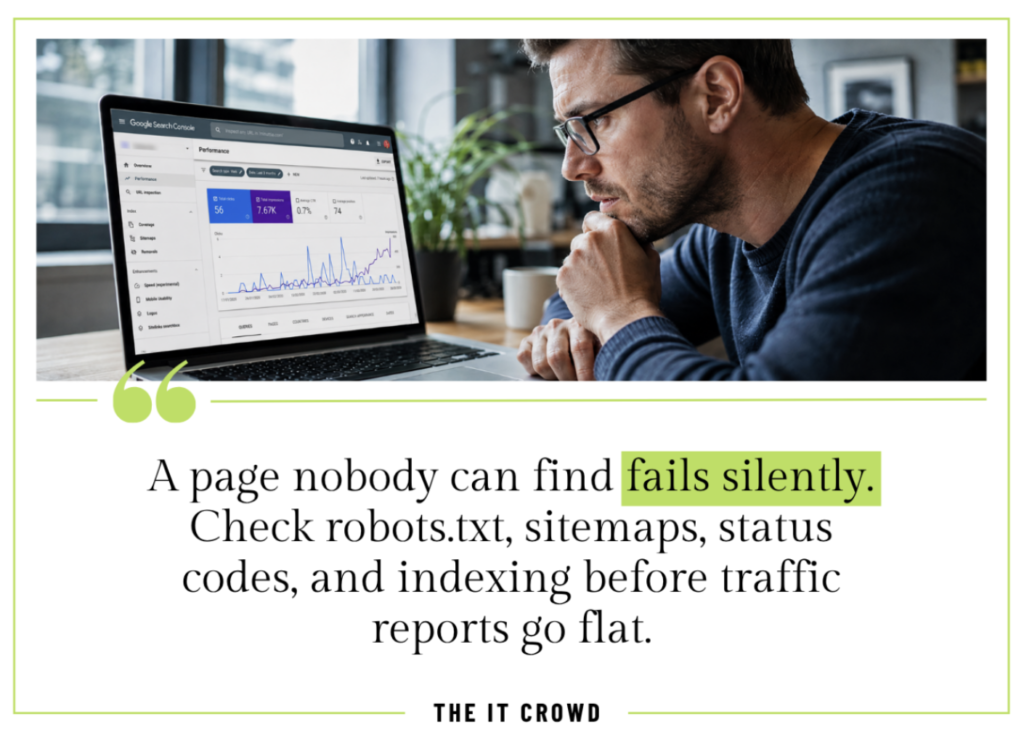
A page that never loads announces itself immediately. A page nobody can find stays quiet until the traffic report comes back flat and nobody knows why. Crawlability and indexability failures hide inside settings nobody remembers changing: a stray noindex tag, an outdated sitemap, a robots.txt file blocking exactly the folder your content team just filled with new pages.
Before the rush hits, run through:
- Google Search Console’s Coverage report for pages marked Excluded or Crawled, currently not indexed
- robots.txt for accidental blocks on folders you actually want found
- Your XML sitemap for stale URLs, 404s, or pages that no longer exist
- HTTP status codes across your top pages: a 301 resolving in one hop instead of three, a 404 sitting where a client page used to be, a 503 nobody caught because it only fires under load
- Redirect chains longer than a single hop, which slow crawlers and bleed link equity with every extra step
Here’s a pattern we see often: a fresh batch of service pages launches, marketing spends real budget promoting them, and yet traffic never comes. The culprit is rarely the content. More often, it’s simply one overlooked line in robots.txt, written months earlier, quietly blocking the entire folder from ever being crawled.
Schema Markup That Actually Gets Read
Half of all home pages published last year skipped structured data entirely, and only 43% used JSON-LD, the format search engines and AI systems parse most reliably, according to HTTP Archive’s latest benchmarking. Organization schema—arguably the clearest trust signal a site can send—sat on just 26%-27% of pages surveyed. If your site has never had a schema audit, the odds are not in your favor.
The Trust Layer Most Sites Skip
Organization schema—paired with sameAs markup linking to verified profiles like LinkedIn or your Google Business listing—tells search engines and AI systems who you actually are before they read a word of your homepage copy. This is entity-based SEO in its most practical form: establishing your business as a known, verifiable entity rather than a collection of pages hoping to rank on keywords alone.
Content Schema That Earns Its Keep
FAQ schema, Article schema, and Service schema do the same job at the page level, telling the crawler what type of content it is looking at instead of leaving it to guess. Validate everything through Google’s Rich Results Test, and check Search Console’s Enhancements tab for errors sitting unresolved since the last redesign.
John Mueller, Google’s Search Advocate, has said as much directly: “Even without the structured data leading to rich results, our systems profit by understanding the pages better when they use structured data.” Schema has always been about being understood correctly, whether or not a rich result ever shows up.
Is Your Site Ready to Be Cited by AI?
Found. Understood. Cited. That is the new three-step funnel, but most technical SEO work still stops at step one.
If the shift from ranking to being referenced still feels abstract, Fortune’s reporting on Google’s AI Overviews puts numbers to it: they appear for only 8% of one- or two-word searches, but 53% of searches running ten words or longer, and roughly 60% of the time when a query opens with who, what, when, or why.
That is the shape of B2B research behavior. A marketing director does not type “SEO agency.” She types a paragraph describing her problem, her budget, and her deadline, and an AI system decides who gets named in the answer.
It is fair to be skeptical of generative engine optimization as a category. Nobody has a definitive ranking algorithm to reverse-engineer, and citation tracking still involves more guesswork than the SEO tools everyone is used to. But skepticism about the measurement is not a reason to ignore the behavior already happening.
Before the season starts, confirm:
- robots.txt is not accidentally blocking GPTBot, Google-Extended, ClaudeBot, or other AI crawlers
- Your most important pages do not rely entirely on JavaScript rendering that some AI crawlers cannot parse
- Key facts and claims are stated as plain sentences an AI can extract, not implied through tone or buried in the fourth paragraph
- FAQ content is written as self-contained answers, since that is often exactly how it gets pulled out of context and used
GEO runs on the same technical work, aimed at a reader who never clicks through.
How The it Crowd Prioritizes These Fixes
A recent industry benchmark found that 92% of marketing leaders plan to optimize for generative engine optimization this year. Only about 40% have actually operationalized any of it. That gap is the opportunity: intention is cheap, and most of the field has not finished the homework. Run this audit before Q4, and you pass a field that is still tying its shoes.
We rank the fixes the same way every time. Indexing and crawlability come first, since a page that is not indexed cannot rank, get cited, or convert. Speed and mobile experience come second, touching every visitor across every channel already being paid for. Schema comes third, compounding slowly rather than fixing anything overnight, which is why the work starts in September, not the week before Thanksgiving.
We have watched businesses spend a full quarter of content budget promoting pages that were never indexed in the first place, technically flawless copy sitting behind a robots.txt block nobody thought to check. The content was not the problem. The order of operations was.
Running this audit first is a lot like tuning an instrument before a performance nobody can hear yet: unglamorous, mostly invisible. But it’s the only thing standing between a season that sounds right and one that quietly falls flat.
A content calendar and a paid media plan still matter. This audit is the floor they stand on. Hand us the spreadsheet, and we will hand back a prioritized fix list, no pitch required.

