
TL;DR
- Enterprise AI in marketing isn’t magic. It’s automated nurture sequences, AI content repurposing, real-time personalization, and AI reporting dashboards working as one connected system.
- The building blocks behind those capabilities are already available at mid-market price points. What’s usually missing is marketing systems design, not budget.
- The five things that separate a working system from a pile of tools: data hygiene, strategy before automation, change management, continuous optimization, and killing your data silos.
It’s 6:47 on a Tuesday evening. A marketing director at a $60M company is alone on the third floor, two monitors glowing, exporting a CSV from one platform so she can manually paste it into another. The coffee went cold an hour ago. Tomorrow morning she’ll present a report she assembled by hand, about campaigns that were supposed to run themselves, to executives who keep asking what the AI strategy is.
She’s not behind. She’s not bad at her job. She’s just running a modern marketing operation on plumbing that was never designed to connect.
The obvious explanation is budget. The enterprises have it, you don’t, end of story. That’s the explanation everyone reaches for — and it’s wrong. The actual gap between enterprise and mid-market AI adoption has a name, and we’ll get to it. But first, let’s look at what the enterprises are actually doing, because it’s far less mystical than the conference keynotes suggest.
What Enterprise AI in Marketing Actually Looks Like
Strip away the buzzwords and enterprise marketing automation comes down to a handful of capabilities, all running on the same connected infrastructure.
Content and personalization at scale
One webinar becomes a blog post, twelve social posts, three email variants, and a sales one-pager, automatically, through AI content repurposing systems. Real-time personalization adjusts what each visitor sees based on behavior, not on a segment someone defined eight months ago. AI customer segmentation updates itself daily, so Friday’s audience model is sharper than Monday’s.
Lead management that never sleeps
Automated nurture sequences respond to what a prospect actually does: opens, clicks, pricing page visits, the works. Automated lead routing gets the right lead to the right rep in minutes, not Mondays. Smart scheduling tools fill calendars without the seventeen-email tennis match. By the time a human touches the lead, it’s already warmed, scored, and in the right hands.
Reporting and optimization on autopilot
AI reporting dashboards surface what changed and why, without anyone exporting a CSV at 6:47 PM. AI campaign optimization shifts budget toward what’s working based on performance signals, not the end of the quarter. Decisions that used to wait for the monthly meeting now happen daily, while the campaign can still benefit.
Here’s the thing about all of this. None of it is impressive in isolation.
Think about the AI J.A.R.V.I.S. in the Iron Man movies. J.A.R.V.I.S. isn’t just a clever chatbot Tony Stark talks to. What makes it impressive is that it’s wired into the whole house: the lab, the suits, the manufacturing arms, the power grid.
A lonely ChatGPT tab open in someone’s browser is a gadget. AI powered marketing that works is an entire nervous system.
The Part Where This Gets Within Reach
Ever wondered why those capabilities feel reserved for companies with nine-figure budgets? Here’s the uncomfortable, liberating answer: they aren’t.
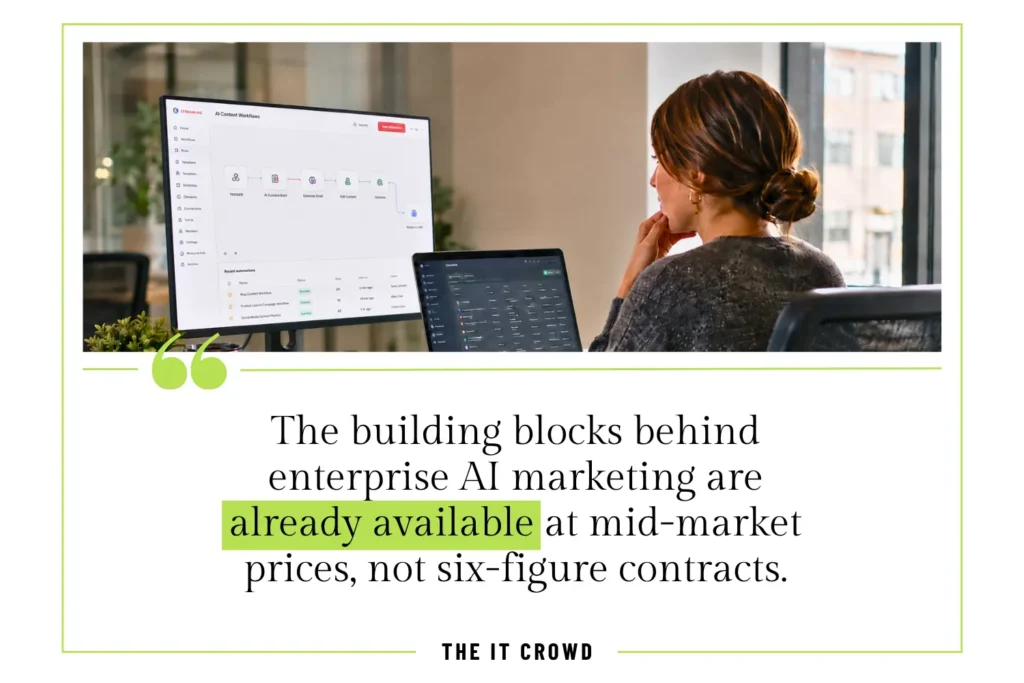
The building blocks behind every AI marketing use case above are available right now at mid-market prices. Workflow automation platforms like n8n and Supabase run on transparent monthly plans, not six-figure contracts with eighteen-month commitments.
The same large language models powering enterprise content engines are accessible through API providers that bill by usage, not by enterprise license. You pay for what you run, and a serious month of content operations often costs less than one sponsored LinkedIn campaign.
In addition, CRM platforms like HubSpot and Salesforce already have automation features most mid-sized teams have never turned on. They’re sitting in the plan you’re already paying for. Even AI-driven analytics tools — the kind that surface insights instead of just displaying charts — are available at price points a $30M company can absorb without a board-level conversation.
The technology is not the bottleneck. The assembly is.
So if the building blocks are available, why does AI adoption in marketing still feel like an enterprise-only sport?
The data tells the story. A recent study published in the Journal of Personal Selling & Sales Management, citing Salesforce research, found that only 35% of respondents trust the accuracy of the data used with AI in their organization. You can’t automate on top of data you don’t trust.
And according to ContentGrip’s analysis of CMO readiness, 70% of CMOs say AI leadership is a primary strategic goal while only 30% believe their organizations have the infrastructure, data foundations, and operating models to get there. That’s not a gap. That’s a canyon — and it has nothing to do with purchasing power.
That distance between ambition and infrastructure has a name: the marketing readiness gap. It’s not a budget problem wearing a technology costume. It’s a systems design problem wearing a budget costume.
Which raises the obvious question: what does good marketing systems design actually involve?
The Five Things That Separate a Working AI Marketing System From a Collection of Tools
1. Data hygiene comes first
Picture a multi-million-dollar airport baggage system: high-speed tracks, laser scanners, automated chutes, ten thousand bags an hour without a human touch. Now imagine half the airlines print tags with smudged ink, a few write them in cursive, and one is still using barcodes from 2014. The machinery is flawless. The luggage still ends up in a pile on the tarmac.
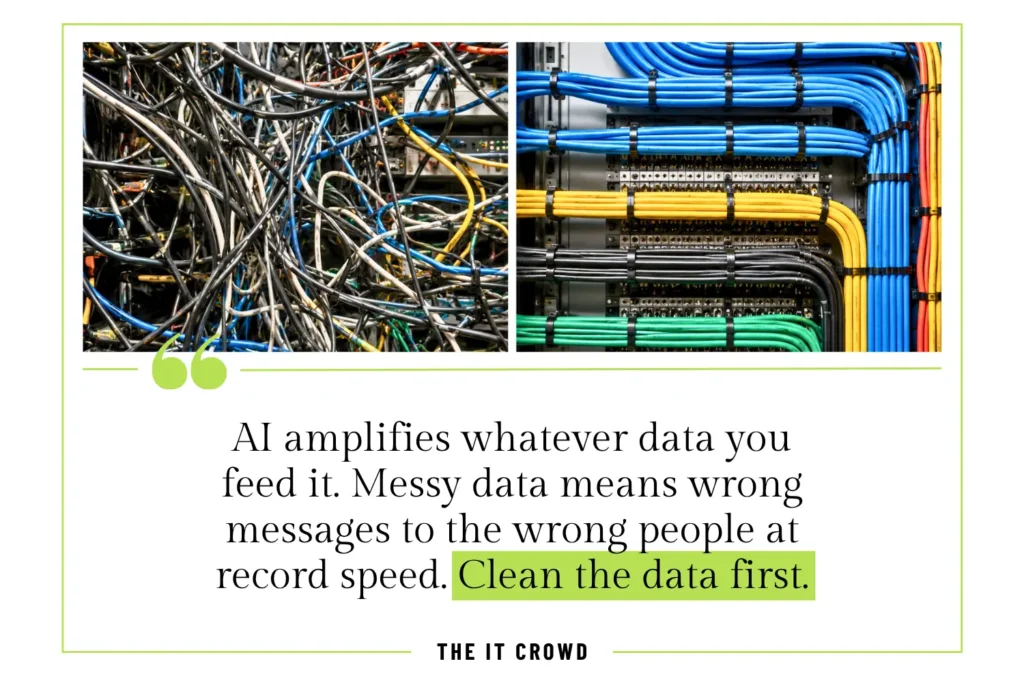
That’s AI deployed over messy data. If your CRM has missing fields, inconsistent naming, and duplicate records, an AI marketing system will route the wrong message to the wrong person at record speed. The fix starts with an audit: standardize field formats, merge duplicates, fill the gaps that matter, and set rules so the data stays clean going forward. Clean the data first. It’s unglamorous, but it’s the foundation of everything.
2. AI marketing strategy before automation
Automating a broken process just breaks things faster. If your lead follow-up is slow because nobody agreed on who owns which leads, automation won’t fix the ownership problem. It will just deliver confusion at machine speed. Strategy decides what gets built, in what order, and why. It’s the same reason marketing problems persist despite great creative: execution can’t fix what strategy never defined.
Says 4Thought Marketing: “Most companies buy the AI tool first, realize the data is messy second, try to clean it while the tool is running third, get partial results fourth, lose executive patience fifth, and restart with a different tool sixth. The cycle repeats because the order is wrong.”
This isn’t a failure of effort or intelligence but a failure of sequence — and sequence is strategy.
3. Change management is a real line item
A system nobody uses is expensive shelfware. And “nobody uses it” is the default outcome when a new system lands on a team without warning, without training, and without an honest answer to the question everyone is thinking: what happens to my job?
Most AI marketing transformation efforts don’t stall on technology. They stall on people who were never brought along. The fix isn’t complicated, but it does require intention: involve the team early, define who owns what, train on real workflows instead of theoretical demos, and give people a reason to trust the system before you ask them to depend on it.
Change management is not the soft side of the project. It’s the side that determines whether the project survives its first quarter.
4. Continuous optimization loops
A working AI marketing system is never set-and-forget. The outputs on day one will be rough. The outputs on day ninety should be noticeably better, but only if someone is paying attention.
That means reviewing what the system produces, refining the inputs, adjusting the prompts, updating the knowledge base, and feeding what the system learns back into how it runs. In practice, that’s a standing review (weekly at first, monthly once things stabilize) with one named owner.
This is where compounding happens. Each cycle of review and refinement makes the next round of outputs more accurate, more on-brand, and more useful. Skip this step and you get a system that performs exactly as well in month six as it did in week one. That’s not automation. That’s a very expensive copy-paste machine.
5. Data silos are the silent killer
Disconnected platforms produce disconnected results. If your email tool, CRM, and analytics platform don’t talk to each other, you don’t have an AI marketing system. You have three tools having three separate conversations about the same customer — and none of them know what the others said.
This is where a lot of mid-sized businesses get stuck. Each department chose its own software, each platform holds a piece of the picture, and nobody built the connective tissue between them. The result is a marketing operation that can’t see itself clearly enough to improve. Integration isn’t the boring part of the project. Integration is the project.
What This Looks Like in Practice
Let’s make it concrete. Imagine a $75M commercial equipment distributor based out of San Antonio with satellite offices in Dallas and El Paso. Instead of their marketing team spending 15 hours a week manually pulling data from legacy CRM systems, an automated pipeline assembles the numbers overnight and the Monday dashboard tells them what to do next, not just what happened last month.
Their AI marketing operations run quietly in the background: one piece of strategic content flows through production and distribution without a manual handoff at every stage, leads route themselves based on behavior signals, and nurture sequences adjust to what prospects actually do. The team didn’t get smaller. It got reassigned to the work that needs human judgment — strategy, relationships, and the creative calls no automation should be making.
This isn’t hypothetical for us. At The it Crowd, we recently mapped roughly 40 distinct workflow outcomes for a single mid-sized client, everything from campaign briefs to brand voice enforcement, each one becoming a permanent, owned asset in their infrastructure. The visible result is speed. The invisible result is the behind-the-scenes machinery that actually drives results, running on the client’s own accounts, owned outright — not rented from an agency that takes the system with it when the contract ends.
That last part matters. AI for growing businesses only compounds if the business owns the system doing the compounding.
The Real Question Isn’t Whether to Adopt AI. It’s Whether You’re Building or Browsing.
Here’s the whole argument in two lines: tools don’t make the system. The system makes the tools.
Enterprises aren’t ahead because they bought more software. They’re ahead because they designed the connections between the software, and connection design is learnable, affordable, and available to a $40M company today. The mid-market businesses that treat AI marketing automation as infrastructure will spend the next two years compounding. The ones that treat it as a shopping list will spend the next two years restarting.
If you’re somewhere in between, you’re not behind. You just have a clear next move. And if you’d like to talk through what that move looks like for your operation, that’s exactly the kind of conversation we like having.

