
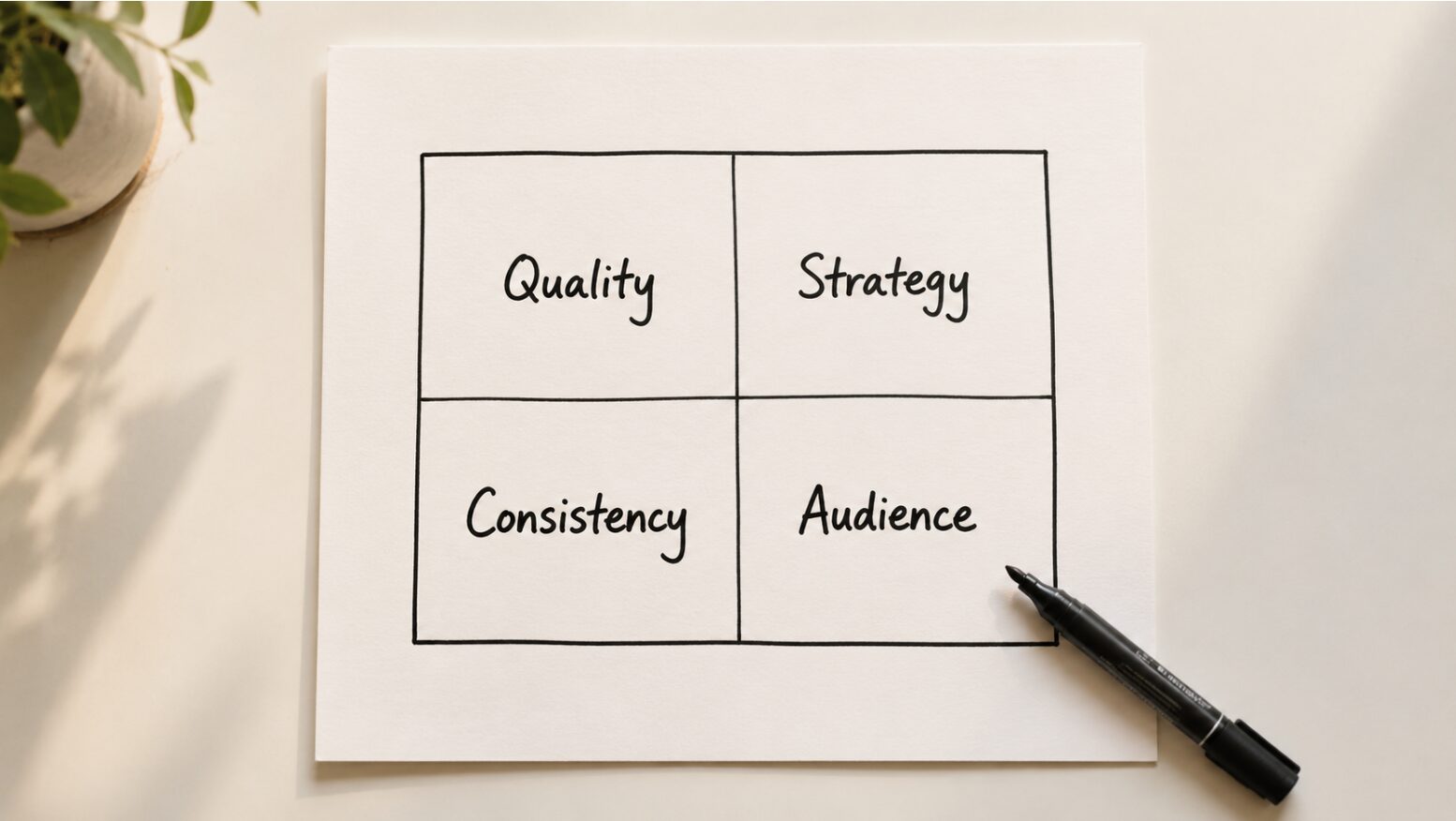
Why strategic content creation outperforms a packed posting schedule every single time.
Your content calendar is full. Every slot is scheduled, every week is covered, your team hasn’t missed a publish date in months. So why does the engagement look like a flatline?
A packed calendar is its own kind of trap. The pressure to post daily, to stay visible, to keep feeding the algorithm — it quietly becomes one of the biggest drains on marketing teams at growing businesses. Strategic content creation means making what you publish worth someone’s time. Volume is just the thing that looks like that, from a distance.
The Numbers Already Figured This Out
Brands across industries posted slightly less content in 2024 than they did in 2023. Average daily engagement went up by nearly 20%. That’s Sprout Social’s 2025 Content Benchmarks Report, drawing on nearly three billion messages from over one million public social profiles.
The report’s conclusion: “Social platforms are reaching peak saturation, and posting for the sake of posting only creates noise.”
There’s a name for what most content calendars are actually optimizing for: the volume trap. It’s a social media posting strategy built around output instead of outcomes, and the data has caught up to it. Every post that exists to fill a slot is a post that cost someone time, budget, and creative energy: and gave the audience nothing to hold onto.
Less content. More engagement. The platforms are telling you something.
The Numbers Already Figured This Out
Brands across industries have started posting slightly less content year over year. Average daily engagement went up by nearly 20%. That’s Sprout Social’s 2025 Content Benchmarks Report, drawing on nearly three billion messages from over one million public social profiles.
The report’s conclusion: “Social platforms are reaching peak saturation, and posting for the sake of posting only creates noise.”
There’s a name for what most content calendars are actually optimizing for: the volume trap. It’s a social media posting strategy built around output instead of outcomes, and the data has caught up to it. Every post that exists to fill a slot is a post that cost someone time, budget, and creative energy: and gave the audience nothing to hold onto.
Less content. More engagement. The platforms are telling you something.
“The volume trap is a social media posting strategy built around output instead of outcomes.”
Your Audience Has Already Made Up Their Mind
Your audience isn’t waiting for your next post. They’re actively filtering it out.
Sprout Social’s Q1 2026 Pulse Survey of more than 2,000 consumers found that passive scrolling has given way to intentional consumption. People are muting, blocking, and tuning out anything that reads like filler. Quality, authenticity, and community all trump volume. That’s not a trend. It’s the new floor.
And yes, we’re a marketing agency telling you to post less. We see the irony. We also see what happens when teams chase output metrics instead of outcomes: the effort goes up, the results go sideways, and good creative energy gets spent on content that nobody remembers by Tuesday. For a mid-sized business with a lean marketing team, that’s not just a missed opportunity. It’s a real cost.
The audience debate — quality of content versus sheer volume — has been settled at the consumer level. What people actually respond to has shifted underneath everyone’s feet. Brands treating social like a broadcast tower are finding out the hard way that nobody asked for that frequency.
Four Squares Beat Forty Products
In 1997, Steve Jobs returned to Apple and found a company drowning in product lines. Dozens of computer versions, each slightly different, none of them clearly the right choice for anyone. The team was busy, but the company was losing.
Jobs drew a two-by-two grid on a whiteboard: Consumer, Pro, Desktop, Portable. Four squares. He told his team to stop making everything else and build those four products brilliantly. It saved Apple.
Before that decision: volume, variety, constant output, and a brand nobody could explain. After: clarity, focus, and one of the most recognizable companies in the world.
Content strategy works the same way. Fewer things, chosen deliberately, executed well. That’s what builds a presence people trust over time. Your organic social media growth has the same choice in front of it.
Before: a calendar packed with posts that exist to fill space, reactive and forgettable, brand messaging consistency an afterthought. After: fewer pieces, each one doing real work, each one earning its place in someone’s feed because it’s specific, relevant, and useful. Showing up matters. Showing up with something worth remembering matters more.
Sustainable content marketing has always been a long game. The businesses that treat it that way are the ones still compounding two years later.
So: what’s actually working in your content right now?
Sit with that before you approve next month’s calendar. If the honest answer is “not much” — you’re not behind. Most growing businesses hit this wall. The content operation that got you here starts to buckle under the weight of getting you there. More channels, more formats, same team, same hours. Something has to give, and it shouldn’t be quality.

