
TL;DR
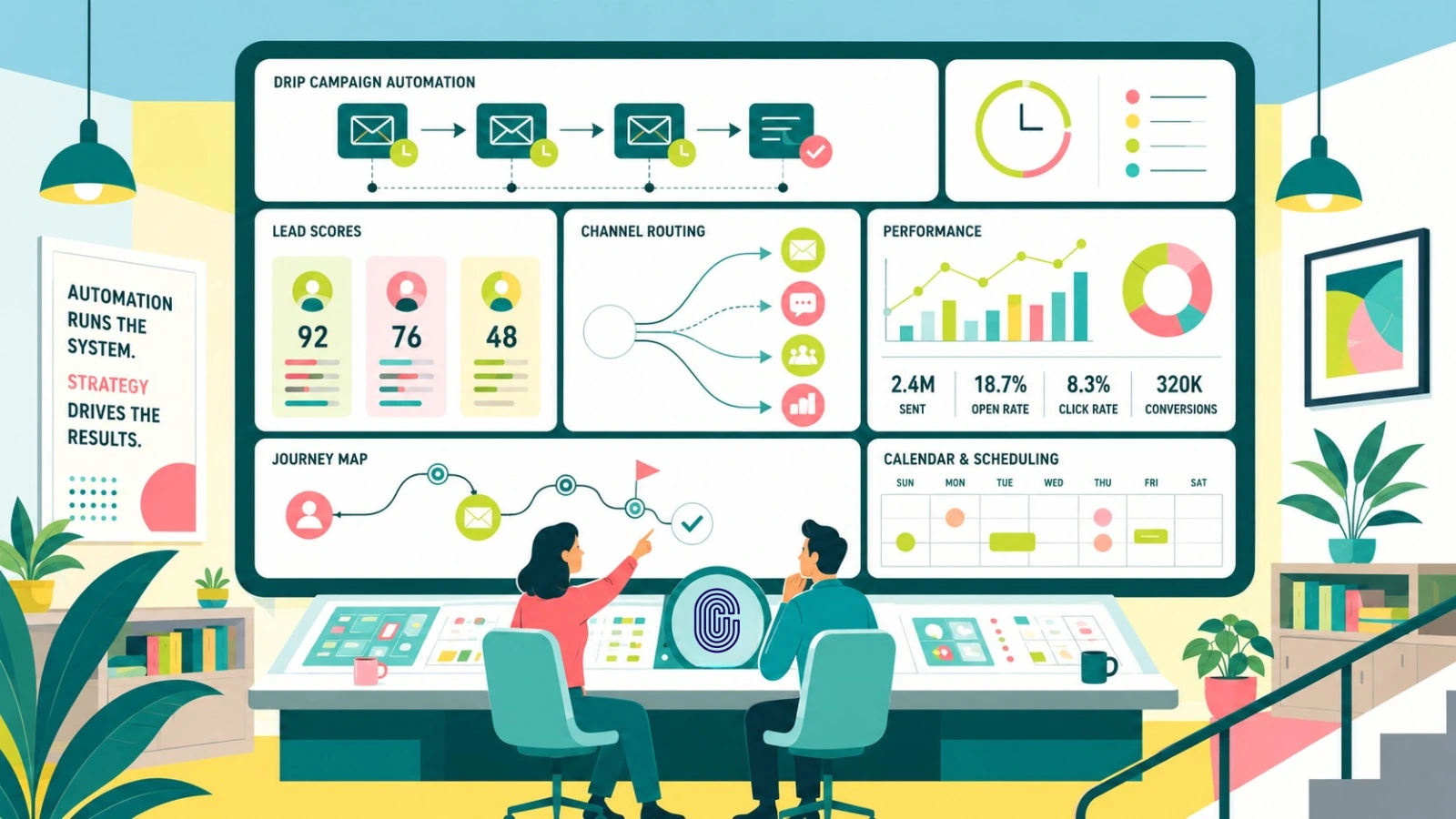
- What is marketing automation? It’s software that handles repetitive marketing tasks like email sequences, lead scoring, reporting, and campaign management — freeing your team to focus on strategy and relationships.
- Modern systems go beyond static rules. AI and first-party data help adapt workflows in real time, adjusting messaging and timing based on actual customer behavior.
- Automation excels at volume, consistency, and timing. Strategic decisions, creative direction, and the relationship-building that closes high-value deals still need humans.
From the tech corridors of Plano and Frisco to the historic storefronts of Deep Ellum, North Texas businesses are scaling at a pace that would have sounded like fiction five years ago. Revenue is up, headcount is climbing, the customer base keeps widening.
And somewhere in that growth, the same thing happens to almost every company. The marketing operation that got you here starts buckling under the weight of getting you there. More leads. More channels. More campaigns. Same team, same hours, same spreadsheets.
If that sounds familiar, you’re in good company. And you keep hearing “marketing automation” pitched as the answer. But what does that actually mean for your operations, and how does it work once the software sales pitch ends?
Let’s strip away the jargon.
What Is Marketing Automation?
Marketing automation is the use of software to handle repetitive marketing tasks that would otherwise eat your team’s week. Email sequences, lead scoring, customer segmentation, campaign scheduling, reporting — these are the jobs that run continuously when handled by a system and grind progress to a halt when done by hand.
Think of it as the operational layer underneath your digital marketing strategy. It doesn’t replace the strategy. It executes the strategy at a speed and consistency that a team doing everything manually cannot match.
Here’s where most explanations stop, and where reality gets more interesting. Marketing automation is not a single piece of marketing software. It’s a category of connected workflows. Your CRM talks to your email platform, which talks to your analytics dashboard, which feeds data back into how the next campaign runs.
When those connections work, you have a system. When they don’t, you have expensive software sitting in separate tabs.
What Does Marketing Automation Actually Do?
The easiest way to understand it is to look at what it handles day to day. Here’s where most systems earn their keep:
Drip campaigns and email sequences
Automated emails triggered by specific actions. A prospect downloads a guide, and the system sends a follow-up three days later, then another a week after that. No one on your team has to remember or hit send.
Lead scoring and customer segmentation.
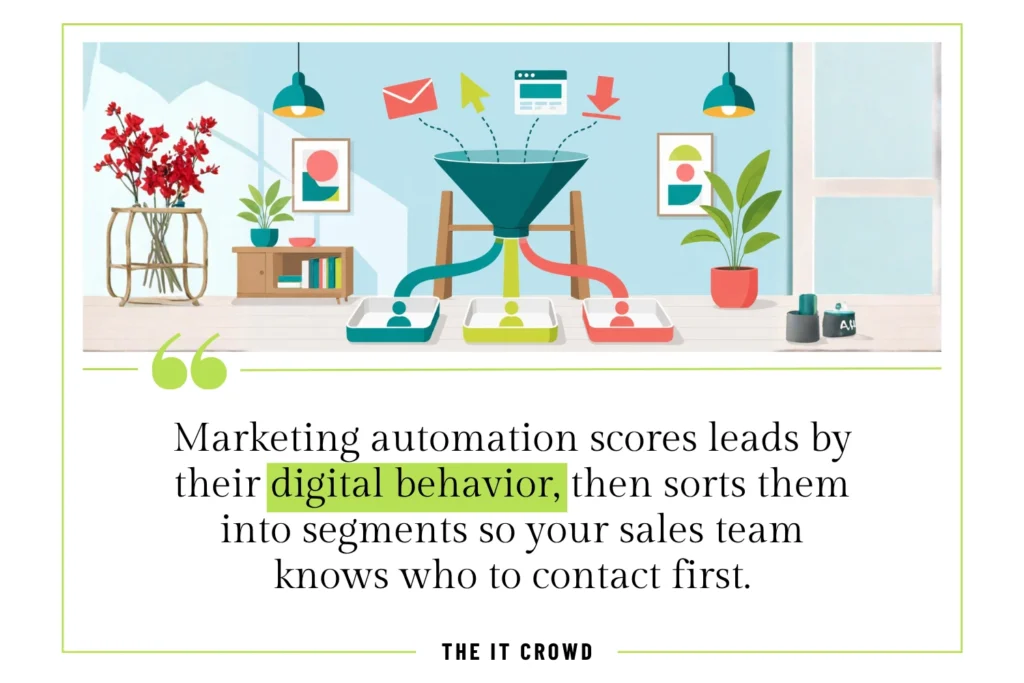
Think of it as the Sorting Hat from Harry Potter, except instead of reading a student’s character to choose between Gryffindor and Slytherin, it reads a prospect’s digital behavior: pages visited, emails opened, content downloaded. Then it sorts them into categories like “ready for a sales conversation” or “needs more nurturing.” Your sales team stops guessing who to call first.
Lead nurturing
Once leads are segmented, they receive content matched to where they sit in the sales funnel. Someone who just discovered your brand gets a different experience than someone who has visited your pricing page three times this week. The sequence adapts as their behavior changes, so the conversation stays relevant without anyone manually adjusting it.
Automated reporting
Dashboards that update themselves. Campaign performance, conversion rates, channel attribution, all assembled overnight instead of by a person at 5 PM on a Friday. Your team walks into Monday morning with clarity instead of a data-pulling assignment.
Campaign management across channels
Modern automation reaches well beyond email. SMS, chat, social, even WhatsApp can run within the same workflow, routing messages to the channel where each customer actually responds. That’s the difference between broadcasting into a crowd and having a conversation with a person.
How Does Marketing Automation Work?
Every automated workflow runs on the same basic architecture: an event happens, the system evaluates it, and a response fires. Here’s what that looks like under the hood.
Triggers, Conditions, and Actions
A trigger is the event that starts the sequence: a new subscriber joins your list, a lead visits a specific page, a customer hasn’t purchased in 90 days.
The condition filters what happens next: is this lead in the right segment? Have they already received this email?
And the action is the response: send a message, update a CRM record, assign a task to a rep, adjust a score.
From Static Rules to Adaptive Systems
Traditional automation was rigid. If a user clicked Link A, the system waited three days and sent Email B, every single time, regardless of what else happened. Modern platforms use AI to adapt on the fly.
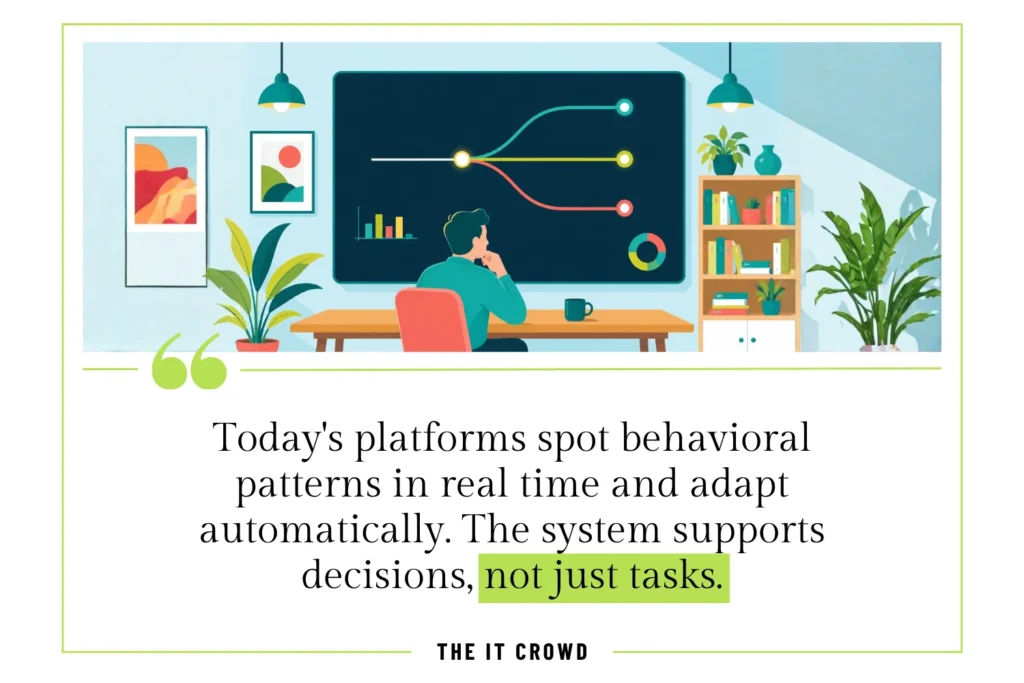
They spot patterns in your customer lifecycle — the drop in email opens, the sudden spike in pricing page visits — and adjust messaging and timing dynamically. Instead of you mapping every possible path in advance, the system learns which paths are working and shifts resources toward them. The system now supports decisions, not just tasks.
This is also where first-party data becomes the whole game. With third-party tracking largely dismantled and data privacy compliance tighter than ever, your automation is only as good as the information your own systems collect.
Behavior signals from your CRM, support interactions, and purchase history are the fuel. The more intentionally you collect and organize that data, the sharper every automated decision becomes. Without clean, consented data, the smartest automation still fires blind.
For businesses thinking about how their digital infrastructure holds up, preparing your website for these shifts is a practical first step.
That’s the machinery. What it produces is a different conversation entirely.
Benefits of Marketing Automation for Growing Businesses
The case for automation tends to start with efficiency, and efficiency is real. But the research paints a more interesting picture.
For every dollar spent on marketing automation, companies see an average return of $5.44 over three years, and 76% of businesses generate a positive ROI within the first year. Those numbers get attention.
What’s more telling is why businesses keep using it. When leaders are asked about the primary benefit of automation, the top answer isn’t cost savings. It’s improving the customer experience, at 43%, followed by better use of internal staff time at 38%. The return that actually sustains adoption is operational, not just financial.
Here’s what that looks like in practice. Marketing automation gives a growing business:
- Consistent brand voice across every touchpoint, even when the team is stretched thin
- Faster lead response, which directly affects close rates and revenue growth
- Clear marketing ROI through automated attribution and reporting
- The ability to scale campaigns without scaling headcount
We recently mapped roughly 40 distinct workflow outcomes for the Lowe Group, a mid-sized client whose marketing needs were growing faster than their team’s capacity to meet them through traditional methods. Each outcome, from campaign briefs to brand voice enforcement, became a permanent, owned asset in their marketing infrastructure. The visible result was speed. The underlying shift was a marketing operation that compounds the longer it runs.
That kind of scalable infrastructure changes what a lean team can accomplish.
Where Automation Ends and Human Judgment Begins
Automation excels at volume, consistency, and timing. It will send the right email to the right segment at 6:15 AM on a Tuesday without complaint. It will score leads, route them, and update your CRM while your team sleeps. For everything that can be reduced to a rule and repeated at scale, it’s the better option.
What it won’t do is build a relationship.
Think about Ted Lasso bringing biscuits to Rebecca’s office every morning. That gesture isn’t a task you can put on a calendar and delegate to software. It’s warmth, it’s trust, it’s a human reading the room and showing up accordingly.
A machine can scale communication, but it cannot scale a biscuits-with-the-boss moment. Your team’s ability to adapt a pitch mid-conversation, show empathy in a difficult meeting, sense when a prospect needs patience instead of a follow-up sequence: that’s where partnerships form and high-value deals close.
As HubSpot co-founder Dharmesh Shah put it: “The paradox is that the better technology becomes, the more it allows us to be human.”
And here’s the part most guides skip: the businesses getting the most from automation are the ones who automated the operational load so their people have more time for work that requires a genuine point of view — strategic oversight, creative direction, the judgment calls that determine how a brand actually sounds, feels, and connects.
Because when generative tools make it cheap to produce content at volume, a distinct human perspective becomes the thing audiences actually respond to. Automation scales the delivery. Humans supply the substance.
The gap between the two is where the real advantage lives.
Frequently Asked Questions
Is marketing automation only for large companies?
No. The platforms powering modern workflow automation are available at price points that work for small and mid-sized businesses. What separates the companies that use it well from those that don’t usually comes down to strategy and systems design, not budget.
What’s the difference between marketing automation and a CRM?
A CRM stores and organizes customer data. Marketing automation acts on that data: sending emails, scoring leads, triggering workflows based on behavior. Most mature operations connect both so they function as a single system.
How long does it take to see results from marketing automation?
Email sequences and lead nurturing can show traction within weeks. Broader campaign management and workflow builds take longer to set up, but each piece added makes the system more capable over time. The returns compound.
Do I need a dedicated team to manage marketing automation?
Not necessarily. Many growing businesses start with one owner who manages the platform and builds workflows incrementally. What matters more than team size is having someone responsible for reviewing outputs, refining the system, and maintaining strategic oversight of what the automation produces.
If you’re weighing whether marketing automation belongs in your operation, or you already know it does and need a clear starting point, we’re happy to think it through with you. No pitch. Just a conversation.

