

TL;DR
- Learning how to make AI content sound human starts with understanding why it defaults to generic in the first place. Without a structured system, it gravitates toward the most statistically average output it can produce. A peer-reviewed study explains the mechanism.
- Before you can teach AI your voice, you need one worth teaching. If your thinking has already converged with everyone else’s, AI just scales the convergence.
- The fix is a system with four layers: voice capture, prompt architecture, a feedback loop, and editorial governance. AI handles volume. Human judgment runs the standards.
“How did your team do this? This sounds exactly like our CEO!” said our client, pausing on his review of the materials we sent them.
He sounded like someone who’d just watched a card trick and wanted to understand the mechanism. We were a few weeks into building their company’s AI content system — early drafts, first calibrations — and they genuinely wanted to know how the CEO’s voice had ended up in the output.
The answer isn’t a better model or a smarter prompt. It’s a system. And most businesses producing AI content right now aren’t running one.
This is for marketing directors, COOs, and founders at mid-sized businesses who keep running into the same problem: the AI output sounds fine. It just doesn’t sound like you.
The Volume Is Easy. The Voice Is the Hard Part.
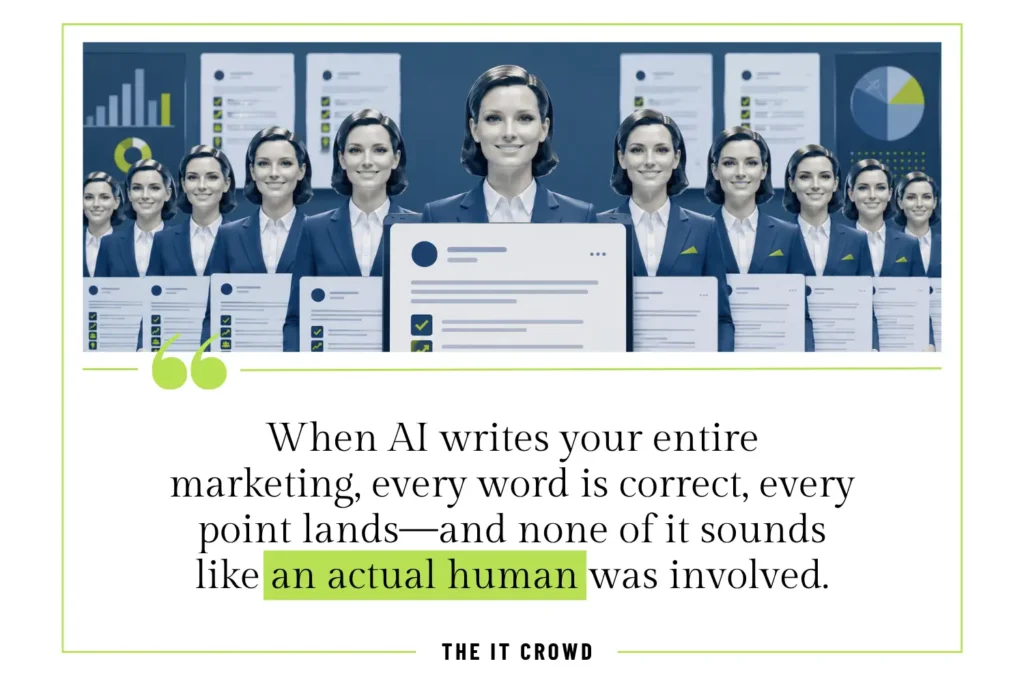
You’ve seen it. A LinkedIn post that’s perfectly structured, uses all the right buzzwords, and leaves you feeling completely cold. Every point lands, yet nothing sticks. Welcome to what we like to call “Stepford Wives Marketing”: unnervingly polite, eager to please, but with a distinct lack of a real human pulse behind the statements.
Now, raw AI content isn’t bad. That’s actually part of the problem. Bad is fixable. Generic is harder to diagnose, because it clears every basic editorial bar — coherent, structured, on-topic — and still somehow sounds like it could have come from any company in your category on any given Tuesday.
The worst part? It’s often indistinguishable from what your competitors are publishing. Same structure, same cadence, same five adjectives rotating on a schedule. Nobody’s lying. Nobody’s trying. Nobody sounds like anyone.
This is a problem most marketing teams keep misdiagnosing. The instinct is to blame the tool. But the actual problem is structural. AI output quality is a systems problem, and the system most teams are running is no system at all.
A better tool won’t fix it. A better setup will.
Why AI Defaults to Generic (And Why That’s Not the AI’s Fault)
Large language models are trained on vast amounts of text, which sounds like it should produce enormous variety. It produces the opposite.
The mechanism that makes AI safe to use — called Reinforcement Learning from Human Feedback (RLHF) — is also, in a twist of magnificent irony, the mechanism that makes it boring.
A 2024 study from Carnegie Mellon’s Tepper School of Business found that safety-aligned models exhibit significantly lower entropy in their token predictions. They gravitate toward what the researchers call “attractor states”: limited clusters of output the model returns to again and again, regardless of what you ask.
The paper’s title: “Creativity Has Left the Chat: The Price of Debiasing Language Models.” The researchers specifically flag marketing copywriting as one of the highest-risk applications for this trade-off.
Call it the Security Paradox. The mechanism used to keep AI polite and safe is the exact reason it defaults to corporate drone. Without a system pulling it out of that safe zone, an AI’s attractor state is the most statistically average thing it can produce.
Without a structured voice framework, your new AI content pipeline is going to look more The Matrix than Mad Men: technically impressive language that feels cold — not the emotionally layered copywriting that actually moves audience.
Before You Can Teach AI Your Voice, You Need One Worth Teaching
Voice capture can only preserve what’s already there. If the source material is derivative, the AI scales the derivativeness. Systematizing average thinking doesn’t improve it. It just makes more of it, faster.
As Ann Handley writes in Everybody Writes: “In a world where everyone has a megaphone, our words are our emissaries.” In 2026, when every business has the same AI tools, the only differentiator left is the distinctiveness of the thinking behind the content. That’s a human job.
So how do you stay original when AI is pulling everyone toward the middle? Four things.
1. Create constantly
Writing is a unique form of thinking. Putting ideas into the world forces you to defend, refine, or abandon them. Even without an audience, a journal or newsletter creates friction that deepens self-knowledge. When people push back (even when they’re wrong) you’re forced to understand what you actually think.
2. Get comfortable going against the grain
Fear of being wrong is a homing signal straight back to the attractor state. Consensus is safer. It’s just not a route to original thinking.
3. Think about your own thinking
Metacognition produces original frameworks. When you interrogate your ideas long enough, you start joining your own dots instead of borrowing someone else’s. You learn to trust your judgment rather than outsource it, and over time, that compounds into a point of view nobody else has.
4. Consume outside your industry
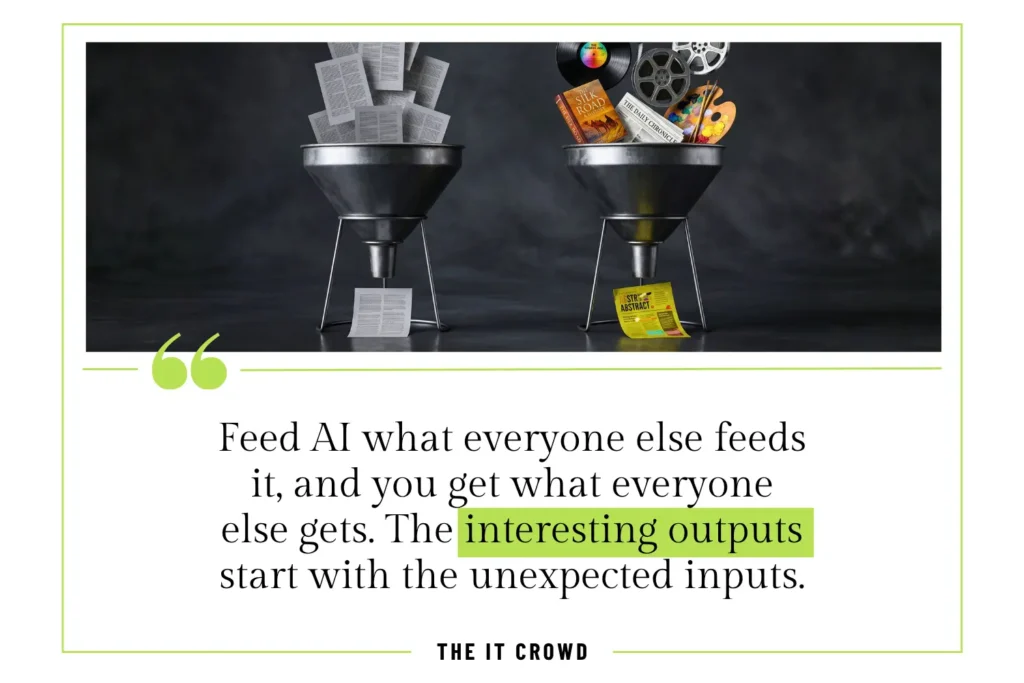
Same inputs, same outputs. AI trains on the most obvious sources in any field, so outsourcing your thinking to it returns the consensus. The way out is to build a content signature from genuinely different inputs. History, music, culture — whatever actually fascinates you. Ideas land differently when they arrive from somewhere unexpected.
What a Voice Capture System Actually Looks Like
A proper system has five components. Most businesses skip at least three, then wonder why the output keeps sounding off.
The voice document
Make sure it’s specific enough to be useful. Not “professional but approachable” — that’s a vibe, not a descriptor. Tone examples. Sentence-level do’s and don’ts. Vocabulary preferences. Approved and prohibited language, written out explicitly.
The rule of thumb: hand it to a freelancer who’s never worked with your brand. If the output sounds right, it’s working. If they’d need a full briefing on top of it, it isn’t done.
Primary source materials
Transcripts, emails, past content that landed well. The less filtered the material, the more accurately the AI reproduces natural voice rather than the polished-for-a-brief version.
Audience personas, integrated
Personas belong in the same knowledge base as the voice document. How a brand talks to a COO evaluating vendors differs from how it talks to a marketing director in a budget conversation. The AI needs both loaded together.
Negative examples
Outputs that missed, with notes on why. Concrete boundaries beat abstract rules. Think of it as showing the AI exactly which attractor states to escape.
Competitor voice sampling
Know how two or three competitors sound — not to imitate them, but to differentiate deliberately. Define what you’re not, and what you are gets clearer.
The Prompt Layer: Where Most Teams Stop Too Early
“Write me a blog post about X in our brand voice.” That’s a starting point. It’s not a system.
A system prompt is the persistent context layer above every individual request: who the AI is writing for, what it knows about the brand, and what it should never do. It is a description of the writer, not the task.
Few-shot prompting takes this further: show the model examples of strong on-brand output before asking it to produce. Three good LinkedIn posts in the prompt will consistently outperform a paragraph describing what good LinkedIn posts look like. The model learns from demonstration. Instruction is a distant second.
Different content types need different prompt templates. A blog post requires different voice calibration than an email sequence. Formalizing those differences removes the inconsistency that comes from rebuilding context from scratch every time.
The question is simple: what does this model need to know to produce something I’d actually publish?
Answer that honestly. Write it down precisely. That’s your system prompt.
Keeping It Human: The Feedback Loop and Governance Layer
Voice capture and prompt architecture get you to a strong first output. Keeping it strong over time is a different job.
The feedback loop
The first batch of AI-assisted content needs a structured review against the voice document — not just a general read, but a deliberate check. Where did the output drift? Which phrases would the brand never use?
The answers go back into the system as refinements: updated negative examples, adjusted prompts, corrected vocabulary. A quarterly audit of ten to fifteen recent pieces catches drift before it becomes the new default.
Editorial governance
Who reviews output before publication? What’s the approval chain? What does the editorial style guide say about disclosure? These decisions need to be made once, written down, and applied consistently.
The FTC and EU AI Act both point the same direction: a documented, human-overseen editorial process is better than no process, across every compliance question you’ll face.
Human-in-the-loop as design principle
AI handles volume, consistency, and the research that would take a human team days to complete. The creative calls, the strategic direction, and the final editorial judgment stay human. That division isn’t a limitation, but a quality mechanism built into the architecture from the start.
What This Looks Like in Practice
This is the framework we apply at The it Crowd across every client engagement. The specifics vary. The structure is the same for all.
Take SPERE Power, an energy tech company needing authoritative content for facility managers across six commercial verticals — each with different priorities, different language, different buying criteria. A church administrator and a golf course manager both care about energy efficiency. They do not respond to the same message.
Voice capture first: primary source materials, formal voice document, audience personas in the knowledge base. Prompt architecture next: vertical-specific templates calibrated per audience. Then a dual-track keyword strategy covering traditional SEO and AI search, including zero-volume terms where AI was already making connections that conventional search hadn’t caught up to yet.
A dozen pieces across six verticals, consistent in voice, differentiated by audience. The client’s assessment, from our AI implementation case study: “They came back with content that understood our market, our buyer, and our positioning. That kind of alignment usually takes much longer to build.”
Voice capture. Prompt architecture. Human editorial judgment.
That’s the system.
The Bottom Line
Ann Handley was right: your words are your emissaries. AI doesn’t change that — it raises the stakes. When every business has access to the same tools, the ones producing distinctive content will be the ones that built the systems to make distinctiveness possible.
The difference between AI content that sounds like AI and AI content that sounds like you is almost always the same thing: what the system was given to work with and whether what it was given was worth preserving in the first place.
That’s a systems problem. Which means it has a systems solution.
If you’d like to talk through what building that looks like for your business, that’s exactly the kind of conversation we’re built for.

