

In 2026, B2B buyers have quietly taken control of the sales process. According to Forbes, 81% of B2B buyers already have a preferred vendor before they ever speak to a sales representative. A separate study found that 69% of buyers won’t engage with a salesperson until they’ve essentially made their purchasing decision. By the time your phone rings, the shortlist is already written.
For mid-sized businesses, this makes marketing debt a genuinely serious problem. Over the years, many have accumulated a pile of campaigns, contractors, and content that were never connected to a coherent plan. When buyers are doing this much independent research before reaching out, showing up inconsistently—or not showing up at all—is a strategy in itself. Just not a good one.
A strong B2B marketing strategy changes that. It puts the right message in front of the right buyer at the right stage of a journey you’re no longer in control of. That’s the gap The it Crowd helps mid-sized businesses close.
Strategy isn’t a luxury. It’s the whole game.
Executive Summary
By the time a B2B buyer contacts a vendor, they’re already further along in their decision than most mid-sized businesses realize. Here’s what this guide covers:
- What a B2B marketing strategy actually is and how it differs from a campaign, a content calendar, or a channel plan
- The core building blocks that every mid-sized business needs before launching anything: audience definition, positioning, messaging, channel mix, and measurement
- What strategy looks like in practice, using a realistic before-and-after scenario to show what shifts when marketing becomes deliberate
- How The it Crowd approaches the work: discovery first, positioning second, phased execution designed to generate compounding marketing returns rather than one-time results
- The most common mistakes that quietly derail mid-sized businesses, and the practical fixes for each
The goal isn’t more marketing activity. It’s a connected system where every decision builds on the last, pipeline generation becomes predictable, and revenue growth stops feeling like a quarterly surprise.
What Is a B2B Marketing Strategy (And What It Isn’t)
A B2B marketing strategy is the overarching plan that connects your business goals to the specific audiences, messages, and channels most likely to reach them. It answers the questions that a campaign never has to: who are we talking to, what do we stand for, how do we reach buyers at every stage of their journey, and how do we know if any of it is working.
That last part matters more than most people realize. According to Gartner, when a B2B buyer is evaluating a purchase, they spend only 17% of their total journey meeting with potential suppliers. If they are comparing three vendors at once, your sales team gets somewhere between 5% and 6% of their attention.
The rest of that journey happens without you in the room, which means your marketing goals have to do the heavy lifting long before anyone picks up the phone.

Some people argue that in a world this fragmented, formal strategy is a luxury—that staying agile and responding to what works is enough. There is something to that. Rigid five-year plans don’t survive contact with a shifting market. But agility without direction is just a faster way to wander. A strong B2B marketing framework doesn’t lock you in; it gives you a foundation sturdy enough to adapt from.
To make this concrete: imagine a mid-sized HR software company. They have an active LinkedIn presence, a monthly newsletter, and a paid search campaign. Each channel is doing something. But none of them are connected to a positioning statement, a defined audience profile, or a shared set of metrics.
That’s a channel plan, not a sales and marketing strategy. The difference shows up in the pipeline.
A campaign asks: what are we launching? A strategy asks: why does this matter, to whom, and what happens next? If you’ve ever watched a well-executed campaign lose momentum after the first three months, you already know what a strategy gap feels like in practice.
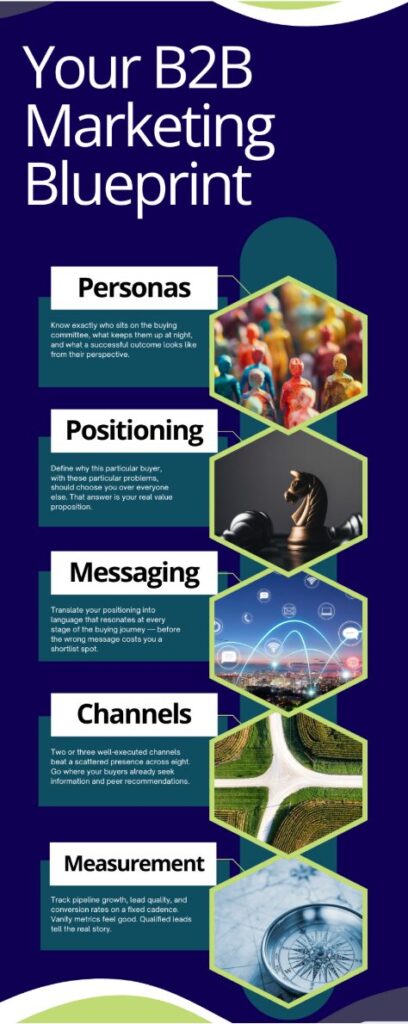
The Building Blocks of a Strong B2B Marketing Strategy
A B2B marketing strategy is only as strong as what it’s built on. These are the building blocks that actually matter.
Audience Definition and Buyer Personas
Strong strategy starts with clearly defined buyer personas: composite profiles of your ideal customers built from real data, real interviews, and honest thinking about customer pain points.
Most buying decisions in B2B aren’t made by one person. They’re made by a buying committee, and each member brings different priorities to the table. A complete persona profile should capture:
- Who they are and what their role involves
- What business problems keep them up at night
- How and where they seek out information
- What objections they raise before signing off
- What a successful outcome looks like from their perspective
Positioning and Brand Differentiation
You cannot simply walk into a boardroom and shout “We are the premium strategic choice!” and expect the market to believe you. That’s the Michael Scott approach to positioning. Real brand differentiation is built through the hard, often unglamorous work of proving why you’re different to a room full of skeptical COOs.
Your value proposition isn’t a tagline. It’s the answer to a very specific question: why should this particular buyer, with these particular problems, choose you over everyone else?
B2B Messaging Strategy
Once you know who you’re talking to and why you’re different, you need to say it in a way that actually lands. A strong B2B messaging strategy translates your positioning into language that resonates with decision-makers at every stage of the buying journey.
This is where many mid-sized businesses quietly lose ground—not because their product is weaker, but because their message never connects with the right person at the right moment.
Channel Mix
Channel selection should follow audience behavior, not trends. The question isn’t which channels are popular right now, but where your buyers are already spending time and seeking information.
A focused mix of two or three well-executed channels will consistently outperform a scattered presence across eight. When evaluating your channel mix, consider:
- Where your buyers actively seek information and peer recommendations
- Where your competitors are visibly and consistently showing up
- Which channels support multiple stages of the buying journey
- Which channels your team can execute well without burning out
- Which channels have historically driven the most qualified leads
Measurement
A strategy without measurement is just a hypothesis with a budget. The goal isn’t to track everything—it’s to track the right things consistently enough to learn from them.
Pick a small set of indicators tied to real business outcomes: pipeline growth, lead quality, conversion rates, and content performance over time. Review them on a fixed cadence. The temptation to celebrate vanity metrics is real and deeply human. Likes and impressions feel good. However, it’s pipeline growth and qualified leads that tell the real story.
What gets measured gets managed. What gets ignored gets repeated.
What Does a B2B Marketing Strategy Actually Look Like in Practice?
Knowing your building blocks is one thing. Watching them work together inside a real business—under real pressure, with real budget constraints—is something else entirely.
Before: Effort Without Structure
Take a mid-sized logistics software company.
Their marketing funnel was a loose collection of blog posts, a trade show presence, and a LinkedIn page updated sporadically. Leads trickled in, but nobody could explain why, or how to get more of them.
Their B2B content marketing strategy (to the extent one existed) was really just a content calendar with good intentions. Blog posts were written around internal preferences rather than search intent. Sales and marketing operated on separate assumptions. Messaging changed depending on who wrote it that week.

After: A System With a Purpose
After building a deliberate strategy, each piece of content was mapped to a specific stage of the customer journey and written to match actual search intent.
Nurture sequences moved prospects through the marketing funnel with timely, relevant follow-ups rather than generic drip emails. Content distribution expanded into the forums, newsletters, and peer communities where their buyers actually spent time.
A clear measurement framework finally connected content activity to pipeline outcomes. The before-and-after, in practical terms:
- Blog posts mapped to search intent rather than internal preferences
- Nurture sequences tailored to each stage of the buying journey
- Content distribution across owned and earned channels
- A shared measurement framework connecting content to pipeline
- Sales and marketing aligned around the same customer journey
- Consistent messaging tied to a defined positioning statement
The Pattern Behind the Example
Scaling from $20M to $200M is the marketing equivalent of Dallas’s High Five Interchange: a structure that looks overwhelming from the ground but was engineered deliberately, layer by layer, to move traffic in multiple directions without everything colliding.
As linguist and entrepreneur Vitaly Tur observed in Startups Magazine, “teams that control platforms are less exposed to outside shifts in rented space” and tend to build more resilient audience relationships over time.
The logistics company proved it. Organic traffic compounded. Sales cycles shortened. The pipeline became something they could forecast rather than just hope for.
Busy marketing optimizes for output. Strategic marketing optimizes for outcomes.
How The it Crowd Builds B2B Marketing Strategies That Actually Stick
The it Crowd’s approach to B2B marketing strategy isn’t a template. It’s a process built around how mid-sized businesses actually grow.
Strategy Before Everything
As category design pioneer Christopher Lochhead puts it: “Marketing that does not drive revenue is not marketing.” That’s the operating principle behind everything The it Crowd does.
Before a single tactic gets discussed, the work starts with discovery: understanding the client’s market, their buyers, their competitive position, and the gap between where they are and where they want to go.
This matters more than most agencies will admit. According to CMI’s 2026 B2B Content and Marketing Trends report, the biggest driver of improved marketing effectiveness isn’t budget or technology. It’s strategy refinement, cited by 74% of marketers who saw their results improve.
The it Crowd’s process is built around exactly that kind of deliberate refinement, applied from day one and revisited at every stage of the engagement.
What the Process Actually Looks Like
A typical engagement moves through four phases:
- Discovery and competitive mapping: understanding the market landscape and identifying where real opportunity sits
- Positioning and messaging: building the strategic foundation that every channel, campaign, and conversation will stand on
- Phased execution: launching in deliberate stages, with clear milestones and measurable outcomes at each gate
- Review and compounding: treating every result as an input for the next decision, not just a number in a report
The it Crowd calls this building an everlasting thumbprint, marketing that keeps generating leads, trust, and authority long after any single campaign ends. It’s the opposite of a launch-and-disappear model.
Built to Last, Not Just to Launch
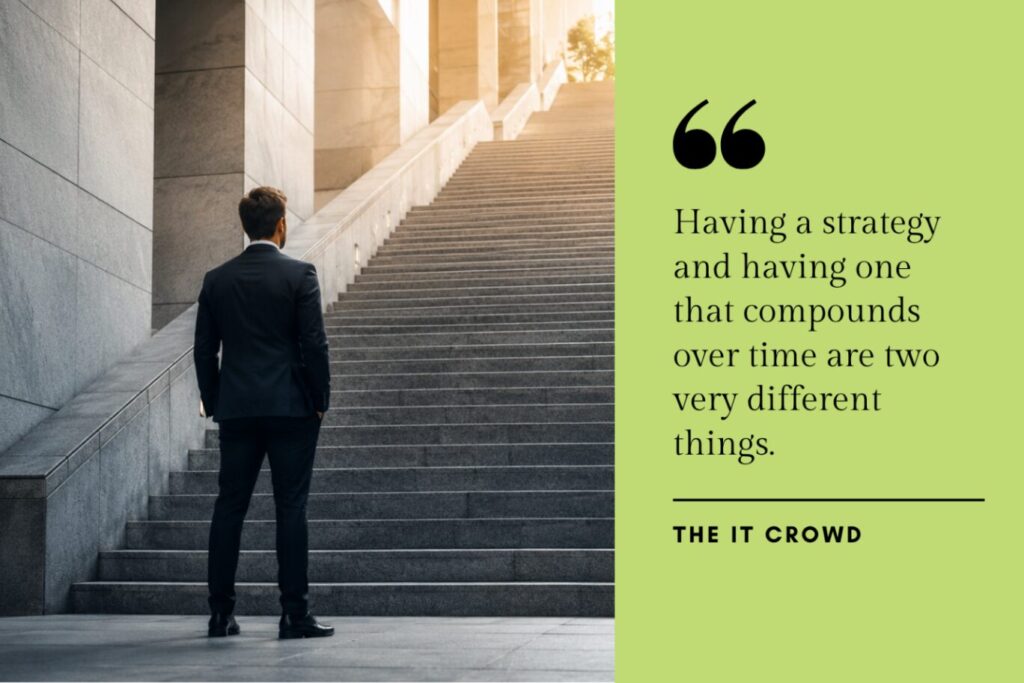
The same CMI research found that 97% of B2B marketers say they have a content strategy, but only 13% describe it as significantly improved in the past year. Having a strategy and having one that compounds over time are two very different things.
The it Crowd exists for the gap between those two. If you’re wondering what choosing the right strategic marketing partner actually looks like in practice, that’s exactly the question worth starting with.
Common B2B Marketing Strategy Mistakes (And How to Avoid Them)
Every mid-sized business makes marketing mistakes. The ones that compound quietly into real damage tend to follow the same patterns.
Skipping the Positioning Work
Most businesses would rather launch a campaign than sit in a room debating what makes them different. Positioning feels abstract. Campaigns feel like progress.
The problem is that everything downstream of positioning—messaging, channel selection, creative direction—gets built on whatever foundation exists. Skip the work, and you’re not saving time. You’re just building faster on sand.
The fix is straightforward, if unglamorous: before the next campaign brief gets written, spend real time on the question your buyers are silently asking. Why you, specifically, over everyone else?
The Shiny Object Trap
We call this the “Jerry’s World” Syndrome—and Dallas Cowboys fans know this one intimately. You have the billion-dollar stadium, the giant screen, the premium seating… and a 1990s offense that still can’t win in the playoffs. That’s the Cowboys approach to marketing: over-investing in a flashy, high-cost channel (a $100,000 brand video, an over-engineered AI chatbot, a sponsorship deal nobody can measure) while the foundational playbook is fundamentally broken.
Shiny objects feel like momentum. They rarely are. Smart resource planning means funding the strategy first and the spectacle second.
Ignoring Internal Alignment
Marketing doesn’t fail in isolation. It fails when sales and marketing are running on different assumptions about who the ideal customer is, what a qualified lead looks like, and what happens after someone fills out a contact form.
Poor internal alignment is one of the most expensive problems in B2B marketing operations, and one of the least discussed. The fix starts with a shared definition of success and a regular cadence where both teams are looking at the same marketing metrics.
Measuring the Wrong Things
Vanity metrics are comfortable. They’re always going up. The problem is that KPIs like impressions and follower counts don’t tell you whether your marketing is generating revenue—which is, presumably, the point.
Tracking B2B marketing ROI requires connecting marketing activity to pipeline outcomes. That means establishing content governance and attribution frameworks before the campaign launches, not after someone asks why the leads aren’t converting.
Not every piece of content needs to go viral. Every piece of content does need a job.
Positioning Every Executive as a Thought Leader
More content is not a strategy. It’s a production schedule.
Many mid-sized businesses respond to a flat pipeline by publishing more: more blog posts, more LinkedIn updates, more executive profiles positioned as industry voices. The logic feels sound. More content means more visibility, which means more leads. In practice, it usually means more noise.
Real thought leadership is selective, specific, and backed by a genuine point of view. As one Forbes contributor argued recently, positioning every executive as a thought leader doesn’t multiply credibility—it dilutes it. The same applies to content at large. Without content governance and a clear brief for what each piece is supposed to do, volume becomes the enemy of authority.
Publish less. Say something worth reading. Let the work compound.
Most B2B businesses don’t have a marketing problem. They have a strategy problem.
When the foundation is right, pipeline generation stops feeling like a scramble and starts feeling like a system. Every channel pulls in the same direction. Every decision compounds into the next one.
A marketing checklist won’t get you there. A deliberate, well-built strategy will—and in a market full of competitors still guessing, that’s a real competitive advantage.
When you’re ready to build something that lasts, we’d love to talk.

