

Picture this. A mid-sized company launches a marketing campaign in January. The creative is sharp, the targeting is dialed in, the metrics are climbing. The leadership team is thrilled. The agency is sending celebratory emails. By March, the silence is deafening.
Sound familiar?
Most marketing campaigns are acts, not habits. Aristotle said it best: “We are what we repeatedly do. Excellence, then, is not an act, but a habit.” At The it Crowd, we build habits. We call it the everlasting thumbprint: marketing that keeps generating leads, trust, and momentum long after any single campaign ends.
So why do so many strategies never get there? That is exactly what this article is here to unpack.
TL;DR — What You’re About to Learn
Understanding why marketing campaigns lose momentum is the first step toward building something that lasts. Here’s what this article covers:
- Most campaigns are built to launch, not to last—the Month Three Drop is a design flaw, not bad luck
- Activity and impact are not the same thing, and measuring the wrong one is expensive
- Sustainable business growth comes from compounding systems, not one-time campaigns
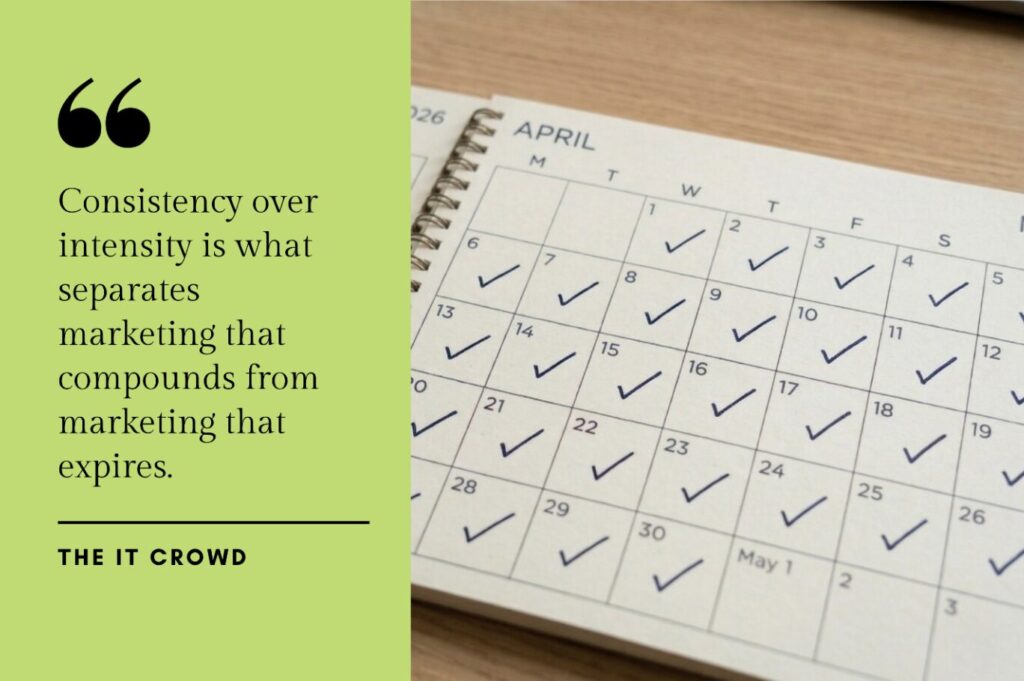
- Consistency over intensity is what separates marketing that compounds from marketing that expires
- The fix is not a bigger budget or a flashier creative. It’s a better system.
Why Do Marketing Campaigns Lose Momentum? The Month Three Drop, Explained
Marketing campaigns lose momentum because they are built around a debut, not a lifecycle. Most strategies are designed to start strong, not to last long. Once the initial push ends, there is no engine left to sustain growth.
This pattern is so common it deserves a name. We call it the Month Three Drop: the predictable point at which campaign energy runs out and silence moves in. Poor campaign planning is usually the culprit. Most strategies favor sprint models over compounding systems: no marketing maturity curve is ever climbed, and no lasting foundation is built.
According to 2026 data, a staggering 84% of companies are currently trapped in a “Brand Doom Loop,” cycling through campaigns that generate short bursts of attention but never build lasting growth. That is a lot of very expensive confetti.
The fix starts with a mindset shift from reactive execution to strategic planning. Here is the rule of thumb: if your marketing stops working the moment your budget pauses, it was never really working.
Campaigns expire. Marketing systems compound.
Activity vs. Impact—The Confusion That’s Costing You
Most marketing teams are not underworking. They are undermeasuring. The campaign versus marketing system confusion shows up most painfully in the metrics businesses choose to celebrate.
Vanity metrics are the reality TV stars of marketing: entertaining, highly visible, and ultimately not doing much. Likes, impressions, and open rates feel good. Leads, pipeline growth, and long-term content performance tell the real story.
Watch out for these common signs you’re optimizing for the wrong finish line:
- Prioritizing awareness without a clear connection to lead generation
- Celebrating campaign kickoffs instead of sustained outcomes
- Reporting activity (posts published, emails sent) instead of impact (revenue influenced)
If you’ve ever wondered how to measure the results that actually move your business forward, that question is worth sitting with before your next campaign kicks off.
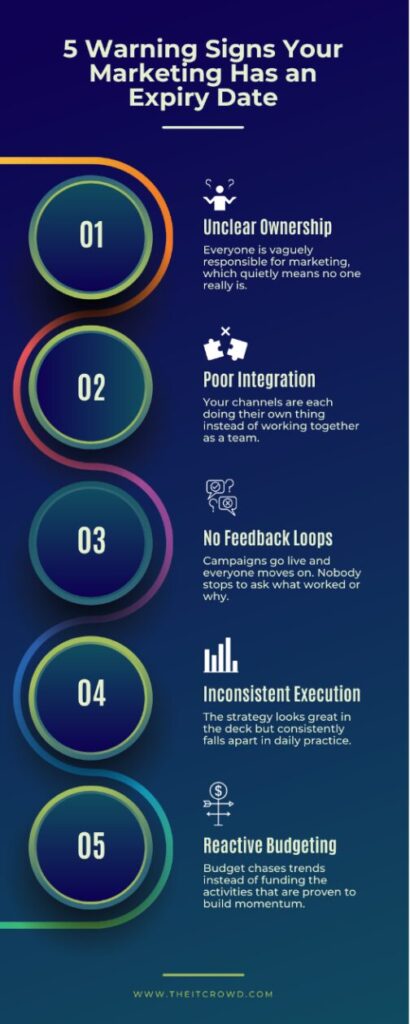
Is Your Marketing Built to Expire? 5 Warning Signs to Watch For
Think of your marketing strategy as a houseplant. If nobody owns it, nobody waters it. And a plant with no water has an expiry date, no matter how pretty the pot.
So, be honest. Does your current strategy show any of these signs?
- No clear marketing ownership and accountability.
Everyone is vaguely responsible for marketing, which means nobody really is. Campaigns drift, deadlines slide, and results get blamed on the algorithm.
- Poor channel integration.
Your social media, email, SEO, and paid ads are all doing their own thing. Picture a band where nobody is playing the same song.
- Weak marketing feedback loops.
You go live. You move on. Nobody circles back to ask what actually worked and why. Data is collected but never actioned.
- Inconsistent execution discipline.
The strategy looks great in the deck. In practice, posting is sporadic, follow-ups are forgotten, and campaigns go out two weeks late.
- Fuzzy resource allocation in marketing.
Budget gets spent reactively, chasing trends instead of funding the activities that actually build momentum.
If two or more of these sound familiar, your marketing has an expiry date printed on the label.
What The it Crowd Calls “Compounding Marketing” (And Why It’s Different)
So what does marketing look like when it doesn’t expire?
We call it compounding marketing, the practice of building assets that grow in value over time, turning every dollar and every decision into a foundation for the next one.
Most marketing chases demand capture: finding people already ready to buy and converting them fast. Compounding marketing focuses on demand generation: building the awareness, trust, and relationships that create future buyers before they even know they need you.
Imagine you stopped all marketing activity today. Cold stop. No posts, no emails, no ads. What would still be working for you in six months? That answer tells you everything about whether your marketing compounds or expires.
Architecture Demarest, one of our longest-running clients, found out firsthand. Four years of integrated, consistent marketing built compounding growth that no single campaign could have delivered: stronger brand authority and a lead pipeline that became more visible and predictable every quarter.
You don’t want a strategy that’s just a catchy jingle. You want the Eras Tour of marketing: every era building on the last, and an audience that keeps showing up.
How to Build a Marketing Strategy That Compounds Over Time
You’ve diagnosed the problem. You’ve seen what expiring marketing looks like up close. Now comes the part your Monday morning meeting actually needs: what to do about it.
Start With Clear Positioning
Before scaling marketing efforts, you need to know exactly what you stand for, who you’re talking to, and why they should choose you. A strategy built on a blurry foundation compounds the wrong things.
Build Systems, Not Just Campaigns
Map out the channels, content, and touchpoints that will keep working between campaigns. Think quarterly rhythms, not one-time events. Consistency is the engine.

Establish Attribution Clarity Early
Know how you will measure success before the strategy goes live. Which signals tell you the marketing is compounding? Pipeline growth, organic traffic trends, returning visitors, lead quality over time. Decide upfront.
Assign Real Ownership
Every workstream needs a named human being accountable for it. Shared responsibility is marketing’s politest way of saying nobody is responsible.
Review, Learn, Adjust
Compounding strategies are not set-and-forget. They require regular reviews that turn data into decisions and decisions into momentum.
The it Crowd Take: Honest Truths Your Agency Probably Won’t Tell You
Campaigns fade for reasons that are rarely discussed honestly. Here are the things most agencies won’t bring up in a kickoff meeting:
- Most agencies are incentivized to sell the next campaign, not optimize the last one.
- Launch energy is intoxicating. Sustained execution is unglamorous. Guess which one gets the case study.
- Poor sales and marketing alignment means leads get generated and then promptly ignored.
- Marketing ownership and accountability gets murky fast when results disappoint.
- Client expectations often prioritize the thrill of launch over the discipline of follow-through.
Nobody built a compounding marketing system by accident. And nobody fixed a fading one by pretending the launch went fine. The first step is simply being willing to ask harder questions.
Back to Month Three (Now You Know What Was Really Happening)
That silence in March wasn’t failure. It was the sound of a strategy that was designed to launch, not to last.
Most people assume a fading campaign is a creative problem. It almost never is. It’s a systems problem. A company running a flawless social media campaign with no content foundation, no attribution clarity, and no ownership structure isn’t doing marketing. It’s throwing a party with no address.
In 2026, the most dangerous marketing decision you can make is to keep optimizing for launch day.
The question worth sitting with: what would your marketing look like if you built it to still be working in January 2027? Let’s figure that out together.
Your Burning Questions About Marketing Momentum, Answered
Why do marketing campaigns lose momentum after a few months?
Most campaigns are built around a launch event rather than a sustained system. Once the launch energy fades, there is no engine left running. Momentum requires consistent execution, not just a strong start.
What is the difference between a campaign and a marketing system?
A campaign is a sprint with a finish line. A marketing system is infrastructure that keeps generating leads, trust, and visibility long after any single campaign ends. The campaign vs. marketing system distinction is the difference between a firework and a lighthouse.
What does compounding growth in marketing actually look like?
It looks like SEO content from eighteen months ago still driving traffic today. It looks like lead pipeline visibility improving quarter over quarter because your brand has been consistently showing up.
Why does my marketing feel busy but not productive?
Activity and impact are not the same thing. Busy marketing optimizes for output. Compounding marketing optimizes for outcomes.
Does it really matter if my agency is in Dallas, or can I just hire a big-box firm in NYC?
Think Cheers, not Mad Men. A local agency that knows your market, answers your calls, and treats your business like a priority will outperform a prestigious firm that slots you between Fortune 500 accounts. Proximity and partnership matter more than an impressive zip code.

