
In August, Priya asked her marketing team a straightforward question: is this working? Her $60M logistics firm outside Fort Worth had spent the year investing in content, running paid campaigns, building out the website. The reports said yes. Traffic was up. Rankings had improved on a dozen target keywords. She had every reason to feel good about where things stood.
Then a prospect mentioned, almost in passing, that they’d asked ChatGPT for logistics providers in the DFW area before ever picking up the phone. Priya’s company didn’t come up. A competitor, ranked well below her on Google, did.
That gap between those two questions shows up every buying cycle, for every business with a website and a search strategy that hasn’t caught up to how people actually search now. GEO and SEO answer two different versions of “can people find us,” and mistaking one for the other is how a strong Google position quietly becomes an invisible business.
What This Article Covers
- What actually separates GEO from traditional SEO, and why one depends on the other
- Why “ranking” no longer means what it used to
- Why this is already costing you, not just a future risk
- Seven things worth auditing on your site right now
GEO Isn’t SEO’s Sequel
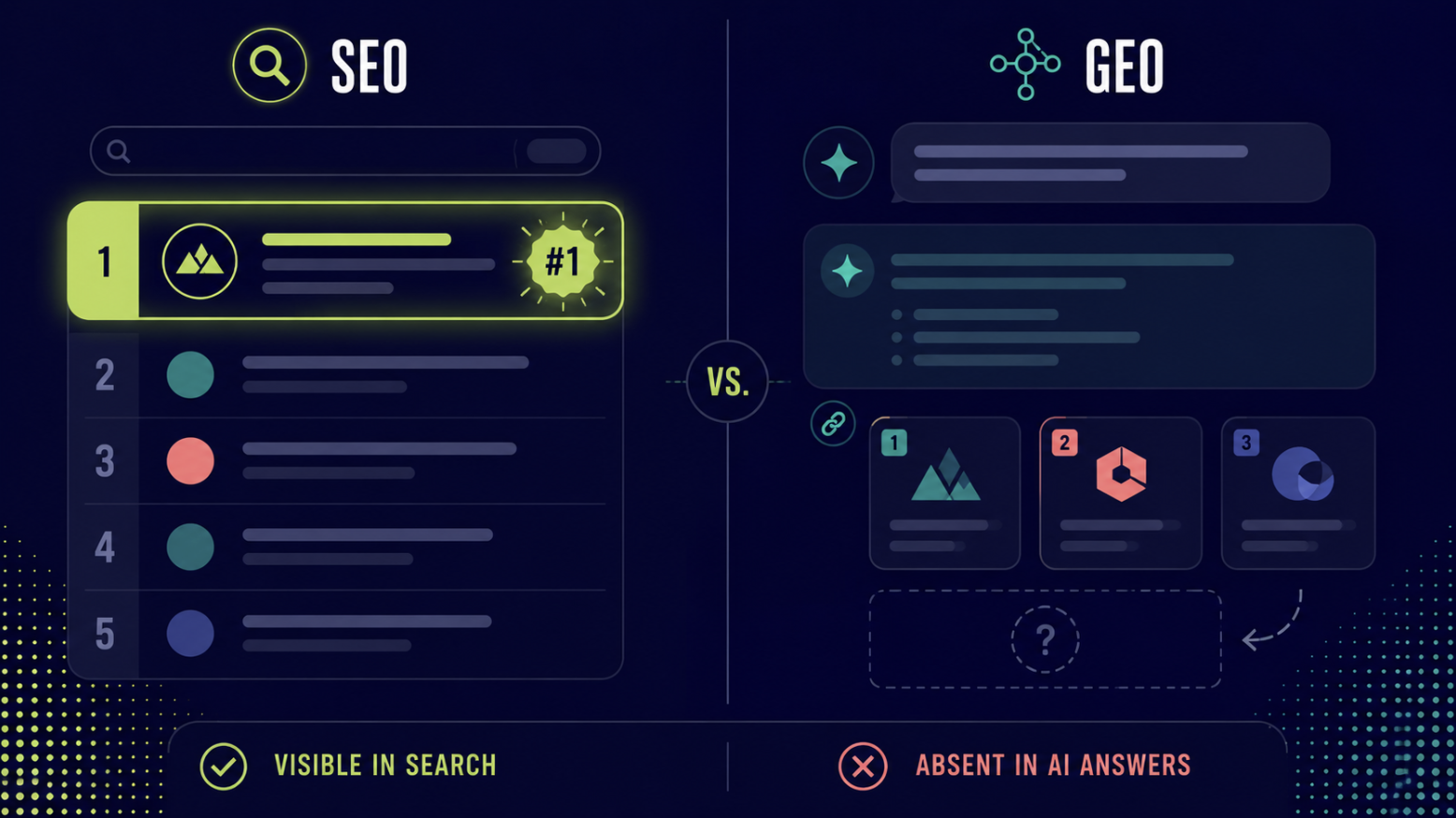
GEO gets talked about like a replacement for SEO. It isn’t one. SEO is the foundation GEO gets built on top of: without crawlable pages, clean structure, and content Google can actually parse, there’s nothing for an AI system to cite in the first place. GEO is a second, separate discipline layered over that foundation, aimed at a different outcome: whether you get mentioned at all when someone asks an AI system a question you could have answered, independent of where you rank.
That distinction matters because the two can now diverge sharply. A page can hold the #1 organic position on Google and still never appear in the AI Overview sitting above it, and never get surfaced when the same question gets asked in ChatGPT or Perplexity. That’s not a hypothetical edge case. Citation overlap between AI Overview results and the traditional organic top 10 has weakened from roughly 76% in mid-2025 to somewhere between 17% and 54% in early 2026, depending on the query category. In plain terms: ranking well used to almost guarantee AI visibility. Now it’s closer to a coin flip.
The businesses feeling this first are the ones that treated SEO as finished work. It never was. It’s the floor GEO stands on, and the floor doesn’t build itself.
What “Ranking” Doesn’t Mean Anymore
Position #1 used to be the finish line. It measured whether you’d get the click. That measurement is breaking down.
Start with the plainest number: 64.82% of Google searches now end without a single click to any website, up from roughly 50% in 2019, according to 2026 research. Nearly two out of three searches resolve before anyone leaves the results page at all.
A large share of that shift traces to AI Overviews, the AI-generated summaries now sitting above traditional organic results. Recent data shows these Overviews now appear on 48% of all queries, a sharp increase since late 2025. For informational and how-to searches specifically, that number climbs past 70%.
For anyone still optimizing purely for position, this is the number that changes the calculation: overlap between the organic top 10 and what actually gets referenced in an AI Overview has dropped from around 76% in mid-2025 to somewhere between 17% and 54% in early 2026. Ranking well no longer means getting cited. You can hold the top spot and still be left out of the answer.
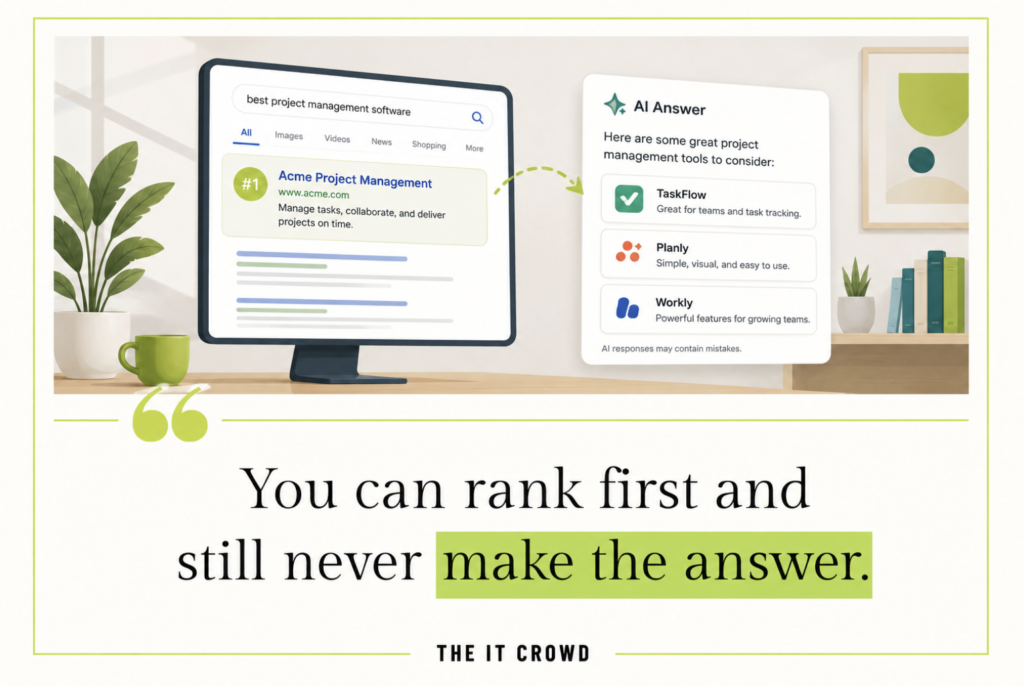
The metric that matters now is mention frequency: how often your business gets referenced across the range of questions an AI system might get asked, regardless of whether any single answer ranks you first.
Why This Is Already Costing You
Derek runs a commercial roofing company in Plano. Good reputation, strong reviews, three decades in business. Last spring, a property manager overseeing a dozen buildings needed a new roofing partner and asked Perplexity to compare local contractors. Derek’s company didn’t appear. Two competitors did, both smaller outfits with weaker portfolios but tighter GEO fundamentals: schema markup, named authorship, FAQ content structured the way AI systems parse it.
Derek found out about this exchange secondhand, months later, from a colleague who happened to know the property manager. He’d lost the account without ever knowing he was in the running.
That’s the part that makes this different from a slow news week or a bad quarter. Derek wasn’t outbid. He wasn’t outworked. He was simply absent from a conversation that happened without him, at a moment when being present was the entire game. As Derek put it once the story got back to him: “I didn’t lose the bid. I never got invited to make one.”
This isn’t a seasonal risk that spikes during one research window and eases off after. Buyers are asking these questions every week, on every platform, whenever the need arises. Every week your site isn’t structured for that conversation is a week you’re quietly out of rooms you never knew existed.
The fix starts with knowing exactly where those gaps are.
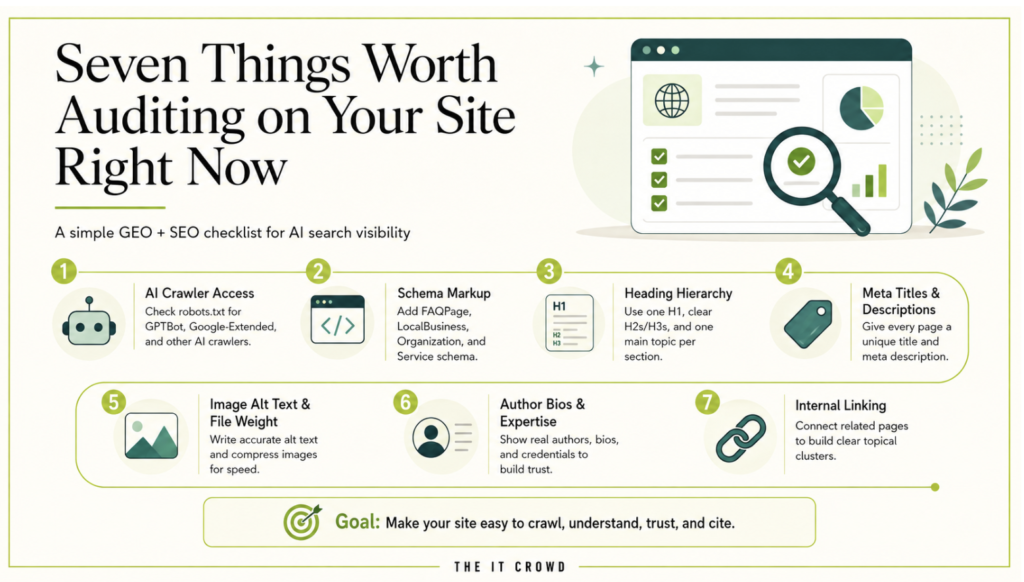
Seven Things Worth Auditing on Your Site Right Now
Most of this doesn’t require new tools or a redesign. It requires knowing where you currently stand. Here’s where to look first.
- AI Crawler Access. Check your robots.txt file for blocks on GPTBot, Google-Extended, or other AI crawlers. This takes five minutes and gets skipped constantly. Example: a site can have perfect content and still be invisible to ChatGPT simply because a plugin quietly added a disallow rule for GPTBot during a security update nobody reviewed afterward.
- Schema Markup. FAQ Page, Local Business, Organization, Service: these structured data types tell AI systems what your business actually is, not just what your page says. Example: two competing service pages can have nearly identical copy, but the one with FAQ schema wrapped around its questions is far more likely to get pulled into an AI Overview, because the structure hands the answer over pre-formatted.
- Heading Hierarchy and Page Structure. One H1 per page, logical H2s and H3s underneath, one clear topic per section. Example: a page with five H2s that all restate “Our Services” in slightly different words gives an AI system nothing to differentiate. A page with H2s like “What It Costs,” “How Long It Takes,” and “What’s Included” gives it exact slots to pull answers from.
- Meta Titles and Descriptions. Every page needs its own, written for a human deciding whether to click. Example: a page with a missing meta description isn’t blank in search results. Google writes one automatically, usually a stitched-together sentence from the page’s own body copy, and it rarely says what would actually earn the click.
- Image Alt Text and File Weight. Alt text describes the image accurately, not just for accessibility but because it’s another data point AI systems read. File size matters separately: oversized images slow load times, and slow pages get deprioritized regardless of how good the content is. Example: a single unoptimized hero image sitting at 900KB can single-handedly drag a page’s mobile performance score into the “Needs Improvement” range.
- Named Authorship and E-E-A-T Signals. A byline reading “Admin” or “The Team” signals nothing. A named author with a bio and credentials signals expertise, which both Google and AI systems weight when deciding what to trust. Example: two blog posts covering the same topic, one with a named, credentialed author and one without, don’t compete on equal footing. The credentialed one gets treated as evidence. The other gets treated as noise.
- Internal Linking Into Topical Clusters. Random cross-links between unrelated pages do little. Deliberate linking between pages that build toward the same topic tells search engines and AI systems that a subject is one you actually cover in depth. Example: a blog post on roof maintenance that links only to the homepage is a dead end. The same post linking to a roofing FAQ page and a related case study builds a cluster an AI system can recognize as a genuine area of expertise.
What This Comes Down To
SEO and GEO aren’t competing strategies. GEO is built on top of SEO, and neither works without the other. A page can hold the #1 spot on Google and still never get cited in an AI Overview or referenced in a ChatGPT answer, because ranking and getting mentioned have become two different outcomes.
The cost of that gap isn’t seasonal. Buyers are asking AI systems to compare their options every week, and a business that isn’t structured for those answers loses opportunities it never knew existed, the way Derek did.
The fix is an audit: AI crawler access, schema markup, page structure, metadata, image weight, named authorship, and internal linking. Seven specific things, all checkable this week, all standing between where you rank and where you actually get seen.
Before Someone Else Gets the Answer
Priya’s team wasn’t lazy or careless. Their reports looked good because, by the old rules, they were good. Traffic was climbing. Rankings had improved. Nobody on that team had a reason to ask whether an AI system would recognize her company as an answer, because six months earlier, that question barely existed.
It exists now, and it isn’t going away. Somewhere today, a buyer in your category is asking an AI system to name their options, and your name is either in that answer or it isn’t. It happens on a loop, every time someone opens a new tab instead of picking up the phone.
The businesses that show up in those answers got there by being audited, fixed, and structured before the question got asked. If you’re not sure where your site actually stands, that’s a conversation worth having, before someone else gets the answer instead of you.

