
How to Write High-Converting Ad Copy
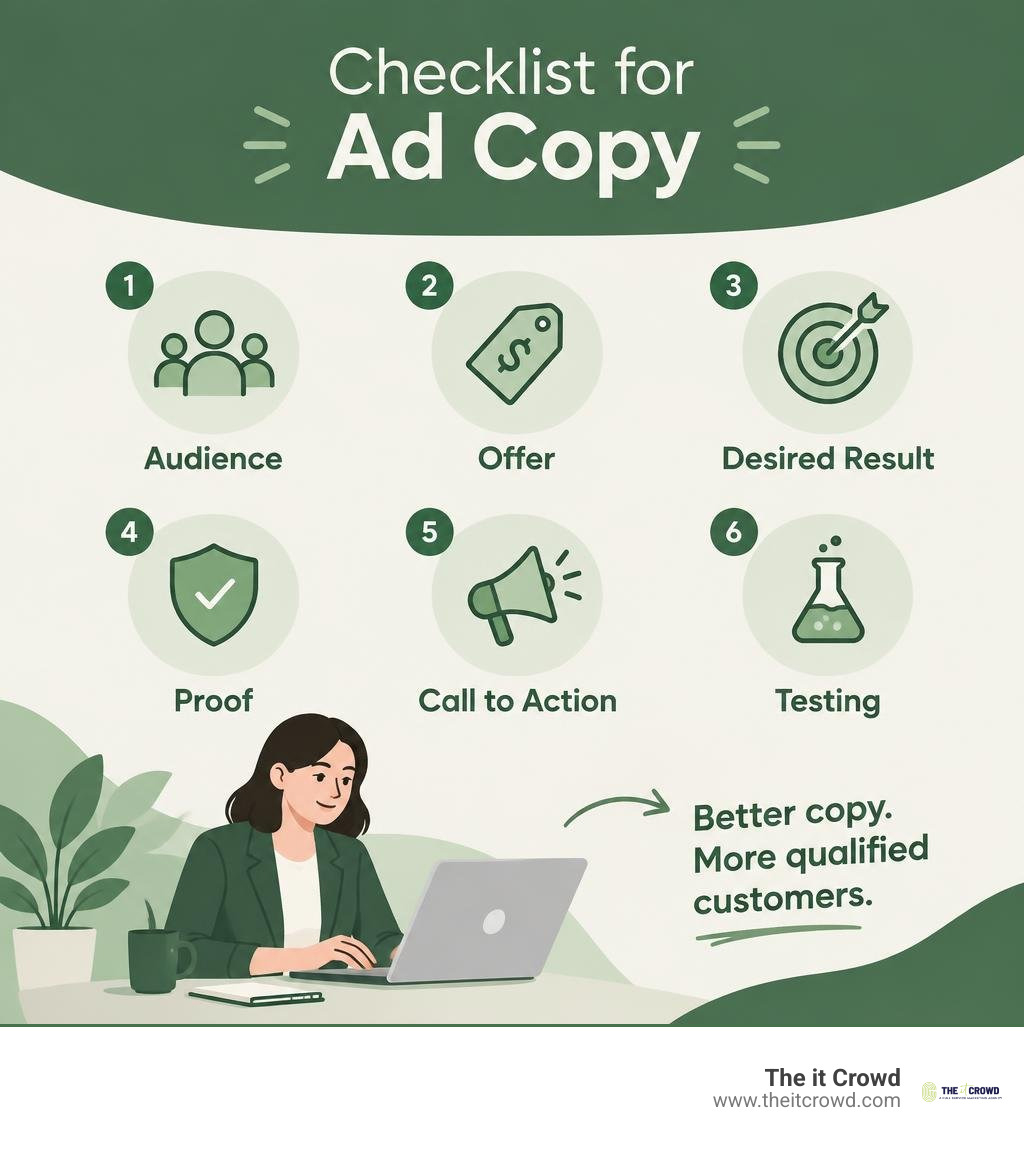
To write high converting ad copy, start with one audience, one clear offer, and the result the buyer wants. Match the message to what they already know, back up your claim with specific proof, and end with one clear next step.
Then test different hooks and offers against the same goal. A strong click-through rate matters, but the better ad is the one that brings in more valuable customers at a cost your business can afford.
I’m Lindsey Huettner, owner of The it Crowd, with over 19 years of experience in marketing and business ownership. I bring that perspective to building high converting ad copy that fits a broader brand and paid media strategy.
The Core Psychology Behind High Converting Ad Copy
Up to 40% of advertising budgets are wasted not because of flawed targeting parameters, but because of weak, uninspired creative messaging. While the average Facebook ad click-through rate (CTR) hovers around 0.9%, well-crafted copy regularly achieves CTRs between 3% and 5%. Converting passive browsers into paying customers requires tapping into behavioral psychology rather than relying on creative guesswork.
Human decision-making is fundamentally driven by cognitive biases. Behavioral economics demonstrates that people are motivated twice as much by avoiding potential losses as they are by acquiring equivalent gains. Framing your value proposition around eliminating an existing operational leak or financial loss frequently outperforms positive-gain messaging.
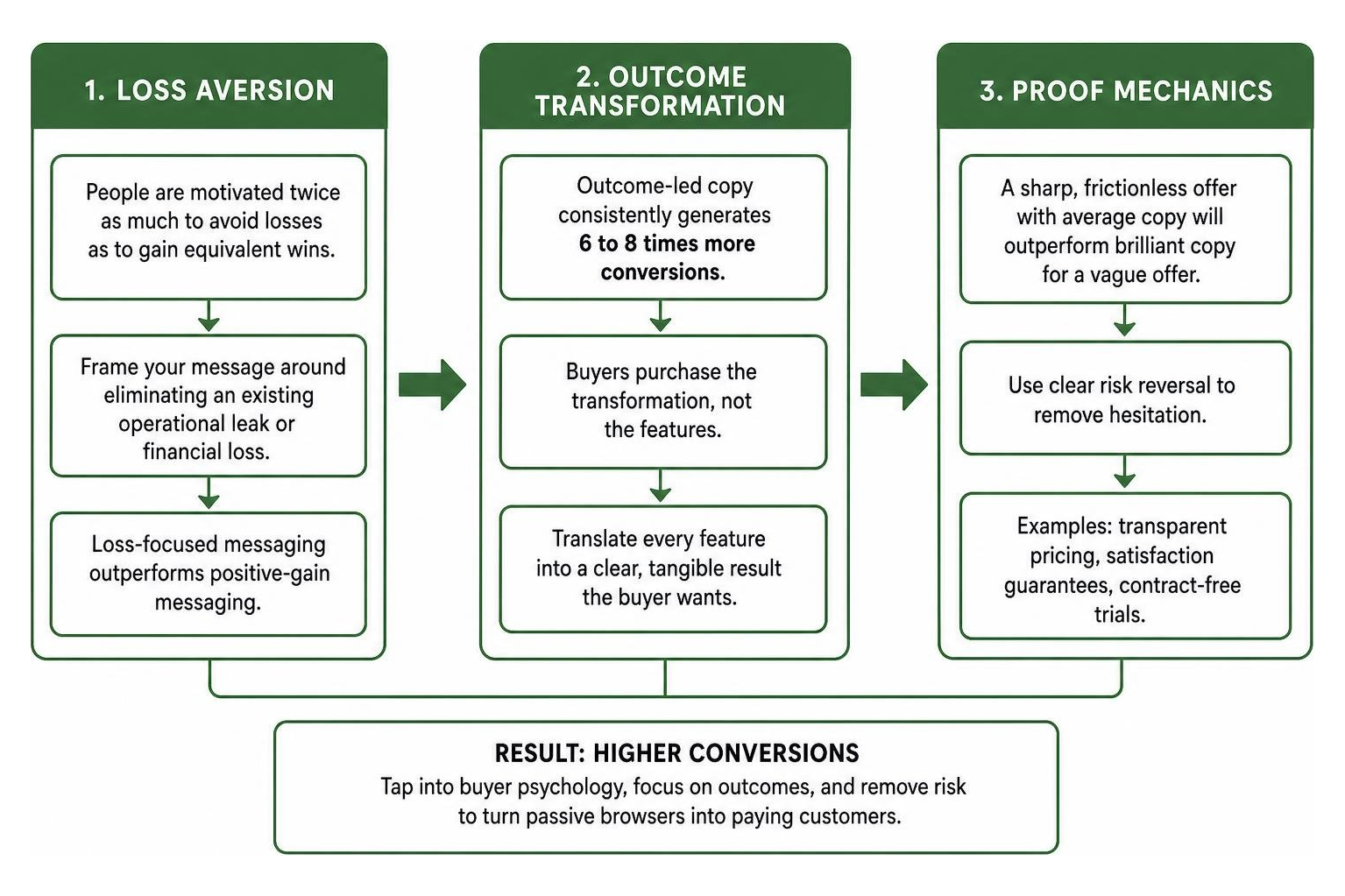
Outcome-led copy consistently generates 6 to 8 times more conversions than feature-led copy. Consumers do not purchase technical specifications; they purchase the emotional and practical transformation those specifications enable. Establishing a sound strategic messaging architecture ensures every product capability translates into a clear, tangible result.
A sharp, frictionless offer with average copy will outperform brilliant copy written for a vague offer more than 90% of the time. Clear risk reversal—such as transparent pricing, satisfaction guarantees, or contract-free trials—eliminates buyer hesitation before it begins.
Matching Ad Copy to Stages of Audience Awareness
Eugene Schwartz’s classic spectrum of customer awareness provides the foundation for effective messaging alignment across the funnel:
- Unaware: The prospect does not know they have a problem. Copy must lead with relatable symptoms, intriguing stories, or disruptive statistics.
- Problem Aware: The prospect feels the pain but does not know a viable solution exists. Messaging should validate their frustration and agitate the consequences of inaction.
- Solution Aware: The prospect knows what category of solutions exists but has not chosen your product. Highlight your unique mechanism and competitive differentiators.
- Product Aware: The prospect knows your brand but has not committed. Focus on overcoming specific objections, handling pricing friction, and offering risk reversal.
- Most Aware: The prospect is ready to purchase and simply needs a compelling incentive, clear call to action, or limited-time promotion.
Cold prospecting campaigns convert best when given room to educate and qualify readers. Retargeting campaigns, by contrast, require concise copy focused squarely on objection handling, testimonials, and clear incentives. Deploying authentic user-generated content and real people in ads bridges the credibility gap faster across every awareness stage than polished corporate stock assets.
Leveraging Specificity and Social Proof to Drive Clicks
Research shows that 95% of consumers consult online reviews before completing a purchase, and 87% trust peer reviews compared to only 41% who trust direct brand advertising. Furthermore, only 8% of buyers automatically believe advertisement claims upon first exposure.
Specificity breeds believability. Vague marketing generalities like “thousands of happy clients” trigger immediate skepticism, whereas exact figures like “2,847 active accounts” signal authentic, verifiable data.
Incorporate verbatim customer phrases, quantified metrics, and authoritative credibility markers into your copy. Highlighting proven client outcomes turns skeptical readers into confident buyers without relying on aggressive sales jargon.
Proven Copywriting Frameworks for Ad Conversions
Copywriting frameworks prevent writers from turning ads into bland feature lists. They structure the persuasion sequence so the reader smoothly transitions from curiosity to action.
| Framework | Best Funnel Stage | Core Focus | Ideal Platform Placements |
|---|---|---|---|
| PAS (Problem, Agitate, Solve) | Cold / Problem-Aware | Agitating pain and offering relief | Meta Feed, LinkedIn, Native Ads |
| AIDA (Attention, Interest, Desire, Action) | Cold to Warm | Linear storytelling and desire building | Long-form Social, Email, Landing Pages |
| BAB (Before, After, Bridge) | Warm / Solution-Aware | Highlighting immediate transformation | Meta Carousels, Short-Form Video |
| 4U (Urgent, Unique, Useful, Ultra-specific) | Retargeting / Most Aware | Driving immediate, friction-free clicks | Google Search Ads, Promo Banners |
Structuring High Converting Ad Copy with Direct-Response Frameworks
Every high-converting framework relies on converting technical specifications into meaningful human benefits:
- The Translation Formula: [Product Feature] so that [Direct Functional Benefit], which means [Emotional / Bottom-Line Outcome].
To illustrate these direct-response frameworks in action:
- PAS in Action:
- Problem: Managing client ad spend across four platforms is chaotic.
- Agitate: One missed budget cap over the weekend can wipe out your entire campaign margin.
- Solve: Our automated guardrails pause underperforming ads the second CPA exceeds your threshold.
- BAB in Action:
- Before: Spending Sunday evenings drafting manual analytics reports.
- After: Waking up Monday morning with automated, client-ready dashboards already delivered.
- Bridge: Plug your ad accounts into our unified reporting engine in under 90 seconds.
Crafting Scroll-Stopping Hooks and Benefit-Driven Headlines
On digital feeds, five times as many people read the headline as read the accompanying body text. The performance gap between your best-performing hook and your worst-performing hook typically creates a 3x to 5x variance in overall return on ad spend.
- The Contrarian Hook: Challenge conventional industry assumptions (“Why adding more ad variations is ruining your campaign performance”).
- The Direct Result Hook: Lead with an exact, verified case metric (“How one brand scaled from $10k to $85k monthly spend while lowering CPA by 22%”).
- The Open-Loop Question: Pose a question that forces the brain to seek closure (“What happens when you stop bidding on your own brand keywords?”).
When reviewing live social campaigns, make sure the primary text hook delivers its core value within the first 125 characters before mobile platforms insert a truncation break. If you want to analyze competing approaches across your industry, learning to reverse engineer competitor Facebook ad strategies provides valuable baseline data on the hooks currently dominating the auction.
Platform-Specific Copywriting Strategies: Search, Social, and Video
Ad copy cannot be copied and pasted across channels without losing efficacy. User intent varies drastically depending on whether a prospect is actively searching for a solution or passively browsing a feed.
| Channel | Core User Mindset | Key Formatting Constraints | Primary Copywriting Focus |
|---|---|---|---|
| Google Search | High intent; active problem solving | 30-char headlines, 90-char descriptions | Literal intent matching, keyword inclusion, explicit CTAs |
| Meta (FB/IG) | Passive discovery; visual browsing | 125 chars before fold; 5-8 word headlines | Pattern-interrupt hooks, social proof, concise objection handling |
| TikTok | Fast-paced entertainment | 15-30s video scripts; 2s visual hook | Conversational tone, text overlays, sound-independent captions |
Writing Responsive Search Ads for Maximum Search Intent
Google Search ads capture active demand, averaging a 6.64% CTR and an 8.18% conversion rate across industries. LocaliQ benchmark data indicates an average all-industry cost per click of $5.42 and a cost per lead of $66.69, climbing to $9.87 per click in competitive sectors like legal services.

According to official Google Ads ad copy best practices, tailoring messaging directly to search intent and boosting Ad Strength from ‘Poor’ to ‘Excellent’ lifts conversions by an average of 12%. For instance, an ultra-low fare airline increased revenue by 71% and conversions by 61% simply by integrating their top-performing search keywords directly into their Responsive Search Ad headlines.
To maximize search ad performance:
- Populate all 15 available headline slots and 4 description fields with distinct, modular assets.
- Ensure each headline is self-contained and makes grammatical sense when combined dynamically with any other asset.
- Eliminate generic calls to action like “Call Us Today” in favor of value-focused steps like “Compare Pricing & Options.”
- Incorporate genuine countdown timers for sales ending soon rather than relying on fabricated urgency.
For teams managing multi-channel initiatives, pairing structured ad copy with well-structured pay-per-click (PPC) campaigns ensures your quality scores remain high and acquisition costs stay under control. Marketers can also systematically audit their vertical by reverse engineering competitor Google Ads strategies to identify messaging gaps on the search engine results page.
Crafting Native Paid Social and Short-Form Video Copy
Paid social campaigns require interrupting a user’s entertainment or networking experience. Nielsen Norman Group research indicates that 79% of people scan digital content while only 16% read word-by-word. A concise rewrite tests 58% more usable, and scannable formatting tests 47% more usable.
When scaling targeted paid social advertising, keep these operational rules in mind:
- Design for Sound-Off Viewing: Up to 85% of Meta video content is viewed without audio. Always script with visual text overlays and burned-in captions.
- Front-Load the Core Proposition: Place your primary hook and offer within the opening 125 characters of social text before truncation occurs.
- Match the Native Platform Tone: Write in a direct, peer-to-peer conversational tone. Overly polished corporate jargon creates immediate banner blindness on platforms like TikTok and Instagram.
How to Test, Iterate, and Scale Ad Copy
High-converting ad copy is the product of disciplined iteration rather than lucky inspiration. Testing ad copy requires isolating variables so you know exactly which element caused the performance shift.
The Ad Copy Testing Hierarchy
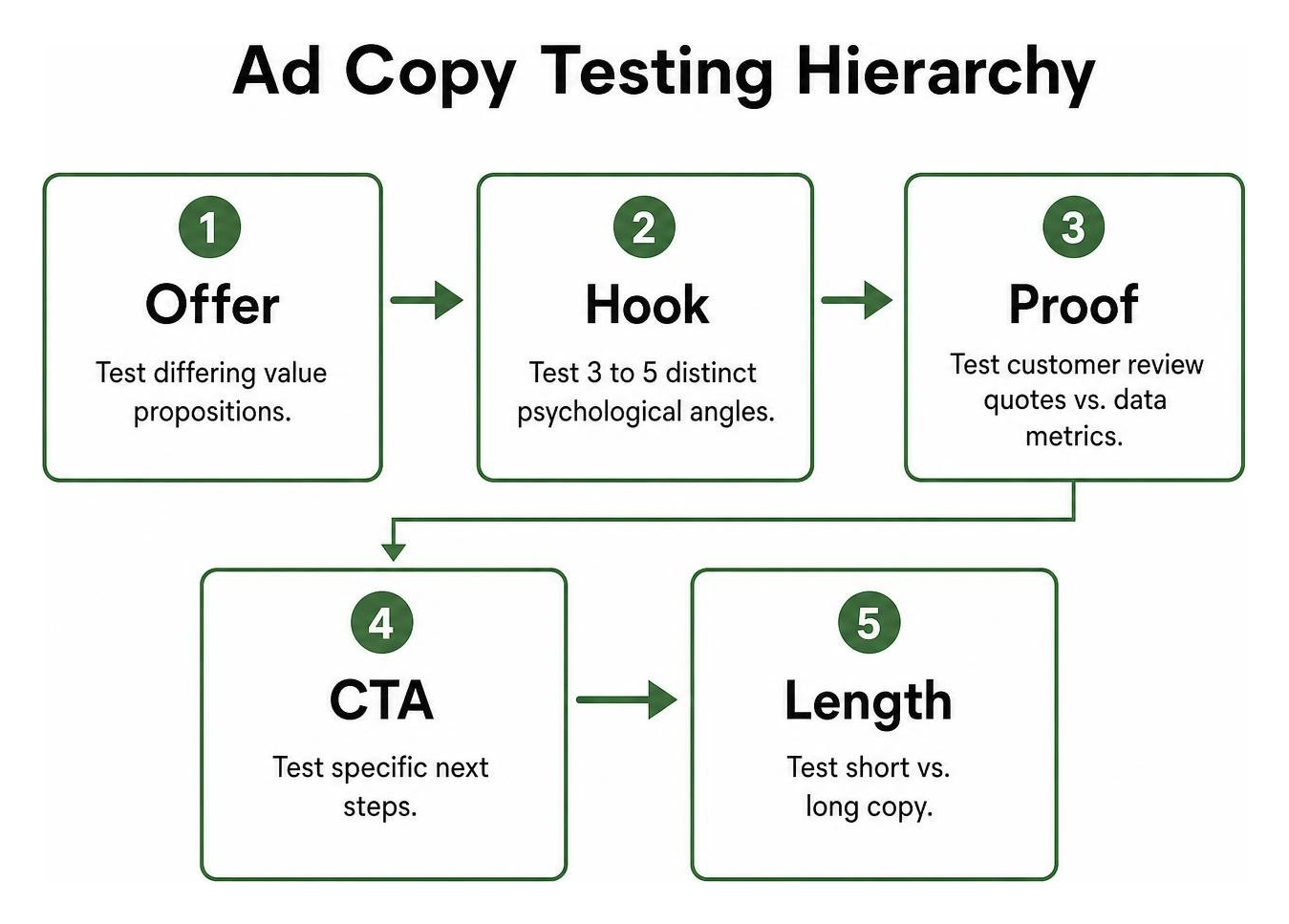
- The Core Offer: Test differing value propositions (e.g., Free Audit vs. Instant Demo vs. 30-Day Risk-Free Trial).
- The Hook / Headline: Test 3 to 5 distinct psychological angles (Contrarian, Number-driven, Pain-focused).
- The Proof Placement: Test customer review quotes against quantified data metrics in the body text.
- The Call to Action: Test specific next steps (e.g., “Get the Pricing Sheet” vs. “Start Free Setup”).
- Tone & Formatting: Test bulleted short-form copy against detailed long-form storytelling.
When executing an A/B split test, run 3 to 5 ad variations per ad set with a dedicated daily budget until each variant gathers at least 1,000 impressions. Testing fewer than three variations starves ad algorithms of comparative data, while testing more than five dilutes your budget and delays statistical clarity.
Scaling High Converting Ad Copy with Generative AI Workflows
Generative AI models like Gemini allow marketers to rapidly brainstorm and scale ad copy variations, provided the tools are guided with precise inputs. AI excels at volume and formatting speed, but it requires human oversight to inject proprietary data, customer sentiment, and verified brand proof.
Use AI to generate angle variations, translate customer support ticket themes into ad hooks, and adapt winning headlines across different character limits while maintaining strict brand guidelines.
Cross-Channel Performance Metrics and Copy Optimization
Evaluating copy performance requires looking at leading indicators alongside final revenue metrics:
- Click-Through Rate (CTR): Measures the stopping power of your hook and headline relevance.
- Conversion Rate (CVR): Measures whether your ad copy accurately set expectations for the destination landing page.
- Cost Per Lead (CPL) / Cost Per Acquisition (CPA): Measures bottom-line commercial efficiency.
- Asset Performance Ratings: In Google Ads and Meta, monitor asset-level labels to replace “Low” performing assets with iterations modeled on “Best” performers.
Ensure complete message continuity between the ad and the destination page. If your ad promotes a “Free 5-Minute Setup Audit,” the landing page header must mirror that exact phrasing above the fold to prevent conversion drop-off.
Frequently Asked Questions About Ad Copywriting
How long should ad copy be across different platforms?
Ad copy length should match user context and platform limits. Google Search ads have strict character limits of 30 characters per headline and 90 characters per description. Meta primary text can range from 125 to 250 characters for retargeting campaigns up to 500 to 1,000 characters for cold audience education, keeping the primary hook within the first 125 characters. TikTok and video ad scripts perform best when kept tight between 15 and 30 seconds.
What is the most common ad copywriting mistake?
The most frequent mistake is focusing on technical features rather than tangible customer outcomes. High-converting copy translates every feature into an emotional or financial benefit using the formula: [Feature] so that [Benefit] which means [Outcome]. Other common errors include fabricated scarcity, vague offers, and passive calls to action.
How many ad copy variations should you test at once?
Test 3 to 5 copy variations per ad set or campaign group. This provides machine learning bidding algorithms with enough creative variation to optimize without diluting ad spend. For search campaigns, maximize responsive search ads by utilizing all 15 headline and 4 description slots.
Conclusion
Writing high-converting ad copy is not about using clever buzzwords; it is about delivering clear, relevant solutions to specific customer problems. By aligning your messaging with your audience’s awareness stage, utilizing battle-tested frameworks like PAS and BAB, adapting to platform constraints, and executing disciplined split tests, you transform your advertising from an unpredictable expense into a reliable growth engine.
If you are looking to scale your paid acquisition, The it Crowd delivers integrated paid media and performance marketing solutions powered by proprietary AI infrastructure and full-funnel creative execution. Clear messaging, combined with rigorous performance tracking, ensures every dollar invested in your campaigns drives measurable commercial growth.

