

Your marketing team is not understaffed. It is doing the wrong work.
There is a version of this problem that looks like a staffing problem: the team is stretched, deadlines slip, and the solution that gets proposed in the budget conversation is another hire.
Except more people running the same manual processes does not fix anything. It just gives you a larger team doing low-leverage work.
In 2026, the marketing teams feeling the most pressure are not the ones without enough hands. They are the ones running sophisticated strategies on infrastructure that was never designed to support them.
Inefficient marketing workflow automation — or the absence of it entirely — shows up as spreadsheets that need updating, emails that get scheduled one by one, follow-up tasks that live in someone’s memory, and brand assets scattered across enough Google Drives and Slack threads to require an archaeologist.
Nucleus Research found that companies see an average return of $5.44 for every dollar invested in marketing automation over three years, with most recovering the cost in under six months. That number exists because the cost of doing things manually is already there, already real, already in your numbers. It just rarely gets a line item.
This article points where those costs actually live and what automation can and cannot do about them.
Where the Hours Actually Go
Ask any marketing director to name their team’s biggest time drain and you will get a different answer every time. Ask their team, and you will hear the same four things, over and over.
The reporting ritual
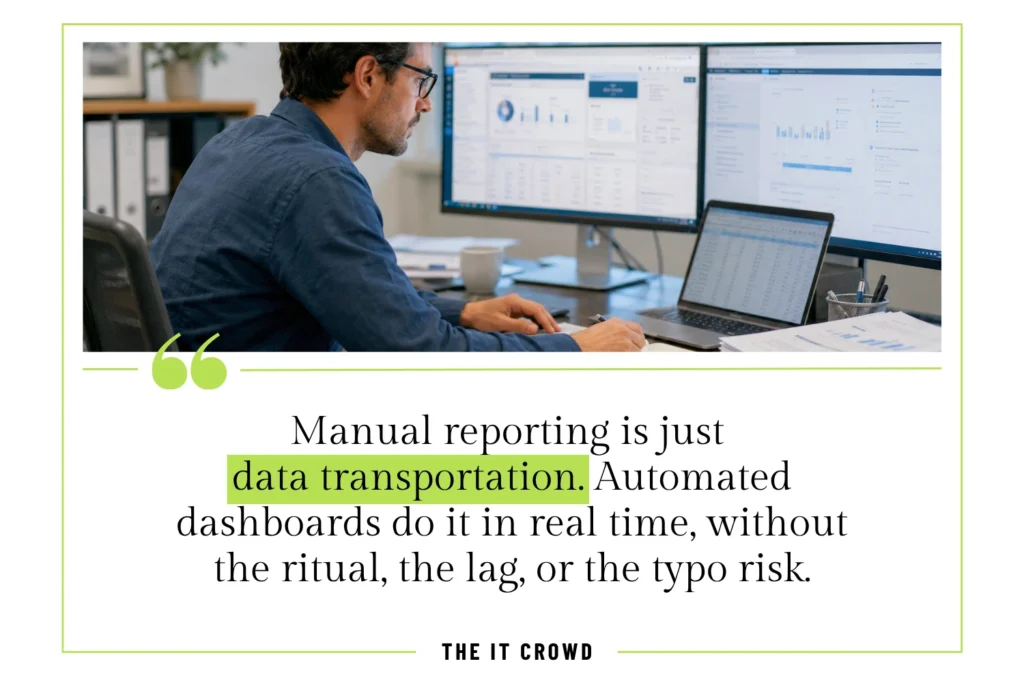
Someone on your team (likely someone overqualified for this) spends a chunk of their week pulling numbers from three or four platforms, dropping them into a spreadsheet, formatting it into something presentable, and sending it to people who will glance at it for ninety seconds. Then they do it again next week.
Manual reporting is data transportation. It produces no competitive advantage, generates no insight that a well-configured dashboard could not surface automatically, and consumes hours that could go toward work that actually requires a person. Automated dashboards do this in real time, without the ritual, without the lag, and without the risk of a transposed number at 4:45 on a Friday.
The email scheduling problem
One-off email sends, drafted and scheduled individually, create a specific kind of drag: the cadence that looked clean in the strategy deck becomes ragged in practice. Emails go out late. Follow-up sequences fall out of sync. Someone meant to send the re-engagement campaign on Tuesday, and it went out Thursday, and by then the moment had passed.
Automated workflows do not get tired, do not get pulled into something else, and do not reschedule because the week got complicated.
This connects to something worth reading if you have not: our piece on why ad and email algorithms are stricter about trust in 2026. Consistency is not just operationally useful. It is algorithmically rewarded.
The follow-up that depends on someone remembering
Call it lead leakage by inertia: the quiet, consistent loss of warm prospects because follow-up lives in a task list or a very well-intentioned person who had seventeen other things happen that week. The lead cools. The window closes.
Nobody dropped the ball on purpose. The system just was not built to catch it. Automated sequences that trigger on behavior rather than memory close that gap reliably, at a scale no individual can match.
The Version_4_FINAL_final_fixed.pdf problem
Everyone has lived through this. Brand assets scattered across personal drives, old Slack threads, and local desktops with folder structures only their creator understands. Finding the right file becomes a twenty-minute dig — and that dig happens every time someone needs an asset.
People use whatever is already on their desktop. That might be an outdated logo, last quarter’s color palette, a photo that was never approved for external use. A centralized digital asset library — one single source of truth — eliminates both the hunt and the workaround.
Manual processes do not just cost time. They cost consistency.
The Costs That Do Not Show Up on a P&L
The work that did not happen
Every hour a skilled marketer spends on manual data entry, formatting, or scheduling is an hour they did not spend on strategy, creative direction, or the kind of thinking that actually moves revenue. The opportunity cost of low-leverage marketing tasks is not the cost of doing them — it is everything else that gets crowded out.
The output looks productive. Hours are logged, things get done. The problem is invisible, which is what makes it so persistent.
Burnout math
Marketing teams running on manual processes burn through people faster than teams that do not. The work is repetitive, the stakes feel low, and the sense that your skills are being spent on something a system could handle is demoralizing in ways that accumulate slowly and then all at once.
Turnover in a marketing team is expensive in ways that also tend not to show up cleanly on a P&L: institutional knowledge walks out the door, the new hire takes months to reach full productivity, and in the meantime someone covers the gap by doing two jobs. Most businesses frame this as a talent retention problem. It is usually a systems problem wearing talent retention’s clothes.
The consistency gap
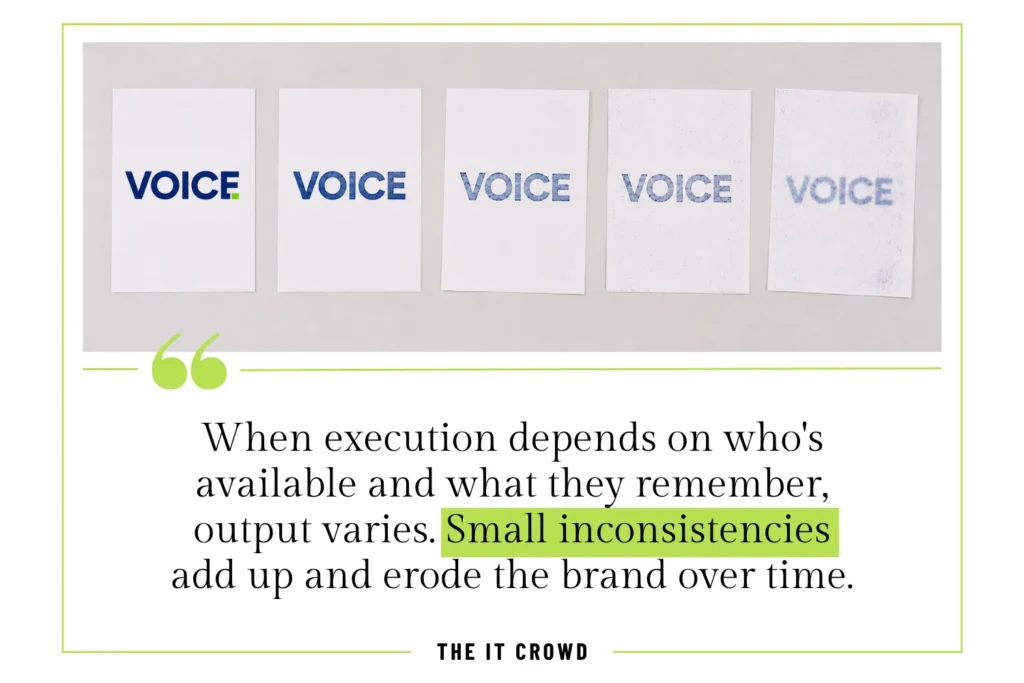
When execution depends on who is available and what they remember, the output varies. Campaigns go out at different times. Tone shifts slightly depending on who wrote it. Each variation is small. Cumulatively, they work against the brand consistency that makes marketing compound over time.
As AI-powered search becomes a bigger part of how businesses get found, consistency signals credibility to systems evaluating your content at scale. It is an authority problem, not just an aesthetic one.
The businesses that feel most stretched are often not the ones with the smallest teams. They are the ones whose teams are doing the most work that should not require a person at all.
What Automation Actually Fixes (And What It Does Not)
Here is what marketing workflow automation genuinely solves, and where it stops.
Where automation delivers
- Reporting and dashboards: Data pulls automatically, formats itself, and surfaces in real time. No assembly ritual, no lag, no risk of a transposed number at 4:45 on a Friday.
- Lead routing and follow-up sequences: Triggers fire on behavior. The lead who visited your pricing page at 11pm gets the right email without anyone setting an alarm — or forgetting to.
- Email scheduling and nurture campaigns: Sequences run on logic. The cadence holds regardless of what else is happening that week, who is out, or what came up.
- Content scheduling: Posts and sends go out on time whether or not the team is heads-down on something else. The calendar does not depend on someone’s availability.
- Asset organization: A centralized library with clear naming conventions means the right file is findable in thirty seconds. The outdated desktop version stops being anyone’s default.
Where human judgment stays
- Strategy: Which audiences, which messages, which channels — these decisions require context and competitive awareness that no workflow replicates.
- Creative direction: Automation distributes content at scale. It does not decide what the content should say, how it should feel, or whether it is actually good.
- Brand voice: Systems can be trained on guidelines. The editorial judgment that keeps voice consistent across contexts is still a people function.
- Relationship management: Automated sequences warm a lead. Closing it, reading the room, building trust over time — that stays human.
Automation gives your team back the hours they are spending on work that does not require them, so they can spend those hours on work that does.
Making the Business Case
The Nucleus Research also found that automating marketing workflows reduces marketing overhead by 12.2% on average and drives a 14.5% increase in sales productivity. The $5.44 return per dollar spent over three years reflects that combination: cost reduction on the operations side, revenue acceleration on the growth side, with payback typically under six months.
The argument is not that automation is cheaper than hiring. It is that it makes the team you already have capable of doing more of the work that actually matters.
At The it Crowd, this is what we built The Hive for: AI workflow design, intelligent agent setup, and automation infrastructure that your business owns outright — not rented from an agency that takes the system when the contract ends. The infrastructure gets smarter the longer it runs. The workflows stay yours either way.
If your team is spending real hours on work a well-built system could handle, that is an infrastructure problem with a clear solution. And if you want to see exactly where the drag is in your operation, that is the kind of conversation we are set up for.
Ready to map it out? Book a conversation with The it Crowd.

