

TL;DR
- Marketing automation uses software to handle repetitive marketing tasks like email sequences, lead scoring, reporting, and campaign management, freeing your team to focus on strategy and relationships.
- Modern systems go beyond static rules. AI and first-party data help adapt workflows in real time, adjusting messaging and timing based on actual customer behavior.
- Automation excels at volume, consistency, and timing. Strategic decisions, creative direction, and the relationship-building that closes high-value deals still need humans.
Every marketing agency in Dallas hands out the same three phone numbers without blinking. Ask for a fourth, the client who left eighteen months ago, and watch the pause that follows.
That pause is the whole story. Buyers treat reference checks like a formality: a box between the pitch deck and the signature line. It’s actually the only unscripted conversation in the entire hiring process. The case studies were built to be seen. The testimonials were built to be seen. A reference call wasn’t supposed to be a performance.
Here’s the part nobody mentions before you dial: the agency picked that number.
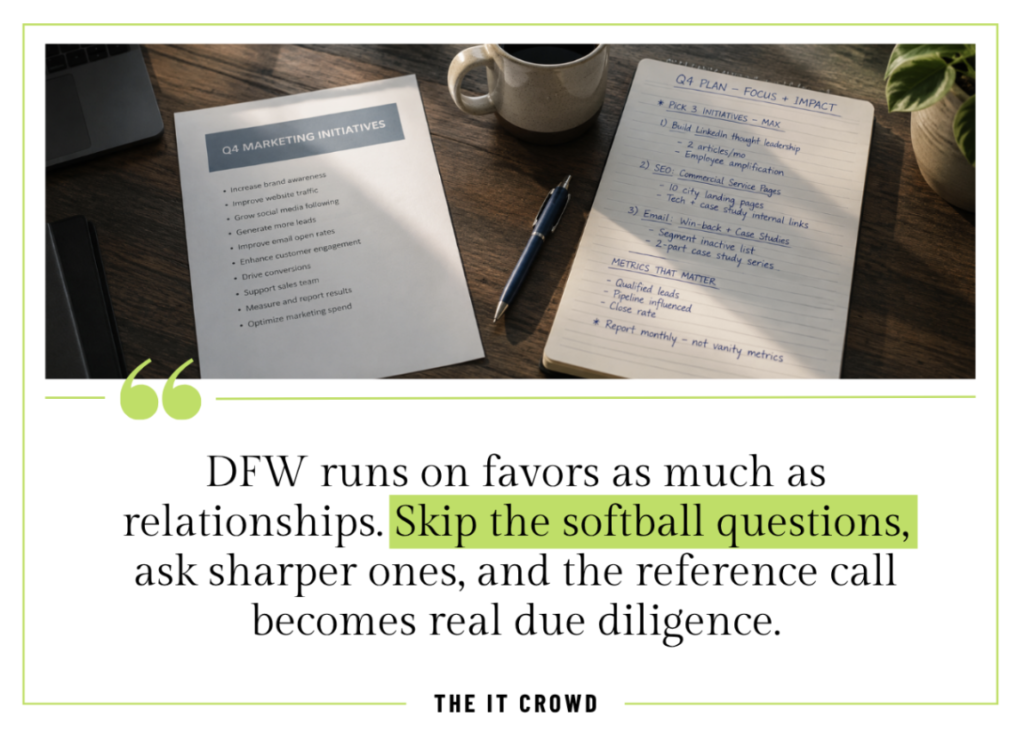
DFW runs on relationships, which also means it runs on favors. Your reference’s account manager might personally know the person you’re calling. The standard questions (how was your experience, would you recommend them) tend to land as a five-star review with extra steps. Ask sharper ones, and the call becomes actual marketing agency due diligence instead of theater.
Get this wrong and you’re not out a subpar blog post. You’re out six months, a chunk of the marketing budget, and the credibility of whoever championed the hire internally.
7 Questions to Ask a Marketing Agency’s Reference
1. “What did onboarding actually look like?”
Sales pitches describe onboarding in one confident sentence: two weeks and you’re live. References describe what actually happened. Ask how long it really took, who they worked with day to day, and whether the plan matched the pitch. A gap between the promise and the onboarding reality is one of the most common sources of buyer’s remorse, and one of the easiest things a reference can confirm.
2. “How did they handle a campaign that underperformed?”
Every agency has a story about a campaign that flopped. What separates a real marketing strategy partner from an order-taker is what happened next: did they diagnose the problem and own the miss, or blame the algorithm, the market, or the client? This question tends to produce longer, more honest answers than almost anything else on the list, because it’s hard to fully script.
3. “How long have you worked together, and why?”
An agency’s tenure with a client tells you something rankings and testimonials can’t. A relationship that’s lasted years usually means the agency earned repeat trust rather than closed a one-time deal. Ask what’s kept them around, then ask what almost made them leave. Agencies with real staying power tend to have an honest answer to both halves of that question.
4. “Did the reporting actually help you make decisions?”
A dashboard full of impressions and reach isn’t the same as performance reporting that tells a client what to do next. Ask whether the reports ever actually shaped a decision: a budget shift, a channel change, a paused campaign. If the reference can point to a specific moment, that’s a good sign. If the answer is vague appreciation for pretty charts, take note.
5. “Who on the team did you actually work with day to day?”
The person who sold the contract and the person who executes it aren’t always the same human, and that’s not automatically a problem. It becomes one when a reference can’t name who they actually worked with, or describes a rotating cast of strangers. Marketing agencies carry notoriously high turnover rates, which makes this question worth asking directly rather than assuming continuity that isn’t there.
6. “Would you say they act like a partner or a vendor?”
This is close to the defining question on the list. A vendor waits to be told what to do. An agency invested in the outcome shows up with opinions, flags problems before being asked, and occasionally pushes back on a bad idea. Ask for a specific example of the agency disagreeing with them. If they can’t think of one, that itself is the answer.
7. “Is there anything you wish you’d asked before signing?”
Save this one for last. It turns a polite reference call into something closer to a debrief, and it tends to surface the one detail every other question missed, whether that’s a hidden fee, a slow response time, or a mismatch nobody could have predicted from a sales deck. The best answers here are specific. The vague ones are their own kind of answer.
Reading Between the Lines
Here’s what nobody teaches you going in: most of what a reference tells you isn’t in the words. Attorneys who specialize in employment screening put it bluntly when it comes to checking someone’s professional past: legally, silence is golden. Former employers and clients alike get coached to stick to the safe stuff—meaning dates, titles, confirmation—because saying more invites liability.
Marketing agency references operate under the same instinct, which means the tells aren’t in what’s said. They’re in what isn’t.
- A pause before an easy question
- Praise that never gets specific
- An answer that could describe any agency
- Enthusiasm that arrives exactly on cue
Call it the Highlight Reel Effect: every agency curates its greatest hits and leaves the deep cuts buried. That’s not deception so much as marketing agency due diligence working exactly as intended, which is why the follow-up question matters more than the first one.
Warren Buffett said, “It takes 20 years to build a reputation and five minutes to ruin it.” That’s a useful reminder for buyers: a curated answer protects a reputation, and your ability to spot one protects your budget.
Verifying Case Studies
References aren’t the only curated evidence you’ll be handed.
Case studies and client testimonials deserve the same skepticism, especially now. Trust in online reviews has been sliding for years, and regulators are catching up: the FTC sent its first-ever warning letters under the Consumer Review Rule in December 2025, targeting companies that bought or faked customer reviews, with penalties climbing into five figures per violation.
None of that means every testimonial on an agency’s site is fabricated. It means treating marketing agency case studies like a contestant’s edit on reality TV: probably rooted in something true, definitely the flattering cut, worth confirming before you commit to anything. Cross-check names, dates, and results against what references say directly.
If nobody can confirm the numbers on the website, that’s worth a follow-up call.
Dallas is small enough that this works both ways. Ask around before you ask an agency for references, and the same names tend to surface—good and bad—before a single call happens. The same scrutiny applies whether you’re vetting a full-service digital marketing agency in Dallas or narrowing in on an SEO partner specifically.
At The it Crowd, we’d rather you call five references than take our word for anything. We hold our own case studies to that same standard. Ask the hard questions. The corner office decisions are only as good as the diligence behind them.

