

Detailed Guide to Learn SEO Basics for Beginners
What Is Search Engine Optimization, and Why Does It Matter?
Search engine optimization (SEO) is the work of helping search engines find, understand, and show your website in unpaid search results. Start with pages that answer your customers’ questions, make them easy to navigate, and ensure search engines can access them. The goal is to help the right people discover your business when they search.
SEO brings together useful content, a well-built website, and trust earned across the web. It can support steady traffic over time, but results take patience and no change guarantees a top ranking. This guide will show you what to focus on first and what you can safely ignore.
I’m Lindsey Huettner, owner of The it Crowd. I have more than 19 years of experience in marketing and business ownership, including work that connects search engine optimization with content, web development, and paid media.
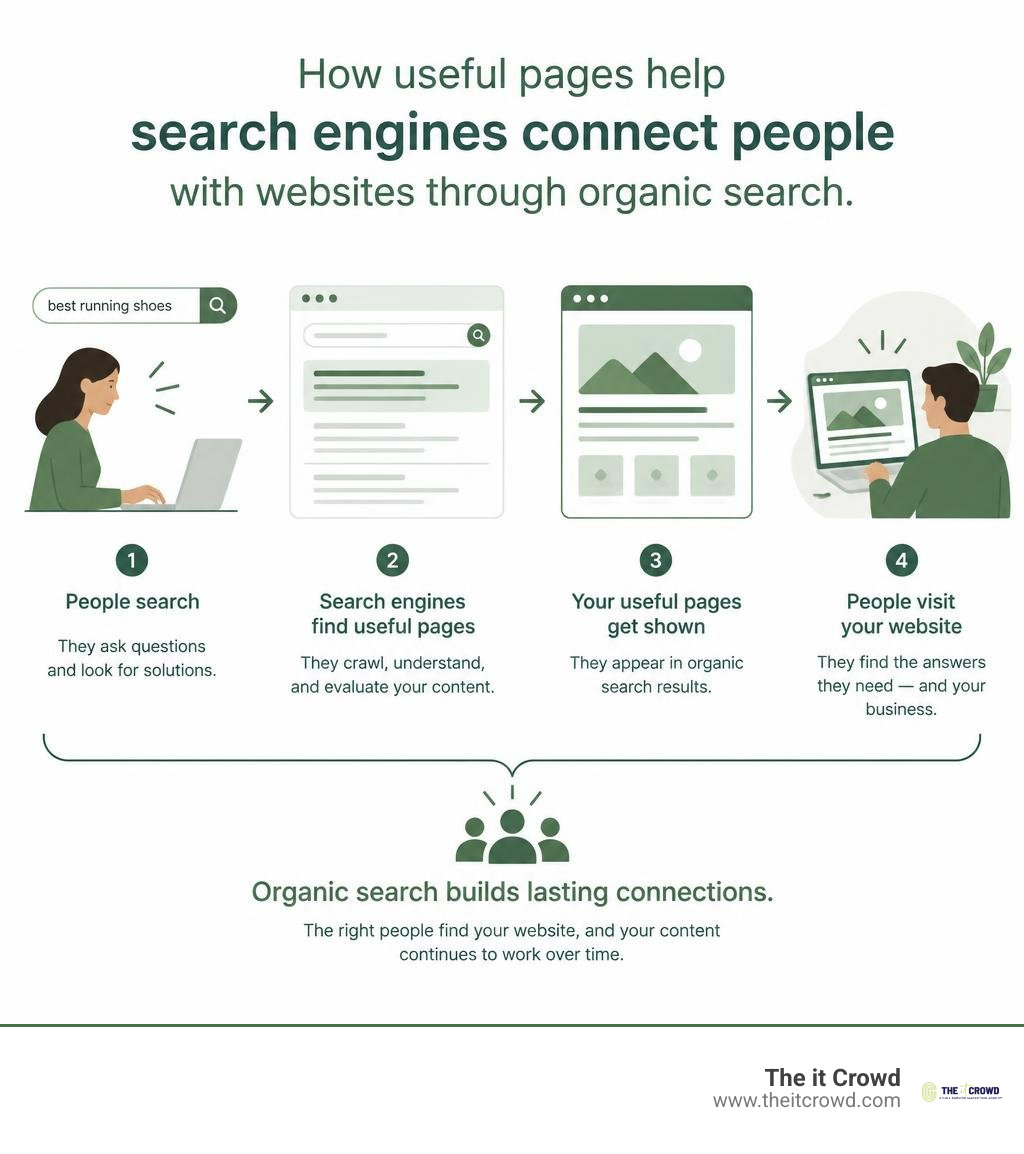
When you run a business, organic search traffic forms the backbone of a sustainable digital presence. Unlike paid advertising where visits vanish the moment your daily budget runs dry, organic visibility compounds over time. Research shows that organic traffic brings tens of thousands of visitors to websites across various sectors, creating an enduring asset whose value expands year over year. The global SEO industry is projected to reach $154.6 billion by 2030, showing just how foundational organic search remains for companies looking to thrive online.
Core Fundamentals of Search Engine Optimization and How Search Works
To optimize a website successfully, you must first understand what search engines are trying to accomplish. At their core, engines like Google act as discovery platforms built to match a searcher’s intent with the most relevant, reliable, and accessible information on the web.
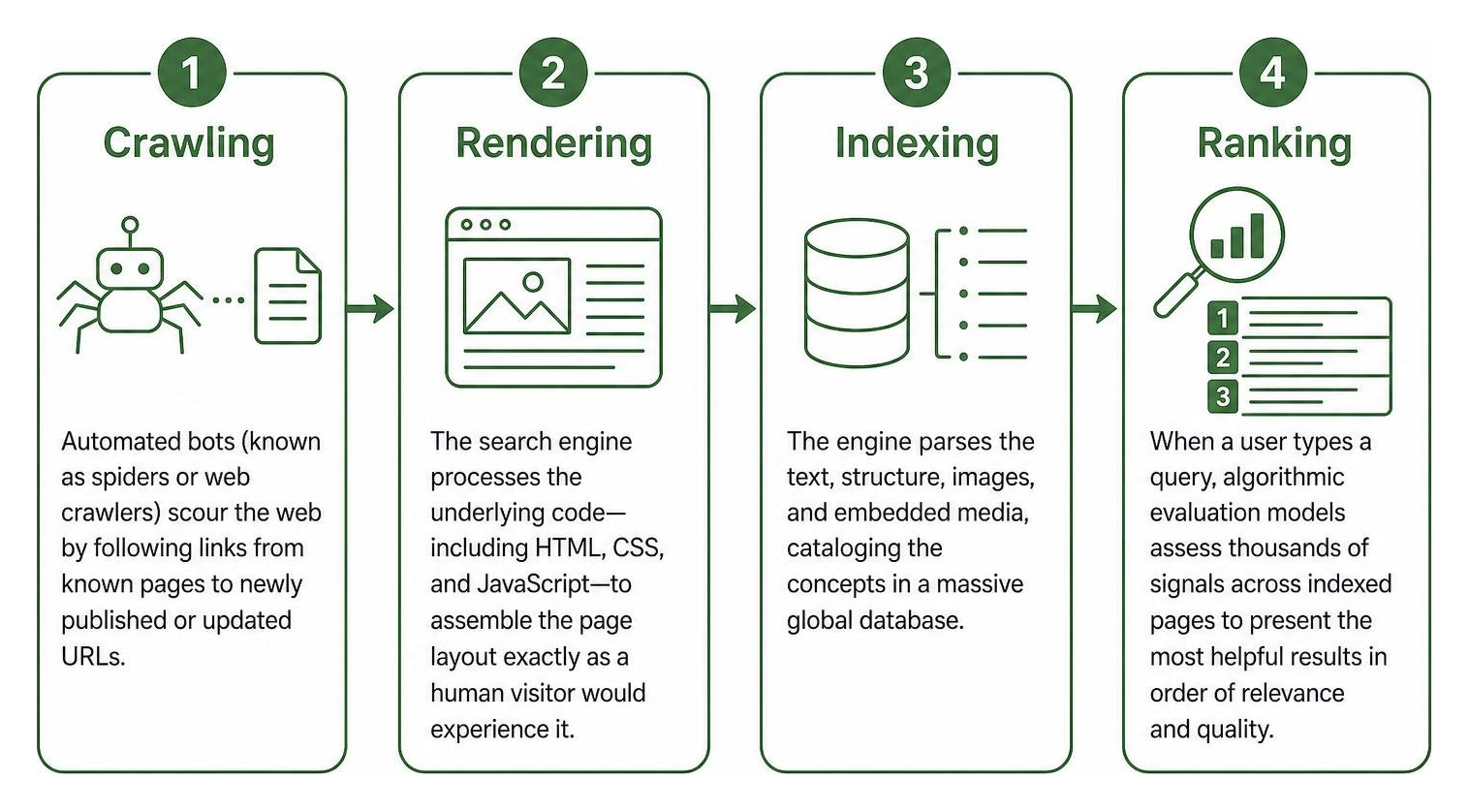
Search engines evaluate billions of documents using an automated, multi-stage pipeline:
- Crawling: Automated bots (known as spiders or web crawlers) scour the web by following links from known pages to newly published or updated URLs.
- Rendering: The search engine processes the underlying code—including HTML, CSS, and JavaScript—to assemble the page layout exactly as a human visitor would experience it.
- Indexing: The engine parses the text, structure, images, and embedded media, cataloging the concepts in a massive global database.
- Ranking: When a user types a query, algorithmic evaluation models assess thousands of signals across indexed pages to present the most helpful results in order of relevance and quality.
The underlying mechanics of Search engine optimization have evolved significantly since the 1990s. Early search directories relied on manual file submissions, and later systems like Google’s foundational PageRank algorithm focused primarily on link structures. Back then, Google was even nicknamed “Backrub” because of how heavily it relied on backlink analysis.
Today, modern search platforms use sophisticated language models to understand conversational semantics and search intent. Whether a user is looking for a quick fact (informational intent), researching a product category (commercial intent), or preparing to make an immediate purchase (transactional intent), search engines aim to surface pages that solve that exact need with minimal friction.
How Search Engines Discover and Index Web Content
Before your website can rank for a single search term, Google must be able to discover and read your pages without hitting roadblocks.
Googlebot primarily finds web pages by following hyperlinks from other pages it has already indexed. If a page has zero links pointing to it from within your own website or from external sources, it becomes an “orphaned page” that crawlers may never find.
To help search engines discover your pages efficiently:
- Submit an XML Sitemap: An XML sitemap is a structured file listing all the critical URLs on your domain that you want indexed. Submitting this file through webmaster tools gives crawlers a direct roadmap of your site’s architecture.
- Configure Your
robots.txtFile: This plain-text file sits in your root directory and tells web crawlers which sections of your site they should or shouldn’t crawl. For example, you might disallow crawlers from accessing your shopping cart checkout funnel or internal search result pages to conserve your crawl budget. - Establish Strong Internal Linking: A clear linking structure passes authority throughout your website and ensures deep pages remain easily accessible within a few clicks of your homepage.
- Inspect Rendered Pages: You can use the URL Inspection Tool in Google Search Console to verify that Googlebot sees your content, styles, and scripts the same way your human visitors do. If your critical content is trapped behind unrendered JavaScript or blocked CSS stylesheets, search engines may fail to index it properly.
Ensuring your site’s code remains clean and accessible is the focus of technical SEO and site optimization, ensuring search engines never struggle to parse your content.
SEO vs. SEM vs. PPC: Understanding the Differences
Digital marketing uses plenty of acronyms, which often causes confusion between SEO, SEM, and PPC.
- SEO (Search Engine Optimization) focuses purely on earning organic (non-paid) visibility on search engine results pages.
- PPC (Pay-Per-Click) involves buying text ads, shopping listings, or sponsored placements where you pay a fee each time a user clicks your link.
- SEM (Search Engine Marketing) is an umbrella discipline encompassing both organic optimization (SEO) and paid search advertising (PPC) to capture maximum market share across search engines.
| Attribute | Search Engine Optimization (SEO) | Pay-Per-Click (PPC) | Search Engine Marketing (SEM) |
|---|---|---|---|
| Direct Media Cost | Free organic clicks | Paid cost-per-click | Blended investment |
| Speed to Results | Medium to long-term (weeks to months) | Immediate (launches instantly) | Immediate ad results paired with growing organic baseline |
| Longevity & Sustainability | Compounding, evergreen traffic | Ceases immediately when ad spend stops | Balanced short-term volume and permanent asset building |
| Primary Placement | Organic listings, Map packs, AI snippets | Sponsored ad blocks at top and bottom of SERP | Complete SERP dominance across paid and unpaid blocks |
While SEO takes time to gain traction, it delivers a compounding return on investment that paid media cannot match on its own. However, high-performing businesses often pair organic initiatives with strategic pay per click PPC campaigns to capture high-intent buyers immediately while building their long-term organic authority.
The Three Pillars of SEO: Technical, On-Page, and Off-Page
Achieving steady organic visibility requires balance across three core disciplines: technical architecture, on-page content strategy, and off-page authority building.
Think of SEO like a competitive sports team: technical SEO is your defense ensuring no structural errors break the play, on-page content is your offense scoring points by answering user queries, and off-page authority is your reputation and fan base cheering you on.

Technical Architecture and Site Organization
A website’s architecture influences how efficiently search engine bots crawl your pages and how easily human visitors find information.
Clean, Descriptive URLs
Your URLs should be human-readable, logical, and descriptive. Avoid long strings of database IDs or random numbers.
- Good:
https://theitcrowd.com/services/web-development/ - Bad:
https://theitcrowd.com/index.php?id=9872&cat=alpha&session=true
Keep your URLs clean by avoiding unnecessary post metadata, publish dates, author names, or subjective filler words. Use simple hyphens to separate words.
Directory-Based Topical Grouping
Group related content within intuitive directory structures. Segmenting resources into distinct subfolders (such as /blog/, /services/, or /locations/) helps search engines understand the topical hierarchy of your website. For larger domains, this organization also allows crawlers to adjust their crawl frequency based on how often specific sections are updated.
Managing Duplicate Content and Canonicalization
Having identical or closely matching content across multiple URLs on your own site does not result in an algorithmic penalty or manual spam action. However, duplicate URLs can dilute your ranking signals and waste crawler resources.
To solve this, implement self-referential or cross-page canonical tags (rel="canonical") to tell search engines which URL represents the master version of the page. Similarly, use 301 redirects to consolidate legacy or duplicate pages into your primary URL.
Speed and Mobile-First Indexing
Mobile devices account for the majority of global web searches. In fact, StatCounter found that mobile browsing officially surpassed desktop traffic worldwide back in 2016, and in the US, over 63% of searches now occur on mobile devices. Because Google indexes the mobile version of your site first, fast loading times, responsive design, and smooth user experiences are mandatory technical baselines. You can dramatically improve user engagement when you work to speed up your website and streamline your core assets.
On-Page Search Engine Optimization and Content Strategy
On-page SEO centers on creating content that answers searchers’ questions while making your page’s topic crystal clear to search engine algorithms.
Creating People-First, Useful Content
Search engines reward helpful, original content written for humans rather than algorithms. If your article merely summarizes existing search results without adding fresh insights, experience, or practical utility, it will struggle to rank.
Google evaluates content quality using the E-E-A-T framework:
- Experience: Real-world, familiarity with the topic.
- Expertise: The depth of knowledge, credentials, or skill demonstrated.
- Authoritativeness: The overall reputation of the creator and the website within their industry.
- Trustworthiness: The accuracy, transparency, and safety of the information provided.
While Google has confirmed that E-E-A-T is not a single direct mathematical ranking factor, its underlying quality raters and algorithmic systems actively reward content that displays these authentic trust signals.
Keyword Targeting and Natural Query Matching
Effective on-page optimization starts with understanding how real people search for your services. Conducting thorough keyword research and mapping allows you to target cohesive keyword clusters on a single comprehensive page rather than creating fragmented, thin pages for minor phrasing variations.
Anticipate natural language differences—for example, recognizing that some users search for “charcuterie” while others search for “cheese board”—and incorporate those natural synonyms into your writing.
Influencing Search Appearance: Title Links and Snippets
How your page appears in search results directly influences whether users decide to click through to your site:
- Title Links (
</code> tag)</strong>: The title tag remains one of the strongest on-page relevance signals. Keep titles clear, concise, and reflective of the primary search query, typically between 50 and 60 characters. Place your primary concept near the front, followed by your brand name.</li> <li><strong>Snippets (Meta Descriptions)</strong>: A meta description does not directly boost rankings, but it acts as your page’s advertising copy on the search results page. Write compelling, informative summaries (around 150 to 160 characters) that give searchers a clear reason to visit your page.</li> </ul> <p class="wp-block-paragraph">For authoritative baseline standards on structuring page titles and metadata, the official <a href="https://developers.google.com/search/docs/fundamentals/seo-starter-guide" target="_blank" rel="noopener">SEO Starter Guide: The Basics</a> outlines Google’s primary indexing recommendations.</p> <h3 class="wp-block-heading" id="media-optimization-images-and-video-search">Media Optimization: Images and Video Search</h3> <p class="wp-block-paragraph">Images and videos make your content engaging, keep visitors on the page longer, and unlock significant visibility across image and video search verticals.</p> <ul class="wp-block-list"> <li><strong>Descriptive Alt Text</strong>: The HTML <code>alt</code> attribute describes the appearance and function of an image for screen readers and search engine crawlers. Write concise, accurate alt text (e.g., <code>alt="stainless steel commercial refrigeration unit in restaurant kitchen"</code>) rather than stuffing the tag with keywords.</li> <li><strong>Contextual Placement</strong>: Place images and videos close to the relevant text paragraphs they illustrate. Search engines use surrounding copy to determine the subject matter and intent of your media.</li> <li><strong>Modern File Formats and Compression</strong>: Serve images in modern, highly compressed formats such as WebP or AVIF. Large, uncompressed media files slow down your page loading speeds and degrade the user experience.</li> <li><strong>Video Schema and Host Structure</strong>: When embedding educational or promotional videos, use structured data markup (such as <code>VideoObject</code> schema) to highlight video titles, descriptions, upload dates, and thumbnail URLs.</li> </ul> <p class="wp-block-paragraph">Comprehensive media management is an essential element of full-scale <a href="https://theitcrowd.com/our-services-website-optimization/">website optimization services</a>.</p> <h3 class="wp-block-heading" id="off-page-authority-and-ethical-website-promotion">Off-Page Authority and Ethical Website Promotion</h3> <p class="wp-block-paragraph">Off-page SEO involves building your brand’s reputation and authority across the wider web. While on-page and technical SEO are entirely within your direct control, off-page authority must be earned.</p> <p class="wp-block-paragraph">Search engines evaluate external backlinks as votes of confidence. However, link quality matters far more than raw quantity. A handful of relevant, editorially earned backlinks from respected industry publications, educational institutions, or local organizations carries significantly more weight than hundreds of links from low-quality directories.</p> <p class="wp-block-paragraph">Effective, ethical off-page strategies include:</p> <ul class="wp-block-list"> <li><strong>Digital PR and Original Research</strong>: Publishing proprietary surveys, industry data, or expert commentary naturally attracts citations and references from journalists and industry bloggers.</li> <li><strong>Niche Brand Partnerships</strong>: Collaborating with non-competing businesses in your ecosystem through guest articles, podcast interviews, and shared educational resources builds contextual relevance.</li> <li><strong>Unlinked Brand Mentions</strong>: As AI-powered search engines evolve, natural brand mentions across the web help algorithms connect your company to specific industries and topic clusters, even when no direct hyperlink is present.</li> <li><strong>Competitor Backlink Analysis</strong>: Examining your <a href="https://theitcrowd.com/sop/sop-090reverse-engineer-your-competitors-backlink-strategy/">competitors backlink strategy</a> reveals which publications, associations, and directories actively link to leaders in your space, giving you a roadmap for your own outreach.</li> </ul> <h2 class="wp-block-heading" id="white-hat-vs-black-hat-strategies-and-common-seo-myths">White Hat vs. Black Hat Strategies and Common SEO Myths</h2> <p class="wp-block-paragraph">Search engine optimization is governed by search engine webmaster guidelines and spam policies. Tactics in the SEO industry generally fall into distinct ethical categories:</p> <p class="wp-block-paragraph"><img decoding="async" alt="Comparison of ethical white hat SEO strategies and risky black hat manipulation tactics" class="aligncenter lazyload" src="data:image/gif;base64,R0lGODlhAQABAAAAACH5BAEKAAEALAAAAAABAAEAAAICTAEAOw==" style="display: block; margin-left: auto; margin-right: auto; max-width: 100%;" title="Comparison of ethical white hat SEO strategies and risky black hat manipulation tactics" data-src="https://storage.googleapis.com/ai-templates.appspot.com/temp_images/4c31db7bb27f47e0aba3954c9914c91f.png" /><noscript><img decoding="async" alt="Comparison of ethical white hat SEO strategies and risky black hat manipulation tactics" class="aligncenter" src="https://storage.googleapis.com/ai-templates.appspot.com/temp_images/4c31db7bb27f47e0aba3954c9914c91f.png" style="display: block; margin-left: auto; margin-right: auto; max-width: 100%;" title="Comparison of ethical white hat SEO strategies and risky black hat manipulation tactics" data-eio="l" /></noscript></p> <ul class="wp-block-list"> <li><strong>White Hat SEO</strong>: Techniques that follow search engine guidelines, prioritize human user experience, provide genuine value, and build sustainable, long-term organic growth.</li> <li><strong>Black Hat SEO</strong>: Deceptive tactics designed to manipulate search algorithms, such as private blog networks (PBNs), automated link spam, hidden text, and doorway pages. These methods violate search engine policies and risk manual actions or severe algorithmic penalties that can wipe a site’s visibility overnight.</li> <li><strong>Grey Hat SEO</strong>: Practices that sit on the boundary of search engine guidelines—such as aggressive link purchasing schemes that attempt to mimic organic citations without offering genuine utility.</li> </ul> <p class="wp-block-paragraph">Participating in deceptive schemes carries immense risk. In documented legal and industry cases, websites hit with manual spam actions have experienced sudden 70% drops in traffic or complete de-indexing. Sustainable businesses focus strictly on transparent, white hat approaches.</p> <h3 class="wp-block-heading" id="debunking-outdated-seo-misconceptions">Debunking Outdated SEO Misconceptions</h3> <p class="wp-block-paragraph">The digital marketing industry moves fast, but outdated myths from the early 2000s still linger in beginner guides. Let’s clear up several common misconceptions:</p> <ul class="wp-block-list"> <li><strong>Myth 1: The Meta Keywords Tag Still Matters.</strong> Google does not use the <code><meta name="keywords"></code> tag in web search rankings and hasn’t for over a decade. Adding it only clutters your HTML and reveals your target keywords to competitors.</li> <li><strong>Myth 2: Keyword Stuffing and Exact Keyword Density Ratios.</strong> Cramming the exact same phrase into every paragraph reads poorly to human visitors and triggers search engine spam filters. Modern search algorithms rely on natural semantic language processing.</li> <li><strong>Myth 3: Every Page Needs a Specific Word Count.</strong> There is no minimum or maximum word count required to rank on Google. A simple 300-word answer to a straightforward question can outrank a rambling 3,000-word article if it satisfies user intent faster and more accurately.</li> <li><strong>Myth 4: Strict Heading Order (H1, H2, H3) Dictates Rankings.</strong> While using organized heading tags makes your content accessible and easy to scan for human readers, Google has confirmed that headings do not need to follow a rigid semantic hierarchy for a page to rank.</li> <li><strong>Myth 5: PageRank Sculpting via Nofollow Tags.</strong> Search engines treat the <code>rel="nofollow"</code> attribute as an interpretive hint rather than an absolute mathematical instruction, making old-school “PageRank hoarding” techniques obsolete.</li> </ul> <p class="wp-block-paragraph">Conducting periodic audits to uncover legitimate <a href="https://theitcrowd.com/sop/sop-041find-on-page-optimization-opportunities-on-a-website/">on-page optimization opportunities</a> will deliver far greater results than chasing outdated ranking tricks.</p> <h3 class="wp-block-heading" id="the-evolution-of-search-engine-optimization-in-the-age-of-ai-and-geo">The Evolution of Search Engine Optimization in the Age of AI and GEO</h3> <p class="wp-block-paragraph">Search technology is experiencing a massive evolution with the arrival of artificial intelligence, large language models (LLMs), and zero-click answer engines. </p> <p class="wp-block-paragraph">Google’s AI Overviews and AI search modes now use query fan-out techniques, taking a user’s initial prompt, breaking it down into multiple sub-topics, executing multiple simultaneous searches, and assembling a concise generative summary. </p> <p class="wp-block-paragraph">Recent consumer research highlights that 82% of consumers find AI-powered search answers more helpful than traditional search result lists for broad informational queries. This shift has given rise to new search optimization disciplines:</p> <ul class="wp-block-list"> <li><strong>GEO (Generative Engine Optimization)</strong>: Structuring content, data tables, and authoritative summaries so that generative AI engines easily cite and attribute your website in synthesized answers.</li> <li><strong>AEO (Answer Engine Optimization)</strong>: Formatting concise, direct answers (typically 50 to 60 words) under clear headings to target voice assistants, zero-click widgets, and direct answer snippets.</li> <li><strong>AIO (Artificial Intelligence Optimization)</strong>: An umbrella term covering optimization strategies across all AI search engines, chatbots, and interactive recommendation platforms.</li> </ul> <p class="wp-block-paragraph">Search engine engineers have clarified that appearing in AI Overviews does not require secret coding tricks. The prerequisites remain the same: high-utility, well-structured content, clean technical indexability, and established brand authority. Discover how our specialized <a href="https://theitcrowd.com/our-services-seo-and-geo-content-optimization/">SEO and GEO content optimization</a> strategies help forward-thinking brands maintain strong visibility across both classic search engines and modern generative AI models.</p> <h2 class="wp-block-heading" id="frequently-asked-questions-about-seo-basics">Frequently Asked Questions About SEO Basics</h2> <h3 class="wp-block-heading" id="how-long-does-it-typically-take-to-see-results-from-seo">How long does it typically take to see results from SEO?</h3> <p class="wp-block-paragraph">Seeing measurable results from SEO efforts typically takes anywhere from <strong>3 to 6 months</strong>, though minor indexing updates can register in just a few days. </p> <p class="wp-block-paragraph">The exact timeline depends on several factors:</p> <ul class="wp-block-list"> <li><strong>Domain Age and Authority</strong>: Brand-new domains require time to build trust and crawl frequency with search engines, whereas established websites often see updates take effect faster.</li> <li><strong>Competition Level</strong>: High-volume, highly competitive search terms require deeper content assets and stronger backlink profiles than low-competition, local search queries.</li> <li><strong>Crawl and Update Frequency</strong>: Google does not re-crawl every web page on the internet daily. In fact, Google made over 500 algorithm adjustments back in 2010—almost 1.5 per day—and updates its systems even more rapidly today. Search engines need time to crawl, re-render, and recalculate quality signals across the web before updating your rankings.</li> </ul> <p class="wp-block-paragraph">Patience and consistency are essential. Sustainable SEO is an ongoing strategy, not a one-time project.</p> <h3 class="wp-block-heading" id="is-duplicate-content-penalized-by-google">Is duplicate content penalized by Google?</h3> <p class="wp-block-paragraph">No, duplicate content on your own website is not penalized with a manual spam action or ranking fine. </p> <p class="wp-block-paragraph">Google understands that websites frequently have legitimate duplicate URLs due to printer-friendly versions, product variants, trailing slashes, or URL tracking parameters. However, duplicate content causes crawl inefficiencies by forcing bots to spend time reading identical pages rather than discovering your fresh content. </p> <p class="wp-block-paragraph">To resolve internal duplicates, use standard <code>rel="canonical"</code> tags to point search engines to the primary URL or use 301 redirects to consolidate identical pages.</p> <h3 class="wp-block-heading" id="what-tools-are-essential-for-monitoring-seo-performance">What tools are essential for monitoring SEO performance?</h3> <p class="wp-block-paragraph">You do not need an expensive suite of software to manage your SEO effectively. Start with these essential, reliable tools:</p> <ol class="wp-block-list"> <li><strong>Google Search Console</strong>: The most important free tool for site owners. It tracks your search impressions, clicks, average keyword positions, indexing errors, and mobile usability straight from Google.</li> <li><strong>Bing Webmaster Tools</strong>: Provides valuable crawling diagnostics, sitemap submissions, and index reporting for Bing and Yahoo search networks.</li> <li><strong>Google Analytics (GA4)</strong>: Tracks post-click user behavior, engagement metrics, landing page conversions, and revenue generated from organic traffic channels.</li> <li><strong>Automated Search Reporting</strong>: Setting up <a href="https://theitcrowd.com/sop/sop-032-create-an-automated-search-query-report/">automated search query reporting</a> lets you track weekly keyword shifts and spot emerging customer queries without spending hours pulling manual data.</li> </ol> <h2 class="wp-block-heading" id="conclusion">Conclusion</h2> <p class="wp-block-paragraph">Mastering search engine optimization comes down to building a fast, accessible website, publishing genuinely helpful content that answers your audience’s questions, and earning credibility across your industry. </p> <p class="wp-block-paragraph">As search continues to evolve alongside generative AI and smart answer engines, the businesses that focus on real user experience and authentic brand authority will continue to earn sustainable organic visibility.</p> <p class="wp-block-paragraph">At The it Crowd, we deliver integrated digital marketing solutions that combine technical web development, custom content creation, paid media, and proprietary AI automation systems like “The Hive.” As a trusted search engine marketing firm in Dallas, our team helps businesses build resilient, scalable organic growth. Ready to elevate your digital visibility? <a href="https://theitcrowd.com/">Partner with an integrated search marketing agency</a> today to start building your long-term search engine presence.</p> </div> </div> <div class="elementor-element elementor-element-f6c7ff2 elementor-widget elementor-widget-shortcode" data-id="f6c7ff2" data-element_type="widget" data-e-type="widget" data-widget_type="shortcode.default"> <div class="elementor-widget-container"> <div class="elementor-shortcode"></div> </div> </div> <div class="elementor-element elementor-element-0953634 elementor-author-box--link-yes elementor-author-box--avatar-yes elementor-author-box--name-yes elementor-author-box--biography-yes elementor-widget elementor-widget-author-box" data-id="0953634" data-element_type="widget" data-e-type="widget" data-widget_type="author-box.default"> <div class="elementor-widget-container"> <div class="elementor-author-box"> <div class="elementor-author-box__avatar"> <img src="data:image/gif;base64,R0lGODlhAQABAAAAACH5BAEKAAEALAAAAAABAAEAAAICTAEAOw==" alt="Picture of Lindsey Huettner" loading="lazy" data-src="https://secure.gravatar.com/avatar/f3f4c3356063de382801f9f8139bee3c676e99883ef13bddd86e0335b708b758?s=300&d=mm&r=g" decoding="async" class="lazyload"><noscript><img src="https://secure.gravatar.com/avatar/f3f4c3356063de382801f9f8139bee3c676e99883ef13bddd86e0335b708b758?s=300&d=mm&r=g" alt="Picture of Lindsey Huettner" loading="lazy" data-eio="l"></noscript> </div> <div class="elementor-author-box__text"> <div > <h4 class="elementor-author-box__name"> Lindsey Huettner </h4> </div> <div class="elementor-author-box__bio"> </div> <a class="elementor-author-box__button elementor-button elementor-size-xs" href="https://theitcrowd.com/author/lindseyhuettner/"> All Posts </a> </div> </div> </div> </div> </div> </div> <div class="elementor-column elementor-col-50 elementor-top-column elementor-element elementor-element-8f8c340" data-id="8f8c340" data-element_type="column" data-e-type="column"> <div class="elementor-widget-wrap elementor-element-populated"> <div class="elementor-element elementor-element-34fb266 elementor-widget elementor-widget-elementskit-category-list" data-id="34fb266" data-element_type="widget" data-e-type="widget" data-widget_type="elementskit-category-list.default"> <div class="elementor-widget-container"> <div class="ekit-wid-con" > <ul class="elementor-icon-list-items"> </ul> </div> </div> </div> <div class="elementor-element elementor-element-4643c08 elementor-widget elementor-widget-heading" data-id="4643c08" data-element_type="widget" data-e-type="widget" data-widget_type="heading.default"> <div class="elementor-widget-container"> <h4 class="elementor-heading-title elementor-size-default">Recent Posts</h4> </div> </div> <div class="elementor-element elementor-element-fccc81e elementor-widget elementor-widget-elementskit-blog-posts" data-id="fccc81e" data-element_type="widget" data-e-type="widget" data-widget_type="elementskit-blog-posts.default"> <div class="elementor-widget-container"> <div class="ekit-wid-con" > <div id="post-items--fccc81e" class="ekit-row post-items ekit-blog-post-masonry-inactive"> <div class="post-item ekit-col-12"> <div class="elementskit-blog-block-post"> <div class="row no-gutters"> <div class="ekit-col-12 order-2"> <div class="elementskit-post-body "> <div class="elementskit-entry-header"> <div class="post-meta-list"> <span class="meta-date"> <i aria-hidden="true" class="icon icon-calendar3"></i> <span class="meta-date-text"> November 25, 2026 </span> </span> </div> <h2 class="entry-title"> <a href="https://theitcrowd.com/detailed-guide-to-learn-seo-basics-for-beginners/"> Detailed Guide to Learn SEO Basics for Beginners </a> </h2> </div><!-- .elementskit-entry-header END --> </div><!-- .elementskit-post-body END --> </div> </div> </div><!-- .elementskit-blog-block-post .radius .gradient-bg END --> </div> <div class="post-item ekit-col-12"> <div class="elementskit-blog-block-post"> <div class="row no-gutters"> <div class="ekit-col-12 order-2"> <div class="elementskit-post-body "> <div class="elementskit-entry-header"> <div class="post-meta-list"> <span class="meta-date"> <i aria-hidden="true" class="icon icon-calendar3"></i> <span class="meta-date-text"> November 23, 2026 </span> </span> </div> <h2 class="entry-title"> <a href="https://theitcrowd.com/setting-up-google-ads-conversion-tracking-in-5-simple-steps/"> Setting Up Google Ads Conversion Tracking in 5 Simple Steps </a> </h2> </div><!-- .elementskit-entry-header END --> </div><!-- .elementskit-post-body END --> </div> </div> </div><!-- .elementskit-blog-block-post .radius .gradient-bg END --> </div> <div class="post-item ekit-col-12"> <div class="elementskit-blog-block-post"> <div class="row no-gutters"> <div class="ekit-col-12 order-2"> <div class="elementskit-post-body "> <div class="elementskit-entry-header"> <div class="post-meta-list"> <span class="meta-date"> <i aria-hidden="true" class="icon icon-calendar3"></i> <span class="meta-date-text"> November 20, 2026 </span> </span> </div> <h2 class="entry-title"> <a href="https://theitcrowd.com/b2b-social-media-metrics-what-impressions-cant-tell/"> How Loud Were You? Why Impressions Can’t Prove Your Social… </a> </h2> </div><!-- .elementskit-entry-header END --> </div><!-- .elementskit-post-body END --> </div> </div> </div><!-- .elementskit-blog-block-post .radius .gradient-bg END --> </div> <div class="post-item ekit-col-12"> <div class="elementskit-blog-block-post"> <div class="row no-gutters"> <div class="ekit-col-12 order-2"> <div class="elementskit-post-body "> <div class="elementskit-entry-header"> <div class="post-meta-list"> <span class="meta-date"> <i aria-hidden="true" class="icon icon-calendar3"></i> <span class="meta-date-text"> November 20, 2026 </span> </span> </div> <h2 class="entry-title"> <a href="https://theitcrowd.com/the-pressure-washers-practical-guide-to-ranking-first-on-google/"> The Pressure Washer’s Practical Guide to Ranking First on Google </a> </h2> </div><!-- .elementskit-entry-header END --> </div><!-- .elementskit-post-body END --> </div> </div> </div><!-- .elementskit-blog-block-post .radius .gradient-bg END --> </div> <div class="post-item ekit-col-12"> <div class="elementskit-blog-block-post"> <div class="row no-gutters"> <div class="ekit-col-12 order-2"> <div class="elementskit-post-body "> <div class="elementskit-entry-header"> <div class="post-meta-list"> <span class="meta-date"> <i aria-hidden="true" class="icon icon-calendar3"></i> <span class="meta-date-text"> November 18, 2026 </span> </span> </div> <h2 class="entry-title"> <a href="https://theitcrowd.com/beginners-guide-to-paid-search-learn-the-basics/"> Beginner’s Guide to Paid Search: Learn the Basics </a> </h2> </div><!-- .elementskit-entry-header END --> </div><!-- .elementskit-post-body END --> </div> </div> </div><!-- .elementskit-blog-block-post .radius .gradient-bg END --> </div> <div class="post-item ekit-col-12"> <div class="elementskit-blog-block-post"> <div class="row no-gutters"> <div class="ekit-col-12 order-2"> <div class="elementskit-post-body "> <div class="elementskit-entry-header"> <div class="post-meta-list"> <span class="meta-date"> <i aria-hidden="true" class="icon icon-calendar3"></i> <span class="meta-date-text"> November 17, 2026 </span> </span> </div> <h2 class="entry-title"> <a href="https://theitcrowd.com/logo-design-trends-2026-what-to-borrow-what-to-skip/"> Logo Design Trends 2026: What’s Worth Borrowing (and What Isn’t) </a> </h2> </div><!-- .elementskit-entry-header END --> </div><!-- .elementskit-post-body END --> </div> </div> </div><!-- .elementskit-blog-block-post .radius .gradient-bg END --> </div> <div class="post-item ekit-col-12"> <div class="elementskit-blog-block-post"> <div class="row no-gutters"> <div class="ekit-col-12 order-2"> <div class="elementskit-post-body "> <div class="elementskit-entry-header"> <div class="post-meta-list"> <span class="meta-date"> <i aria-hidden="true" class="icon icon-calendar3"></i> <span class="meta-date-text"> November 17, 2026 </span> </span> </div> <h2 class="entry-title"> <a href="https://theitcrowd.com/write-high-converting-ad-copy-that-drives-better-results/"> Write High-Converting Ad Copy That Drives Better Results </a> </h2> </div><!-- .elementskit-entry-header END --> </div><!-- .elementskit-post-body END --> </div> </div> </div><!-- .elementskit-blog-block-post .radius .gradient-bg END --> </div> <div class="post-item ekit-col-12"> <div class="elementskit-blog-block-post"> <div class="row no-gutters"> <div class="ekit-col-12 order-2"> <div class="elementskit-post-body "> <div class="elementskit-entry-header"> <div class="post-meta-list"> <span class="meta-date"> <i aria-hidden="true" class="icon icon-calendar3"></i> <span class="meta-date-text"> November 13, 2026 </span> </span> </div> <h2 class="entry-title"> <a href="https://theitcrowd.com/demystifying-front-end-programming-for-modern-web-developers/"> Demystifying Front End Programming for Modern Web Developers </a> </h2> </div><!-- .elementskit-entry-header END --> </div><!-- .elementskit-post-body END --> </div> </div> </div><!-- .elementskit-blog-block-post .radius .gradient-bg END --> </div> </div> </div> </div> </div> <div class="elementor-element elementor-element-8eeded5 elementor-widget elementor-widget-heading" data-id="8eeded5" data-element_type="widget" data-e-type="widget" data-widget_type="heading.default"> <div class="elementor-widget-container"> <h4 class="elementor-heading-title elementor-size-default">Share Posts</h4> </div> </div> <div class="elementor-element elementor-element-c0064da elementor-widget elementor-widget-elementskit-social-share" data-id="c0064da" data-element_type="widget" data-e-type="widget" data-widget_type="elementskit-social-share.default"> <div class="elementor-widget-container"> <div class="ekit-wid-con" > <ul class="ekit_socialshare"> <li class="elementor-repeater-item-e70ed63" data-social="facebook"> <div class="facebook"> <button type="button" aria-label="Share on Facebook"> <i aria-hidden="true" class="icon icon-facebook"></i> </button> </div> </li> <li class="elementor-repeater-item-0ff79a5" data-social="twitter"> <div class="twitter"> <button type="button" aria-label="Share on Twitter"> <i aria-hidden="true" class="icon icon-twitter"></i> </button> </div> </li> <li class="elementor-repeater-item-9cb79ce" data-social="linkedin"> <div class="linkedin"> <button type="button" aria-label="Share on Linkedin"> <i aria-hidden="true" class="icon icon-linkedin"></i> </button> </div> </li> </ul> </div> </div> </div> </div> </div> </div> </section> </div> <footer data-elementor-type="footer" data-elementor-id="51" class="elementor elementor-51 elementor-location-footer" data-elementor-post-type="elementor_library"> <section class="elementor-section elementor-top-section elementor-element elementor-element-942a7d9 elementor-section-boxed elementor-section-height-default elementor-section-height-default" data-id="942a7d9" data-element_type="section" data-e-type="section" data-settings="{"background_background":"classic"}"> <div class="elementor-container elementor-column-gap-default"> <div class="elementor-column elementor-col-33 elementor-top-column elementor-element elementor-element-9039387" data-id="9039387" data-element_type="column" data-e-type="column"> <div class="elementor-widget-wrap elementor-element-populated"> <div class="elementor-element elementor-element-310532a elementor-widget elementor-widget-image" data-id="310532a" data-element_type="widget" data-e-type="widget" data-widget_type="image.default"> <div class="elementor-widget-container"> <img width="218" height="197" src="data:image/png;base64,iVBORw0KGgoAAAANSUhEUgAAANoAAADFAQAAAAAa5tE4AAAAAnRSTlMAAHaTzTgAAAAcSURBVFjD7cGBAAAAAMOg+VNf4QBVAQAAAADAYRZRAAHtTvn6AAAAAElFTkSuQmCC" class="attachment-full size-full wp-image-1067 lazyload ewww_webp_lazy_load" alt="design" data-src="https://theitcrowd.com/wp-content/uploads/2023/08/Untitled-design-9.png" decoding="async" data-eio-rwidth="218" data-eio-rheight="197" data-src-webp="https://theitcrowd.com/wp-content/uploads/2023/08/Untitled-design-9.png.webp" /><noscript><img width="218" height="197" src="https://theitcrowd.com/wp-content/uploads/2023/08/Untitled-design-9.png" class="attachment-full size-full wp-image-1067" alt="design" data-eio="l" /></noscript> </div> </div> <div class="elementor-element elementor-element-b766286 elementor-mobile-align-center elementor-icon-list--layout-traditional elementor-list-item-link-full_width elementor-widget elementor-widget-icon-list" data-id="b766286" data-element_type="widget" data-e-type="widget" data-widget_type="icon-list.default"> <div class="elementor-widget-container"> <ul class="elementor-icon-list-items"> <li class="elementor-icon-list-item"> <span class="elementor-icon-list-text">Do good things.</span> </li> <li class="elementor-icon-list-item"> <span class="elementor-icon-list-text">Make great people.</span> </li> <li class="elementor-icon-list-item"> <span class="elementor-icon-list-text">Pursue opportunities. to love and serve others.</span> </li> </ul> </div> </div> <div class="elementor-element elementor-element-d5fdb6f elementor-mobile-align-center elementor-icon-list--layout-traditional elementor-list-item-link-full_width elementor-widget elementor-widget-icon-list" data-id="d5fdb6f" data-element_type="widget" data-e-type="widget" data-widget_type="icon-list.default"> <div class="elementor-widget-container"> <ul class="elementor-icon-list-items"> <li class="elementor-icon-list-item"> <a href="tel:%209729966216"> <span class="elementor-icon-list-icon"> <i aria-hidden="true" class="fas fa-phone-alt"></i> </span> <span class="elementor-icon-list-text">972-996-6216</span> </a> </li> <li class="elementor-icon-list-item"> <span class="elementor-icon-list-text">STAY UP TO DATE WITH OUR NEWSLETTER</span> </li> </ul> </div> </div> <div class="elementor-element elementor-element-9a1962f elementor-button-align-stretch elementor-widget elementor-widget-form" data-id="9a1962f" data-element_type="widget" data-e-type="widget" data-settings="{"button_width":"25","button_width_mobile":"25","step_next_label":"Next","step_previous_label":"Previous","step_type":"number_text","step_icon_shape":"circle"}" data-widget_type="form.default"> <div class="elementor-widget-container"> <form class="elementor-form" method="post" name="New Form" aria-label="New Form"> <input type="hidden" name="post_id" value="51"/> <input type="hidden" name="form_id" value="9a1962f"/> <input type="hidden" name="referer_title" value="Full Service Digital Marketing agency in Dallas, TX - The it Crowd" /> <input type="hidden" name="queried_id" value="21"/> <div class="elementor-form-fields-wrapper elementor-labels-"> <div class="elementor-field-type-email elementor-field-group elementor-column elementor-field-group-email elementor-col-75 elementor-sm-75 elementor-field-required"> <label for="form-field-email" class="elementor-field-label elementor-screen-only"> Email </label> <input size="1" type="email" name="form_fields[email]" id="form-field-email" class="elementor-field elementor-size-sm elementor-field-textual" placeholder="Your Email Address" required="required"> </div> <div class="elementor-field-group elementor-column elementor-field-type-submit elementor-col-25 e-form__buttons elementor-sm-25"> <button class="elementor-button elementor-size-sm" type="submit"> <span class="elementor-button-content-wrapper"> <span class="elementor-button-icon"> <i aria-hidden="true" class="fas fa-arrow-right"></i> <span class="elementor-screen-only">Submit</span> </span> </span> </button> </div> </div> </form> </div> </div> </div> </div> <div class="elementor-column elementor-col-33 elementor-top-column elementor-element elementor-element-b55d6b3" data-id="b55d6b3" data-element_type="column" data-e-type="column"> <div class="elementor-widget-wrap elementor-element-populated"> <div class="elementor-element elementor-element-ba7a02e elementor-widget elementor-widget-heading" data-id="ba7a02e" data-element_type="widget" data-e-type="widget" data-widget_type="heading.default"> <div class="elementor-widget-container"> <h2 class="elementor-heading-title elementor-size-default">YOUR GO TO FOR MARKETING TIPS:</h2> </div> </div> <div class="elementor-element elementor-element-019b2c8 elementor-mobile-align-center elementor-icon-list--layout-traditional elementor-list-item-link-full_width elementor-widget elementor-widget-icon-list" data-id="019b2c8" data-element_type="widget" data-e-type="widget" data-widget_type="icon-list.default"> <div class="elementor-widget-container"> <ul class="elementor-icon-list-items"> <li class="elementor-icon-list-item"> <a href="https://theitcrowd.com/how-to-leverage-influencer-marketing-for-your-brand/"> <span class="elementor-icon-list-text">How to Leverage Influencer Marketing for Your Brand</span> </a> </li> <li class="elementor-icon-list-item"> <a href="https://theitcrowd.com/buzzing-success-it-crowd-marketing-service-busy-bee/"> <span class="elementor-icon-list-text">Buzzing with Success</span> </a> </li> <li class="elementor-icon-list-item"> <a href="https://theitcrowd.com/unleashing-power-web-presence-strategies-importance/"> <span class="elementor-icon-list-text">Unleashing the Power of Web Presence: How to Do It and Why It’s Important</span> </a> </li> <li class="elementor-icon-list-item"> <a href="https://theitcrowd.com/the-top-tips-for-social-media-to-implement-right-now/"> <span class="elementor-icon-list-text">The Top Tips for Social Media to Implement Right Now</span> </a> </li> <li class="elementor-icon-list-item"> <a href="https://theitcrowd.com/effective-branding-dos-donts-strategies/"> <span class="elementor-icon-list-text">The World of Branding 6:12</span> </a> </li> </ul> </div> </div> </div> </div> <div class="elementor-column elementor-col-33 elementor-top-column elementor-element elementor-element-714897d" data-id="714897d" data-element_type="column" data-e-type="column"> <div class="elementor-widget-wrap elementor-element-populated"> <div class="elementor-element elementor-element-03fb7b4 elementor-widget elementor-widget-html" data-id="03fb7b4" data-element_type="widget" data-e-type="widget" data-widget_type="html.default"> <div class="elementor-widget-container"> <blockquote class="instagram-media" data-instgrm-permalink="https://www.instagram.com/theitcrowdmarketing/?utm_source=ig_embed&utm_campaign=loading" data-instgrm-version="14" style=" background:#FFF; border:0; border-radius:3px; box-shadow:0 0 1px 0 rgba(0,0,0,0.5),0 1px 10px 0 rgba(0,0,0,0.15); margin: 1px; max-width:540px; min-width:326px; padding:0; width:99.375%; width:-webkit-calc(100% - 2px); width:calc(100% - 2px);"><div style="padding:16px;"> <a href="https://www.instagram.com/theitcrowdmarketing/?utm_source=ig_embed&utm_campaign=loading" style=" background:#FFFFFF; line-height:0; padding:0 0; text-align:center; text-decoration:none; width:100%;" target="_blank"> <div style=" display: flex; flex-direction: row; align-items: center;"> <div style="background-color: #F4F4F4; border-radius: 50%; flex-grow: 0; height: 40px; margin-right: 14px; width: 40px;"></div> <div style="display: flex; flex-direction: column; flex-grow: 1; justify-content: center;"> <div style=" background-color: #F4F4F4; border-radius: 4px; flex-grow: 0; height: 14px; margin-bottom: 6px; width: 100px;"></div> <div style=" background-color: #F4F4F4; border-radius: 4px; flex-grow: 0; height: 14px; width: 60px;"></div></div></div><div style="padding: 19% 0;"></div> <div style="display:block; height:100pxpx; margin:0 auto 12px; width:50px;"><svg width="50px" height="100px" viewBox="0 0 60 60" version="1.1" xmlns="https://www.w3.org/2000/svg" xmlns:xlink="https://www.w3.org/1999/xlink"><g stroke="none" stroke-width="1" fill="none" fill-rule="evenodd"><g transform="translate(-511.000000, -20.000000)" fill="#000000"><g><path d="M556.869,30.41 C554.814,30.41 553.148,32.076 553.148,34.131 C553.148,36.186 554.814,37.852 556.869,37.852 C558.924,37.852 560.59,36.186 560.59,34.131 C560.59,32.076 558.924,30.41 556.869,30.41 M541,60.657 C535.114,60.657 530.342,55.887 530.342,50 C530.342,44.114 535.114,39.342 541,39.342 C546.887,39.342 551.658,44.114 551.658,50 C551.658,55.887 546.887,60.657 541,60.657 M541,33.886 C532.1,33.886 524.886,41.1 524.886,50 C524.886,58.899 532.1,66.113 541,66.113 C549.9,66.113 557.115,58.899 557.115,50 C557.115,41.1 549.9,33.886 541,33.886 M565.378,62.101 C565.244,65.022 564.756,66.606 564.346,67.663 C563.803,69.06 563.154,70.057 562.106,71.106 C561.058,72.155 560.06,72.803 558.662,73.347 C557.607,73.757 556.021,74.244 553.102,74.378 C549.944,74.521 548.997,74.552 541,74.552 C533.003,74.552 532.056,74.521 528.898,74.378 C525.979,74.244 524.393,73.757 523.338,73.347 C521.94,72.803 520.942,72.155 519.894,71.106 C518.846,70.057 518.197,69.06 517.654,67.663 C517.244,66.606 516.755,65.022 516.623,62.101 C516.479,58.943 516.448,57.996 516.448,50 C516.448,42.003 516.479,41.056 516.623,37.899 C516.755,34.978 517.244,33.391 517.654,32.338 C518.197,30.938 518.846,29.942 519.894,28.894 C520.942,27.846 521.94,27.196 523.338,26.654 C524.393,26.244 525.979,25.756 528.898,25.623 C532.057,25.479 533.004,25.448 541,25.448 C548.997,25.448 549.943,25.479 553.102,25.623 C556.021,25.756 557.607,26.244 558.662,26.654 C560.06,27.196 561.058,27.846 562.106,28.894 C563.154,29.942 563.803,30.938 564.346,32.338 C564.756,33.391 565.244,34.978 565.378,37.899 C565.522,41.056 565.552,42.003 565.552,50 C565.552,57.996 565.522,58.943 565.378,62.101 M570.82,37.631 C570.674,34.438 570.167,32.258 569.425,30.349 C568.659,28.377 567.633,26.702 565.965,25.035 C564.297,23.368 562.623,22.342 560.652,21.575 C558.743,20.834 556.562,20.326 553.369,20.18 C550.169,20.033 549.148,20 541,20 C532.853,20 531.831,20.033 528.631,20.18 C525.438,20.326 523.257,20.834 521.349,21.575 C519.376,22.342 517.703,23.368 516.035,25.035 C514.368,26.702 513.342,28.377 512.574,30.349 C511.834,32.258 511.326,34.438 511.181,37.631 C511.035,40.831 511,41.851 511,50 C511,58.147 511.035,59.17 511.181,62.369 C511.326,65.562 511.834,67.743 512.574,69.651 C513.342,71.625 514.368,73.296 516.035,74.965 C517.703,76.634 519.376,77.658 521.349,78.425 C523.257,79.167 525.438,79.673 528.631,79.82 C531.831,79.965 532.853,80.001 541,80.001 C549.148,80.001 550.169,79.965 553.369,79.82 C556.562,79.673 558.743,79.167 560.652,78.425 C562.623,77.658 564.297,76.634 565.965,74.965 C567.633,73.296 568.659,71.625 569.425,69.651 C570.167,67.743 570.674,65.562 570.82,62.369 C570.966,59.17 571,58.147 571,50 C571,41.851 570.966,40.831 570.82,37.631"></path></g></g></g></svg></div><div style="padding-top: 8px;"> <div style=" color:#3897f0; font-family:Arial,sans-serif; font-size:14px; font-style:normal; font-weight:550; line-height:18px;">Come Follow Us!</div></div><div style="padding: 12.5% 0;"></div> <div style="display: flex; flex-direction: row; margin-bottom: 14px; align-items: center;"><div> <div style="background-color: #F4F4F4; border-radius: 50%; height: 12.5px; width: 12.5px; transform: translateX(0px) translateY(7px);"></div> <div style="background-color: #F4F4F4; height: 12.5px; transform: rotate(-45deg) translateX(3px) translateY(1px); width: 12.5px; flex-grow: 0; margin-right: 14px; margin-left: 2px;"></div> <div style="background-color: #F4F4F4; border-radius: 50%; height: 12.5px; width: 12.5px; transform: translateX(9px) translateY(-18px);"></div></div><div style="margin-left: 8px;"> <div style=" background-color: #F4F4F4; border-radius: 50%; flex-grow: 0; height: 20px; width: 20px;"></div> <div style=" width: 0; height: 0; border-top: 2px solid transparent; border-left: 6px solid #f4f4f4; border-bottom: 2px solid transparent; transform: translateX(16px) translateY(-4px) rotate(30deg)"></div></div><div style="margin-left: auto;"> <div style=" width: 0px; border-top: 8px solid #F4F4F4; border-right: 8px solid transparent; transform: translateY(16px);"></div> <div style=" background-color: #F4F4F4; flex-grow: 0; height: 12px; width: 16px; transform: translateY(-4px);"></div> <div style=" width: 0; height: 0; border-top: 8px solid #F4F4F4; border-left: 8px solid transparent; transform: translateY(-4px) translateX(8px);"></div></div></div> <div style="display: flex; flex-direction: column; flex-grow: 1; justify-content: center; margin-bottom: 24px;"> <div style=" background-color: #F4F4F4; border-radius: 4px; flex-grow: 0; height: 14px; margin-bottom: 6px; width: 224px;"></div> <div style=" background-color: #F4F4F4; border-radius: 4px; flex-grow: 0; height: 14px; width: 144px;"></div></div></a><p style=" color:#c9c8cd; font-family:Arial,sans-serif; font-size:14px; line-height:17px; margin-bottom:0; margin-top:8px; overflow:hidden; padding:8px 0 7px; text-align:center; text-overflow:ellipsis; white-space:nowrap;"><a href="https://www.instagram.com/theitcrowdmarketing/?utm_source=ig_embed&utm_campaign=loading" style=" color:#c9c8cd; font-family:Arial,sans-serif; font-size:14px; font-style:normal; font-weight:normal; line-height:17px;" target="_blank">The it Crowd Marketing Agency</a> (@<a href="https://www.instagram.com/theitcrowdmarketing/?utm_source=ig_embed&utm_campaign=loading" style=" color:#c9c8cd; font-family:Arial,sans-serif; font-size:14px; font-style:normal; font-weight:normal; line-height:17px;" target="_blank">theitcrowdmarketing</a>) • Instagram photos and videos</p></div></blockquote> <script async src="//www.instagram.com/embed.js"></script> </div> </div> <div class="elementor-element elementor-element-1e27e4d e-grid-align-left elementor-shape-rounded elementor-grid-0 elementor-widget elementor-widget-social-icons" data-id="1e27e4d" data-element_type="widget" data-e-type="widget" data-widget_type="social-icons.default"> <div class="elementor-widget-container"> <div class="elementor-social-icons-wrapper elementor-grid" role="list"> <span class="elementor-grid-item" role="listitem"> <a class="elementor-icon elementor-social-icon elementor-social-icon-facebook elementor-repeater-item-2a8ca48" href="https://www.facebook.com/theitcrowdmarketing" target="_blank"> <span class="elementor-screen-only">Facebook</span> <i aria-hidden="true" class="fab fa-facebook"></i> </a> </span> <span class="elementor-grid-item" role="listitem"> <a class="elementor-icon elementor-social-icon elementor-social-icon-instagram elementor-repeater-item-cbb549f" href="https://www.instagram.com/theitcrowdmarketing/?hl=en" target="_blank"> <span class="elementor-screen-only">Instagram</span> <i aria-hidden="true" class="fab fa-instagram"></i> </a> </span> <span class="elementor-grid-item" role="listitem"> <a class="elementor-icon elementor-social-icon elementor-social-icon-linkedin elementor-repeater-item-ac913c9" href="https://www.linkedin.com/company/it-crowd-marketing/" target="_blank"> <span class="elementor-screen-only">Linkedin</span> <i aria-hidden="true" class="fab fa-linkedin"></i> </a> </span> <span class="elementor-grid-item" role="listitem"> <a class="elementor-icon elementor-social-icon elementor-social-icon-twitter elementor-repeater-item-30feb41" href="https://twitter.com/theitcrowdmktng?lang=en" target="_blank"> <span class="elementor-screen-only">Twitter</span> <i aria-hidden="true" class="fab fa-twitter"></i> </a> </span> </div> </div> </div> </div> </div> </div> </section> <section class="elementor-section elementor-top-section elementor-element elementor-element-ec1b8c0 elementor-hidden-widescreen elementor-hidden-desktop elementor-hidden-tablet elementor-hidden-mobile elementor-section-boxed elementor-section-height-default elementor-section-height-default" data-id="ec1b8c0" data-element_type="section" data-e-type="section" data-settings="{"background_background":"classic"}"> <div class="elementor-container elementor-column-gap-default"> <div class="elementor-column elementor-col-50 elementor-top-column elementor-element elementor-element-b374474" data-id="b374474" data-element_type="column" data-e-type="column"> <div class="elementor-widget-wrap elementor-element-populated"> <div class="elementor-element elementor-element-6211dbd e-grid-align-left e-grid-align-mobile-center elementor-shape-rounded elementor-grid-0 elementor-widget elementor-widget-social-icons" data-id="6211dbd" data-element_type="widget" data-e-type="widget" data-widget_type="social-icons.default"> <div class="elementor-widget-container"> <div class="elementor-social-icons-wrapper elementor-grid" role="list"> <span class="elementor-grid-item" role="listitem"> <a class="elementor-icon elementor-social-icon elementor-social-icon-facebook-f elementor-repeater-item-1d3fbf1" href="https://www.facebook.com/theitcrowdmarketing" target="_blank"> <span class="elementor-screen-only">Facebook-f</span> <i aria-hidden="true" class="fab fa-facebook-f"></i> </a> </span> <span class="elementor-grid-item" role="listitem"> <a class="elementor-icon elementor-social-icon elementor-social-icon-instagram elementor-repeater-item-23d476b" href="https://www.instagram.com/theitcrowdmarketing/?hl=en" target="_blank"> <span class="elementor-screen-only">Instagram</span> <i aria-hidden="true" class="fab fa-instagram"></i> </a> </span> <span class="elementor-grid-item" role="listitem"> <a class="elementor-icon elementor-social-icon elementor-social-icon-icon-linkedin elementor-repeater-item-c6cf1bf" href="https://www.linkedin.com/company/it-crowd-marketing/" target="_blank"> <span class="elementor-screen-only">Icon-linkedin</span> <i aria-hidden="true" class="icon icon-linkedin"></i> </a> </span> <span class="elementor-grid-item" role="listitem"> <a class="elementor-icon elementor-social-icon elementor-social-icon-twitter elementor-repeater-item-1a27b95" href="https://twitter.com/theitcrowdmktng?lang=en" target="_blank"> <span class="elementor-screen-only">Twitter</span> <i aria-hidden="true" class="fab fa-twitter"></i> </a> </span> </div> </div> </div> </div> </div> <div class="elementor-column elementor-col-50 elementor-top-column elementor-element elementor-element-8176c38" data-id="8176c38" data-element_type="column" data-e-type="column"> <div class="elementor-widget-wrap elementor-element-populated"> <div class="elementor-element elementor-element-df2ccd9 elementor-mobile-align-center elementor-align-end elementor-icon-list--layout-traditional elementor-list-item-link-full_width elementor-widget elementor-widget-icon-list" data-id="df2ccd9" data-element_type="widget" data-e-type="widget" data-widget_type="icon-list.default"> <div class="elementor-widget-container"> <ul class="elementor-icon-list-items"> <li class="elementor-icon-list-item"> <a href="tel:%209729966216"> <span class="elementor-icon-list-text">9729966216</span> </a> </li> </ul> </div> </div> </div> </div> </div> </section> </footer> <script type="speculationrules"> {"prefetch":[{"source":"document","where":{"and":[{"href_matches":"/*"},{"not":{"href_matches":["/wp-*.php","/wp-admin/*","/wp-content/uploads/*","/wp-content/*","/wp-content/plugins/*","/wp-content/themes/hello-elementor-child/*","/wp-content/themes/hello-elementor/*","/*\\?(.+)"]}},{"not":{"selector_matches":"a[rel~=\"nofollow\"]"}},{"not":{"selector_matches":".no-prefetch, .no-prefetch a"}}]},"eagerness":"conservative"}]} </script> <script> function _indOffset() { if (jQuery(window).width() > 601) { // left offset if (jQuery(".custom_padding").length > 0) { var offset_left = jQuery(".custom_padding .e-con-inner").offset().left; jQuery("._leftOffset").css("padding-left", offset_left + 0 + "px"); jQuery("._rightOffset").css("padding-right", offset_left + 0 + "px"); console.log(offset_left); } } } _indOffset(); var resizeHandler = function () { _indOffset(); }; jQuery(window).resize(resizeHandler); setTimeout(function () { _indOffset(); }, 100); </script> <script> jQuery(document).ready(function($) { $('.read-btn').click(function () { var $text = $(this).siblings('.cust-text'); var $btn = $(this); $text.toggleClass('expanded'); if ($text.hasClass('expanded')) { $btn .text('Read Less') .removeClass('readmore-active') .addClass('readless-active'); } else { $btn .text('Read More') .removeClass('readless-active') .addClass('readmore-active'); } }); }); </script> <script> const faqItems = document.querySelectorAll(".faq-item"); faqItems.forEach(item => { const btn = item.querySelector(".faq-question"); btn.addEventListener("click", () => { // close other items faqItems.forEach(i => { if (i !== item) { i.classList.remove("active"); i.querySelector(".icon").textContent = "+"; } }); // toggle current item item.classList.toggle("active"); const icon = item.querySelector(".icon"); icon.textContent = item.classList.contains("active") ? "–" : "+"; }); }); </script> <div data-elementor-type="popup" data-elementor-id="96" class="elementor elementor-96 elementor-location-popup" data-elementor-settings="{"entrance_animation":"fadeInLeft","exit_animation":"fadeInLeft","entrance_animation_duration":{"unit":"px","size":0.5,"sizes":[]},"a11y_navigation":"yes","timing":[]}" data-elementor-post-type="elementor_library"> <section class="elementor-section elementor-top-section elementor-element elementor-element-25862ecb elementor-section-full_width elementor-section-height-default elementor-section-height-default" data-id="25862ecb" data-element_type="section" data-e-type="section" data-settings="{"background_background":"classic"}"> <div class="elementor-container elementor-column-gap-default"> <div class="elementor-column elementor-col-100 elementor-top-column elementor-element elementor-element-7341c9fb" data-id="7341c9fb" data-element_type="column" data-e-type="column"> <div class="elementor-widget-wrap elementor-element-populated"> <section class="elementor-section elementor-inner-section elementor-element elementor-element-a7566fd elementor-section-full_width elementor-section-height-default elementor-section-height-default" data-id="a7566fd" data-element_type="section" data-e-type="section"> <div class="elementor-container elementor-column-gap-default"> <div class="elementor-column elementor-col-100 elementor-inner-column elementor-element elementor-element-6f7bd40f" data-id="6f7bd40f" data-element_type="column" data-e-type="column"> <div class="elementor-widget-wrap elementor-element-populated"> <div class="elementor-element elementor-element-3886b8b elementor-widget elementor-widget-image" data-id="3886b8b" data-element_type="widget" data-e-type="widget" data-widget_type="image.default"> <div class="elementor-widget-container"> <img loading="lazy" width="300" height="127" src="data:image/png;base64,iVBORw0KGgoAAAANSUhEUgAAASwAAAB/AQAAAAB9a8I1AAAAAnRSTlMAAHaTzTgAAAAcSURBVFjD7cExAQAAAMKg9U9tBn+gAAAAAIDbABNZAAFLOLC/AAAAAElFTkSuQmCC" class="attachment-full size-full wp-image-4382 lazyload" alt="" data-src="https://theitcrowd.com/wp-content/uploads/2023/08/The-it-Crowd-Icon-101922-1-15-e1708554616356-300x127-1.webp" decoding="async" data-eio-rwidth="300" data-eio-rheight="127" /><noscript><img loading="lazy" width="300" height="127" src="https://theitcrowd.com/wp-content/uploads/2023/08/The-it-Crowd-Icon-101922-1-15-e1708554616356-300x127-1.webp" class="attachment-full size-full wp-image-4382" alt="" data-eio="l" /></noscript> </div> </div> </div> </div> </div> </section> <section class="elementor-section elementor-inner-section elementor-element elementor-element-536044bd elementor-section-boxed elementor-section-height-default elementor-section-height-default" data-id="536044bd" data-element_type="section" data-e-type="section" data-settings="{"background_background":"classic"}"> <div class="elementor-container elementor-column-gap-default"> <div class="elementor-column elementor-col-100 elementor-inner-column elementor-element elementor-element-3c759039" data-id="3c759039" data-element_type="column" data-e-type="column"> <div class="elementor-widget-wrap elementor-element-populated"> <div class="elementor-element elementor-element-25529668 elementor-widget__width-auto elementor-widget-mobile__width-auto custom-menu elementor-nav-menu__text-align-aside elementor-widget elementor-widget-nav-menu" data-id="25529668" data-element_type="widget" data-e-type="widget" data-settings="{"layout":"dropdown","submenu_icon":{"value":"<i class=\"fas fa-caret-down\"><\/i>","library":"fa-solid"}}" data-widget_type="nav-menu.default"> <div class="elementor-widget-container"> <nav class="elementor-nav-menu--dropdown elementor-nav-menu__container" aria-hidden="true"> <ul id="menu-2-25529668" class="elementor-nav-menu"><li class="menu-item menu-item-type-post_type menu-item-object-page menu-item-home menu-item-85"><a href="https://theitcrowd.com/" class="elementor-item" tabindex="-1">Home</a></li> <li class="menu-item menu-item-type-post_type menu-item-object-page menu-item-86"><a href="https://theitcrowd.com/about-us/" class="elementor-item" tabindex="-1">About us</a></li> <li class="menu-item menu-item-type-post_type menu-item-object-page menu-item-89"><a href="https://theitcrowd.com/our-services/" class="elementor-item" tabindex="-1">Our Services</a></li> <li class="menu-item menu-item-type-custom menu-item-object-custom menu-item-has-children menu-item-2879"><a class="elementor-item" tabindex="-1">Resources</a> <ul class="sub-menu elementor-nav-menu--dropdown"> <li class="menu-item menu-item-type-post_type menu-item-object-page menu-item-2869"><a href="https://theitcrowd.com/letters-from-lindsey/" class="elementor-sub-item" tabindex="-1">Letters From Lindsey</a></li> <li class="menu-item menu-item-type-post_type menu-item-object-page menu-item-3165"><a href="https://theitcrowd.com/case-studies/" class="elementor-sub-item" tabindex="-1">Case Studies</a></li> <li class="menu-item menu-item-type-post_type menu-item-object-page menu-item-2870"><a href="https://theitcrowd.com/sops/" class="elementor-sub-item" tabindex="-1">SOPs</a></li> </ul> </li> <li class="menu-item menu-item-type-custom menu-item-object-custom menu-item-has-children menu-item-4761"><a href="#" class="elementor-item elementor-item-anchor" tabindex="-1">Problem? Solved</a> <ul class="sub-menu elementor-nav-menu--dropdown"> <li class="menu-item menu-item-type-post_type menu-item-object-page menu-item-6057"><a href="https://theitcrowd.com/competitors-louder-online-but-not-better/" class="elementor-sub-item" tabindex="-1">Stuck in a Marketing Rut?</a></li> <li class="menu-item menu-item-type-post_type menu-item-object-page menu-item-4764"><a href="https://theitcrowd.com/frustrated-with-your-google-ranking/" class="elementor-sub-item" tabindex="-1">Frustrated with Your Google Ranking?</a></li> <li class="menu-item menu-item-type-post_type menu-item-object-page menu-item-4763"><a href="https://theitcrowd.com/feeling-like-your-brand-is-stuck-in-the-past/" class="elementor-sub-item" tabindex="-1">Feeling Like Your Brand is Stuck in the Past?</a></li> <li class="menu-item menu-item-type-post_type menu-item-object-page menu-item-4762"><a href="https://theitcrowd.com/feeling-like-youre-doing-all-the-social-media-work/" class="elementor-sub-item" tabindex="-1">Is Your Agency Making You Do the Social Media Work?</a></li> <li class="menu-item menu-item-type-post_type menu-item-object-page menu-item-5253"><a href="https://theitcrowd.com/marketing-team-doing-nothing/" class="elementor-sub-item" tabindex="-1">What is My Marketing Team Actually Doing?</a></li> </ul> </li> <li class="menu-item menu-item-type-custom menu-item-object-custom menu-item-2880"><a href="/resources/" class="elementor-item" tabindex="-1">Blogs</a></li> <li class="menu-item menu-item-type-post_type menu-item-object-page menu-item-88"><a href="https://theitcrowd.com/contact-us/" class="elementor-item" tabindex="-1">Contact Us</a></li> </ul> </nav> </div> </div> </div> </div> </div> </section> </div> </div> </div> </section> </div> <script> ( () => { const lazyloadRunObserver = () => { const lazyloadBackgrounds = document.querySelectorAll( `.e-con.e-parent:not(.e-lazyloaded)` ); const lazyloadBackgroundObserver = new IntersectionObserver( ( entries ) => { entries.forEach( ( entry ) => { if ( entry.isIntersecting ) { let lazyloadBackground = entry.target; if( lazyloadBackground ) { lazyloadBackground.classList.add( 'e-lazyloaded' ); } lazyloadBackgroundObserver.unobserve( entry.target ); } }); }, { rootMargin: '200px 0px 200px 0px' } ); lazyloadBackgrounds.forEach( ( lazyloadBackground ) => { lazyloadBackgroundObserver.observe( lazyloadBackground ); } ); }; const events = [ 'DOMContentLoaded', 'elementor/lazyload/observe', ]; events.forEach( ( event ) => { document.addEventListener( event, lazyloadRunObserver ); } ); } )(); </script> <script type="text/javascript">(function(n,t,c,d){if(t.getElementById(d)){return}var o=t.createElement('script');o.id=d;(o.async=!0),(o.src='https://cdn.buttonizer.io/embed.js'),(o.onload=function(){window.Buttonizer?window.Buttonizer.init(c):window.addEventListener('buttonizer_script_loaded',()=>window.Buttonizer.init(c))}),t.head.appendChild(o)})(window,document,'04e2e9a6-0cfa-4943-b8a8-7bf1e13249f6','buttonizer_script')</script><link rel='stylesheet' id='elementor-post-96-css' href='https://theitcrowd.com/wp-content/uploads/elementor/css/post-96.css?ver=1795589038' media='all' /> <link rel='stylesheet' id='e-animation-fadeInLeft-css' href='https://theitcrowd.com/wp-content/plugins/elementor/assets/lib/animations/styles/fadeInLeft.min.css?ver=4.2.3' media='all' /> <link rel='stylesheet' id='e-popup-css' href='https://theitcrowd.com/wp-content/plugins/elementor-pro/assets/css/conditionals/popup.min.css?ver=3.31.2' media='all' /> <script id="eio-lazy-load-js-before"> var eio_lazy_vars = {"bg_min_dpr":1.1,"exactdn_domain":"","safe_domains":["theitcrowd.com","www.theitcrowd.com"],"skip_autoscale":0,"threshold":0,"use_dpr":1}; //# sourceURL=eio-lazy-load-js-before </script> <script async data-wp-strategy="async" id="eio-lazy-load-js" src="https://theitcrowd.com/wp-content/plugins/ewww-image-optimizer/includes/lazysizes.min.js?ver=875"></script> <script id="wp-hooks-js" src="https://theitcrowd.com/wp-includes/js/dist/hooks.min.js?ver=f0f188028580e8dc1255"></script> <script id="wp-i18n-js" src="https://theitcrowd.com/wp-includes/js/dist/i18n.min.js?ver=1dfe7db3940c23ea9216"></script> <script id="wp-i18n-js-after"> wp.i18n.setLocaleData( { 'text direction\u0004ltr': [ 'ltr' ] } ); //# sourceURL=wp-i18n-js-after </script> <script id="swv-js" src="https://theitcrowd.com/wp-content/plugins/contact-form-7/includes/swv/js/index.js?ver=6.1.7"></script> <script id="contact-form-7-js-before"> var wpcf7 = { "api": { "root": "https:\/\/theitcrowd.com\/wp-json\/", "namespace": "contact-form-7\/v1" }, "cached": 1 }; //# sourceURL=contact-form-7-js-before </script> <script id="contact-form-7-js" src="https://theitcrowd.com/wp-content/plugins/contact-form-7/includes/js/index.js?ver=6.1.7"></script> <script id="ra-make-section-clickable-js" src="https://theitcrowd.com/wp-content/plugins/make-section-column-clickable-elementor/assets/js/ra-clickable.js?ver=2.4.1"></script> <script id="highlight-script-js" src="https://theitcrowd.com/wp-content/themes/hello-elementor-child/assets/js/animation.gsap.js"></script> <script id="custom-script-js" src="https://theitcrowd.com/wp-content/themes/hello-elementor-child/assets/js/ScrollMagic.js"></script> <script id="skrollr-js" src="https://cdnjs.cloudflare.com/ajax/libs/skrollr/0.6.30/skrollr.min.js"></script> <script id="custom-scroll-js-js" src="https://theitcrowd.com/wp-content/themes/hello-elementor-child/assets/my-custom.js"></script> <script id="scroll-plugin-js" src="https://theitcrowd.com/wp-content/themes/hello-elementor-child/assets/plugins.js"></script> <script id="hello-theme-frontend-js" src="https://theitcrowd.com/wp-content/themes/hello-elementor/assets/js/hello-frontend.js?ver=3.4.4"></script> <script id="dflip-script-js" src="https://theitcrowd.com/wp-content/plugins/3d-flipbook-dflip-lite/assets/js/dflip.min.js?ver=2.4.37"></script> <script id="elementor-webpack-runtime-js" src="https://theitcrowd.com/wp-content/plugins/elementor/assets/js/webpack.runtime.min.js?ver=4.2.3"></script> <script id="elementor-frontend-modules-js" src="https://theitcrowd.com/wp-content/plugins/elementor/assets/js/frontend-modules.min.js?ver=4.2.3"></script> <script id="jquery-ui-core-js-before"> jQuery.uiBackCompat = true; //# sourceURL=jquery-ui-core-js-before </script> <script id="jquery-ui-core-js" src="https://theitcrowd.com/wp-includes/js/jquery/ui/core.min.js?ver=1.14.2"></script> <script id="elementor-frontend-js-before"> var elementorFrontendConfig = {"environmentMode":{"edit":false,"wpPreview":false,"isScriptDebug":false},"i18n":{"shareOnFacebook":"Share on Facebook","shareOnX":"Share on X","pinIt":"Pin it","download":"Download","downloadImage":"Download image","fullscreen":"Fullscreen","zoom":"Zoom","share":"Share","playVideo":"Play Video","previous":"Previous","next":"Next","close":"Close","a11yCarouselPrevSlideMessage":"Previous slide","a11yCarouselNextSlideMessage":"Next slide","a11yCarouselFirstSlideMessage":"This is the first slide","a11yCarouselLastSlideMessage":"This is the last slide","a11yCarouselPaginationBulletMessage":"Go to slide"},"is_rtl":false,"breakpoints":{"xs":0,"sm":480,"md":768,"lg":1025,"xl":1440,"xxl":1600},"responsive":{"breakpoints":{"mobile":{"label":"Mobile Portrait","value":767,"default_value":767,"direction":"max","is_enabled":true},"mobile_extra":{"label":"Mobile Landscape","value":880,"default_value":880,"direction":"max","is_enabled":false},"tablet":{"label":"Tablet Portrait","value":1024,"default_value":1024,"direction":"max","is_enabled":true},"tablet_extra":{"label":"Tablet Landscape","value":1200,"default_value":1200,"direction":"max","is_enabled":false},"laptop":{"label":"Laptop","value":1366,"default_value":1366,"direction":"max","is_enabled":false},"widescreen":{"label":"Widescreen","value":1920,"default_value":2400,"direction":"min","is_enabled":true}}, "hasCustomBreakpoints":true},"version":"4.2.3","is_static":false,"experimentalFeatures":{"additional_custom_breakpoints":true,"container":true,"e_panel_promotions":true,"theme_builder_v2":true,"hello-theme-header-footer":true,"landing-pages":true,"nested-elements":true,"global_classes_should_enforce_capabilities":true,"e_variables":true,"e_opt_in_v4_page":true,"e_components":true,"e_interactions":true,"e_widget_creation":true,"import-export-customization":true},"urls":{"assets":"https:\/\/theitcrowd.com\/wp-content\/plugins\/elementor\/assets\/","ajaxurl":"https:\/\/theitcrowd.com\/wp-admin\/admin-ajax.php","uploadUrl":"https:\/\/theitcrowd.com\/wp-content\/uploads"},"nonces":{"floatingButtonsClickTracking":"0d9161afc9","atomicFormsSendForm":"57c4f6eacd"},"swiperClass":"swiper","settings":{"page":[],"editorPreferences":[]},"kit":{"active_breakpoints":["viewport_mobile","viewport_tablet","viewport_widescreen"],"viewport_widescreen":1920,"global_image_lightbox":"yes","lightbox_enable_counter":"yes","lightbox_enable_fullscreen":"yes","lightbox_enable_zoom":"yes","lightbox_enable_share":"yes","lightbox_title_src":"title","lightbox_description_src":"description","hello_header_logo_type":"logo","hello_header_menu_layout":"horizontal","hello_footer_logo_type":"logo"},"post":{"id":6761,"title":"Search%20Engine%20Optimization%3A%20Ultimate%20Beginner%27s%20Guide","excerpt":"Learn the fundamentals of search engine optimization with this beginner's guide covering technical, on-page, and off-page SEO strategies.","featuredImage":"https:\/\/theitcrowd.com\/wp-content\/uploads\/2026\/11\/detailed-guide-to-learn-seo-basics-for-beginners-image-1024x576.jpg"}}; //# sourceURL=elementor-frontend-js-before </script> <script id="elementor-frontend-js" src="https://theitcrowd.com/wp-content/plugins/elementor/assets/js/frontend.min.js?ver=4.2.3"></script> <script id="smartmenus-js" src="https://theitcrowd.com/wp-content/plugins/elementor-pro/assets/lib/smartmenus/jquery.smartmenus.min.js?ver=1.2.1"></script> <script id="e-sticky-js" src="https://theitcrowd.com/wp-content/plugins/elementor-pro/assets/lib/sticky/jquery.sticky.min.js?ver=3.31.2"></script> <script id="imagesloaded-js" src="https://theitcrowd.com/wp-includes/js/imagesloaded.min.js?ver=5.0.0"></script> <script id="ekit-masonry-js" src="https://theitcrowd.com/wp-content/plugins/elementskit-lite/widgets/init/assets/js/ekit-masonry.js?ver=4.0.1"></script> <script id="ekit-core-js-extra"> var ekit_config = {"ajaxurl":"https://theitcrowd.com/wp-admin/admin-ajax.php","nonce":"17f4e6eecc"}; //# sourceURL=ekit-core-js-extra </script> <script id="ekit-core-js" src="https://theitcrowd.com/wp-content/plugins/elementskit-lite/widgets/init/assets/js/widgets/core.js?ver=4.0.1"></script> <script id="ekit-blog-posts-js" src="https://theitcrowd.com/wp-content/plugins/elementskit-lite/widgets/init/assets/js/widgets/blog-posts.js?ver=4.0.1"></script> <script id="goodshare-js" src="https://theitcrowd.com/wp-content/plugins/elementskit-lite/assets/libs/goodshare/goodshare.min.js?ver=4.0.1"></script> <script id="ekit-nav-menu-js" src="https://theitcrowd.com/wp-content/plugins/elementskit-lite/widgets/init/assets/js/widgets/nav-menu.js?ver=4.0.1"></script> <script id="magnific-popup-js" src="https://theitcrowd.com/wp-content/plugins/elementskit-lite/assets/libs/magnific-popup/jquery.magnific-popup.min.js?ver=4.0.1"></script> <script id="ekit-menu-js" src="https://theitcrowd.com/wp-content/plugins/elementskit-lite/widgets/init/assets/js/nav-menu.js?ver=4.0.1"></script> <script id="ekit-header-search-js" src="https://theitcrowd.com/wp-content/plugins/elementskit-lite/widgets/init/assets/js/widgets/header-search.js?ver=4.0.1"></script> <script id="ekit-header-offcanvas-js" src="https://theitcrowd.com/wp-content/plugins/elementskit-lite/widgets/init/assets/js/widgets/header-offcanvas.js?ver=4.0.1"></script> <script id="elementor-pro-webpack-runtime-js" src="https://theitcrowd.com/wp-content/plugins/elementor-pro/assets/js/webpack-pro.runtime.min.js?ver=3.31.2"></script> <script id="elementor-pro-frontend-js-before"> var ElementorProFrontendConfig = {"ajaxurl":"https:\/\/theitcrowd.com\/wp-admin\/admin-ajax.php","nonce":"019434f45b","urls":{"assets":"https:\/\/theitcrowd.com\/wp-content\/plugins\/elementor-pro\/assets\/","rest":"https:\/\/theitcrowd.com\/wp-json\/"},"settings":{"lazy_load_background_images":true},"popup":{"hasPopUps":true},"shareButtonsNetworks":{"facebook":{"title":"Facebook","has_counter":true},"twitter":{"title":"Twitter"},"linkedin":{"title":"LinkedIn","has_counter":true},"pinterest":{"title":"Pinterest","has_counter":true},"reddit":{"title":"Reddit","has_counter":true},"vk":{"title":"VK","has_counter":true},"odnoklassniki":{"title":"OK","has_counter":true},"tumblr":{"title":"Tumblr"},"digg":{"title":"Digg"},"skype":{"title":"Skype"},"stumbleupon":{"title":"StumbleUpon","has_counter":true},"mix":{"title":"Mix"},"telegram":{"title":"Telegram"},"pocket":{"title":"Pocket","has_counter":true},"xing":{"title":"XING","has_counter":true},"whatsapp":{"title":"WhatsApp"},"email":{"title":"Email"},"print":{"title":"Print"},"x-twitter":{"title":"X"},"threads":{"title":"Threads"}}, "facebook_sdk":{"lang":"en_US","app_id":""},"lottie":{"defaultAnimationUrl":"https:\/\/theitcrowd.com\/wp-content\/plugins\/elementor-pro\/modules\/lottie\/assets\/animations\/default.json"}}; //# sourceURL=elementor-pro-frontend-js-before </script> <script id="elementor-pro-frontend-js" src="https://theitcrowd.com/wp-content/plugins/elementor-pro/assets/js/frontend.min.js?ver=3.31.2"></script> <script id="pro-elements-handlers-js" src="https://theitcrowd.com/wp-content/plugins/elementor-pro/assets/js/elements-handlers.min.js?ver=3.31.2"></script> <script data-cfasync="false"> window.dFlipLocation = 'https://theitcrowd.com/wp-content/plugins/3d-flipbook-dflip-lite/assets/'; window.dFlipWPGlobal = {"text":{"toggleSound":"Turn on\/off Sound","toggleThumbnails":"Toggle Thumbnails","toggleOutline":"Toggle Outline\/Bookmark","previousPage":"Previous Page","nextPage":"Next Page","toggleFullscreen":"Toggle Fullscreen","zoomIn":"Zoom In","zoomOut":"Zoom Out","toggleHelp":"Toggle Help","singlePageMode":"Single Page Mode","doublePageMode":"Double Page Mode","downloadPDFFile":"Download PDF File","gotoFirstPage":"Goto First Page","gotoLastPage":"Goto Last Page","share":"Share","mailSubject":"I wanted you to see this FlipBook","mailBody":"Check out this site {{url}}","loading":"DearFlip: Loading "},"viewerType":"flipbook","moreControls":"download,pageMode,startPage,endPage,sound","hideControls":"","scrollWheel":"false","backgroundColor":"#777","backgroundImage":"","height":"auto","paddingLeft":"20","paddingRight":"20","controlsPosition":"bottom","duration":800,"soundEnable":"true","enableDownload":"true","showSearchControl":"false","showPrintControl":"false","enableAnnotation":false,"enableAnalytics":"false","webgl":"true","hard":"none","maxTextureSize":"1600","rangeChunkSize":"524288","zoomRatio":1.5,"stiffness":3,"pageMode":"0","singlePageMode":"0","pageSize":"0","autoPlay":"false","autoPlayDuration":5000,"autoPlayStart":"false","linkTarget":"2","sharePrefix":"flipbook-"}; </script> <script id="wp-emoji-settings" type="application/json"> {"baseUrl":"https://s.w.org/images/core/emoji/17.0.2/72x72/","ext":".png","svgUrl":"https://s.w.org/images/core/emoji/17.0.2/svg/","svgExt":".svg","source":{"concatemoji":"https://theitcrowd.com/wp-includes/js/wp-emoji-release.min.js?ver=7.1.5"}} </script> <script type="module"> /*! This file is auto-generated */ var e="script#wp-emoji-settings",t=document.querySelector(e);if(!(t instanceof HTMLScriptElement))throw new Error("Element missing: "+e);const r=JSON.parse(t.text),s=(window._wpemojiSettings=r,"wpEmojiSettingsSupports"),o=["flag","emoji"];function i(e){try{var t={supportTests:e,timestamp:(new Date).valueOf()};sessionStorage.setItem(s,JSON.stringify(t))}catch(e){}}function c(e,t,n){e.clearRect(0,0,e.canvas.width,e.canvas.height),e.fillText(t,0,0);t=new Uint32Array(e.getImageData(0,0,e.canvas.width,e.canvas.height).data);e.clearRect(0,0,e.canvas.width,e.canvas.height),e.fillText(n,0,0);const r=new Uint32Array(e.getImageData(0,0,e.canvas.width,e.canvas.height).data);return t.every((e,t)=>e===r[t])}function p(e,t){e.clearRect(0,0,e.canvas.width,e.canvas.height),e.fillText(t,0,0);var n=e.getImageData(16,16,1,1);for(let e=0;e<n.data.length;e++)if(0!==n.data[e])return!1;return!0}function u(e,t,n,r){switch(t){case"flag":return n(e,"\ud83c\udff3\ufe0f\u200d\u26a7\ufe0f","\ud83c\udff3\ufe0f\u200b\u26a7\ufe0f")?!1:!n(e,"\ud83c\udde8\ud83c\uddf6","\ud83c\udde8\u200b\ud83c\uddf6")&&!n(e,"\ud83c\udff4\udb40\udc67\udb40\udc62\udb40\udc65\udb40\udc6e\udb40\udc67\udb40\udc7f","\ud83c\udff4\u200b\udb40\udc67\u200b\udb40\udc62\u200b\udb40\udc65\u200b\udb40\udc6e\u200b\udb40\udc67\u200b\udb40\udc7f");case"emoji":return!r(e,"\ud83e\u1fac8")}return!1}function f(e,t,n,r){let a;const s=(a="undefined"!=typeof WorkerGlobalScope&&self instanceof WorkerGlobalScope?new OffscreenCanvas(300,150):document.createElement("canvas")).getContext("2d",{willReadFrequently:!0}),o=(s.textBaseline="top",s.font="600 32px Arial",{});return e.forEach(e=>{o[e]=t(s,e,n,r)}),o}function a(e){var t=document.createElement("script");t.src=e,t.defer=!0,document.head.appendChild(t)}r.supports={everything:!0,everythingExceptFlag:!0},new Promise(t=>{let n=function(){try{var e=JSON.parse(sessionStorage.getItem(s));if("object"==typeof e&&"number"==typeof e.timestamp&&(new Date).valueOf()<e.timestamp+604800&&"object"==typeof e.supportTests)return e.supportTests}catch(e){}return null}();if(!n){if("undefined"!=typeof Worker&&"undefined"!=typeof OffscreenCanvas&&"undefined"!=typeof URL&&URL.createObjectURL&&"undefined"!=typeof Blob)try{var e="postMessage("+f.toString()+"("+[JSON.stringify(o),u.toString(),c.toString(),p.toString()].join(",")+"));",r=new Blob([e],{type:"text/javascript"});const a=new Worker(URL.createObjectURL(r),{name:"wpTestEmojiSupports"});return void(a.onmessage=e=>{i(n=e.data),a.terminate(),t(n)})}catch(e){}i(n=f(o,u,c,p))}t(n)}).then(e=>{for(const n in e)r.supports[n]=e[n],r.supports.everything=r.supports.everything&&r.supports[n],"flag"!==n&&(r.supports.everythingExceptFlag=r.supports.everythingExceptFlag&&r.supports[n]);var t;r.supports.everythingExceptFlag=r.supports.everythingExceptFlag&&!r.supports.flag,r.supports.everything||((t=r.source||{}).concatemoji?a(t.concatemoji):t.wpemoji&&t.twemoji&&(a(t.twemoji),a(t.wpemoji)))}); //# sourceURL=https://theitcrowd.com/wp-includes/js/wp-emoji-loader.min.js </script> <!-- start Simple Custom CSS and JS --> <script> // const cursor = document.querySelector('.mov-sec'); // const mainn = document.querySelector('.mainn'); // mainn.addEventListener('mousemove', e => { // cursor.setAttribute("style", "top: " + (e.pageY - 10) + "px; left: " + (e.pageX - 10) + "px;") // }); // var cursor = document.querySelector("#cursor"); // var main = document.querySelector("#main"); // // main.addEventListener("mousemove", function(dets){ // // cursor.style.left = dets.x+ "px" // // cursor.style.top = dets.y+ "px" // // }); // document.querySelector("#overlay1").addEventListener("mousemove", function(dets){ // document.querySelector(".mov-con1").style.scale = 1; // document.querySelector(".mov-con1").style.left = (dets.x-100)+ "px"; // document.querySelector(".mov-con1").style.top = (dets.y-100)+ "px"; // }); var cursor = document.querySelector("#cursor"); var main = document.querySelector("#main"); // main.addEventListener("mousemove", function(dets){ // cursor.style.left = dets.x+ "px" // cursor.style.top = dets.y+ "px" // }); document.querySelector("#overlay1").addEventListener("mousemove", function(dets){ document.querySelector(".mov-con1").style.scale = 1; document.querySelector(".mov-con1").style.left = (dets.x-100)+ "px"; document.querySelector(".mov-con1").style.top = (dets.y-100)+ "px"; }); document.querySelector("#overlay1").addEventListener("mouseout", function(dets){ document.querySelector(".mov-con1").style.scale = 0; }); document.querySelector("#overlay2").addEventListener("mousemove", function(dets){ document.querySelector(".mov-con2").style.scale = 1; document.querySelector(".mov-con2").style.left = (dets.x-1000)+ "px"; document.querySelector(".mov-con2").style.top = (dets.y-200)+ "px"; }); document.querySelector("#overlay2").addEventListener("mouseout", function(dets){ document.querySelector(".mov-con2").style.scale = 0; });</script> <!-- end Simple Custom CSS and JS --> <script src="https://maxcdn.bootstrapcdn.com/bootstrap/3.4.1/js/bootstrap.min.js"></script> <script src="https://theitcrowd.com/wp-content/themes/hello-elementor-child/assets/js/owl.carousel.js"></script> <script src="https://theitcrowd.com/wp-content/themes/hello-elementor-child/assets/js/wow.js"></script> <script> new WOW().init(); </script> <script> jQuery.noConflict(); jQuery(document).ready(function($) { var owl = $('.owl-carousel'); owl.owlCarousel({ loop: true, margin: 0, nav:true, navigation:true, navRewind: false, responsive: { 0: { items: 1 }, 600: { items: 1 }, 1000: { items: 1 } } }) }); // You can use $ safely here </script> <script> document.addEventListener('DOMContentLoaded', function() { var readMoreButton = document.getElementById('read-more-button'); var expandableSection = document.getElementById('expandable-section'); var isExpanded = false; if (readMoreButton && expandableSection) { readMoreButton.addEventListener('click', function(event) { event.preventDefault(); if (!isExpanded) { expandableSection.style.display = 'block'; readMoreButton.textContent = 'Read less'; } else { expandableSection.style.display = 'none'; readMoreButton.textContent = 'Read more'; } isExpanded = !isExpanded; }); } }); </script> <!-- Juvo Leads Tag for theitcrowd.com --> <script type="text/javascript"> (function() { var fd = document.createElement("script"); fd.type = "text/javascript"; fd.async = true; fd.src = ("https:" == document.location.protocol ? "https://" : "http://") + "cdn.juvoleads.com/tag/9262951398.js?v="+Math.floor(Math.random()*9999999999); var s = document.getElementsByTagName("script")[0]; s.parentNode.insertBefore(fd, s); })(); </script> </body> <script>'undefined'=== typeof _trfq || (window._trfq = []);'undefined'=== typeof _trfd && (window._trfd=[]),_trfd.push({'tccl.baseHost':'secureserver.net'},{'ap':'cpsh-oh'},{'server':'p3plzcpnl505389'},{'dcenter':'p3'},{'cp_id':'9966592'},{'cp_cl':'8'}) // Monitoring performance to make your website faster. If you want to opt-out, please contact web hosting support.</script><script src='https://img1.wsimg.com/traffic-assets/js/tccl.min.js'></script></html>