

Beginner’s Guide to Paid Search: Learn the Basics
What Is Paid Search, and Why Does It Matter?
Paid search is advertising that places your business in sponsored search results when people look for relevant products or services. You choose the searches you want to target, set a budget, and typically pay when someone clicks your ad. Unlike organic search, which earns visibility through SEO, paid search can bring visitors to your site soon after a campaign launches.
That speed is useful, but clicks alone are not the goal. The right keywords, clear ads, and a helpful landing page work together to turn search traffic into leads or sales. This guide covers how to launch a campaign and measure whether it pays off.
I’m Lindsey Huettner, owner of The it Crowd, with over 19 years of experience in marketing and business ownership. My work connects paid search with SEO, branding, and web development to help businesses build a more joined-up growth strategy.
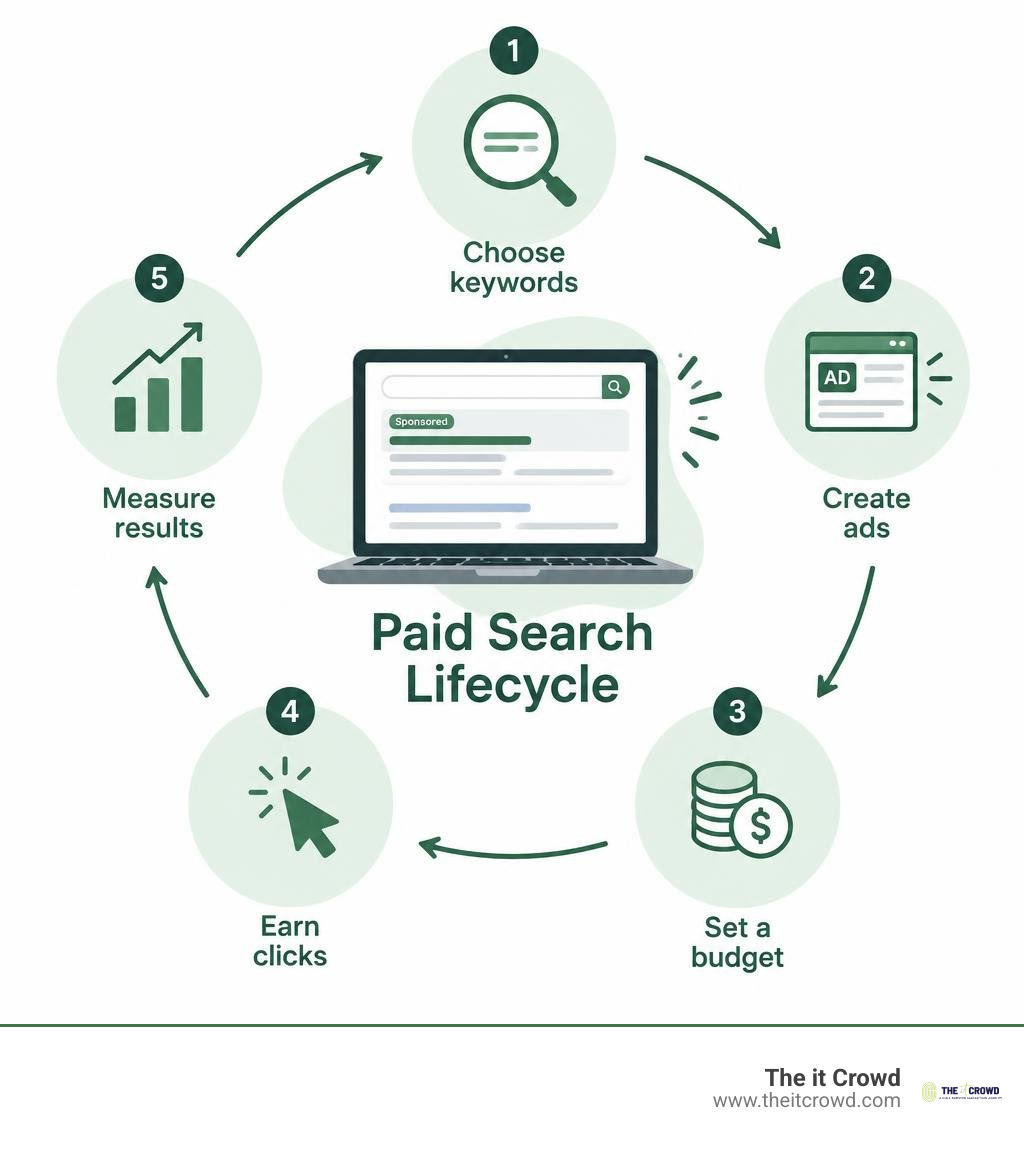
What Is Paid Search Advertising and How Does It Work?
Every day, billions of queries pass through major search engines. In fact, Google alone processes approximately 95.4 billion searches each month. Paid search advertising—often called pay-per-click (PPC) or search engine marketing (SEM)—lets businesses tap into this massive stream of high-intent searchers at the exact moment they look for answers, products, or services.
When a user submits a query into a search engine, an automated, lightning-fast auction takes place behind the scenes. Within milliseconds, the search platform evaluates every advertiser bidding on terms related to that query, selects the most relevant ads, and determines their visual position on the Search Engine Results Page (SERP).
Winning ads are displayed at the very top or bottom of the search results, accompanied by a clear “Sponsored” or “Ad” indicator. Under standard PPC billing, advertisers do not pay when their ad appears; costs are incurred only when a prospective customer actually clicks through to the website.
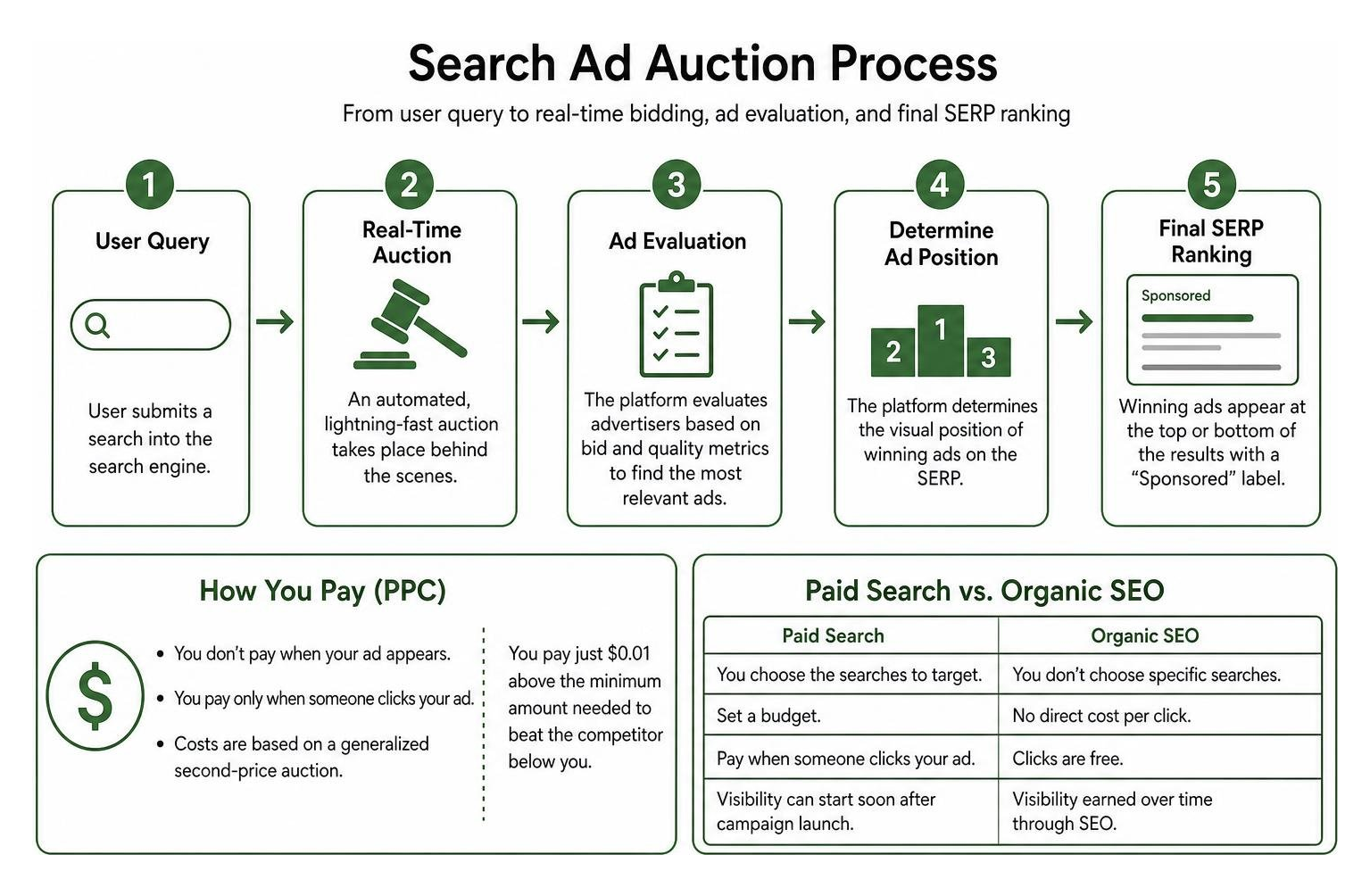
Major platforms rely on a generalized second-price auction model to calculate the actual cost per click (CPC). In this system, you do not automatically pay your absolute maximum bid. Instead, the auction determines your price by charging you just one cent ($0.01) above the minimum amount required to outperform the competitor ranking directly below you.
For instance, if you set a maximum bid ceiling of $5.00 on a target phrase and the next closest competitor’s bid and quality metrics only require a $3.00 threshold, your actual cost for that click is approximately $3.01. Understanding this system is essential to master the fundamentals outlined in Google’s official overview of search mechanics.
Paid Search vs. Organic SEO: Key Differences
While both paid search and organic search engine optimization (SEO) share the goal of driving targeted web traffic from SERPs, they operate on distinct timelines, investment models, and ranking mechanisms.
Organic SEO centers on optimizing your site architecture, technical health, content depth, and backlink authority. It builds durable, compounding value over months or years without direct media costs for clicks. However, earning top organic rankings for competitive terms requires substantial time and effort.
Paid search, by contrast, gives you direct, immediate visibility. As soon as you activate your campaign, your ads can secure premium placement above organic listings, allowing you to bypass the traditional ramp-up period.
| Attribute | Paid Search (PPC) | Organic SEO |
|---|---|---|
| Speed to Visibility | Immediate upon campaign launch and approval | Compounding growth over months or years |
| Ongoing Click Cost | Charged per click based on real-time auctions | Zero direct cost per click |
| SERP Positioning | Occupies top slots (up to 4 ads above organic results) | Displays below sponsored listings and local packs |
| Message Control | Instant control over copy, headlines, and destination URLs | Dependent on search engine indexing and page title tags |
| Traffic Sustainability | Traffic stops when budgets or campaigns are paused | Delivers sustained, residual organic traffic over time |
Rather than viewing these two disciplines as opposing tactics, the most effective marketing strategies deploy them in tandem. Industry studies consistently show that running search ads alongside high-ranking organic listings creates a powerful “1+1=3” synergy effect.
Because only up to four text ads can appear above the organic results on Google, capturing both a top sponsored position and the number-one organic slot allows your brand to dominate the SERP’s visual real estate. This dual presence reinforces credibility, discourages users from clicking competitor links, and generates a higher combined click-through rate than either channel could capture alone.
Core Benefits of Paid Search for Growing Businesses
Paid search provides a range of distinct advantages for growing organizations across both business-to-consumer and business-to-business sectors:
- Instant Access to Active Commercial Intent: Unlike social media ads that interrupt users as they scroll through personal feeds, search ads reach prospective buyers at the exact moment they actively seek a solution.
- Granular Audience and Geographic Targeting: Campaigns can be precisely targeted by zip code, city radius, language, device preference, and time of day, ensuring ad spend is concentrated on qualified leads.
- Actionable Behavioral Insights: Every impression, click, search term, and user action is recorded. This data reveals which value propositions convert best, providing valuable intelligence that helps in navigating modern advertising realities across all marketing channels.
- Precise Budget Control and Measurable ROI: Advertisers set strict daily budget limits that can be adjusted or paused at any time, with performance directly tied to revenue, form fills, or phone calls.
The Anatomy of the Search Ad Auction and Quality Score
Winning a prime position on the search results page does not simply come down to who has the deepest pockets. Search engines prioritize user satisfaction; delivering irrelevant ads degrades the search experience and reduces user trust. To ensure quality, search engines use a combined calculation known as Ad Rank to determine the placement and cost of every ad in an auction.
Ad Rank is primarily determined by two core inputs: your Maximum CPC Bid (the highest dollar amount you are willing to pay for a click) and your Quality Score.

Quality Score is a diagnostic metric graded on a scale of 1 to 10 assigned to each of your keywords. It evaluates how relevant and helpful your ad and landing page are to a searcher. The score comprises three components:
- Expected Click-Through Rate (CTR): An algorithmic prediction of how likely searchers are to click your ad when shown for that keyword, based on historical performance data and competitor benchmarks.
- Ad Relevance: How closely the messaging and phrasing in your ad copy align with the user’s explicit search query.
- Landing Page Experience: An assessment of whether your destination web page is transparent, easy to navigate, fast-loading, mobile-optimized, and directly related to what the ad promised.
A high Quality Score directly reduces your advertising costs. In the ad auction calculation, an advertiser with a high Quality Score of 9 or 10 can secure top-page ad positioning while paying significantly less per click than a competitor with a Quality Score of 3 or 4 who places higher bids. Maintaining high ad relevance and frictionless landing pages allows you to outrank competitors while keeping your budget efficient.
Step-by-Step Guide to Launching Your First Search Campaign
Launching a successful campaign requires careful planning. Rushing to activate ads without the right campaign structure or budget safeguards often leads to wasted spend. You can review our step-by-step process for setting up an advertising account to make sure your foundation is properly configured.
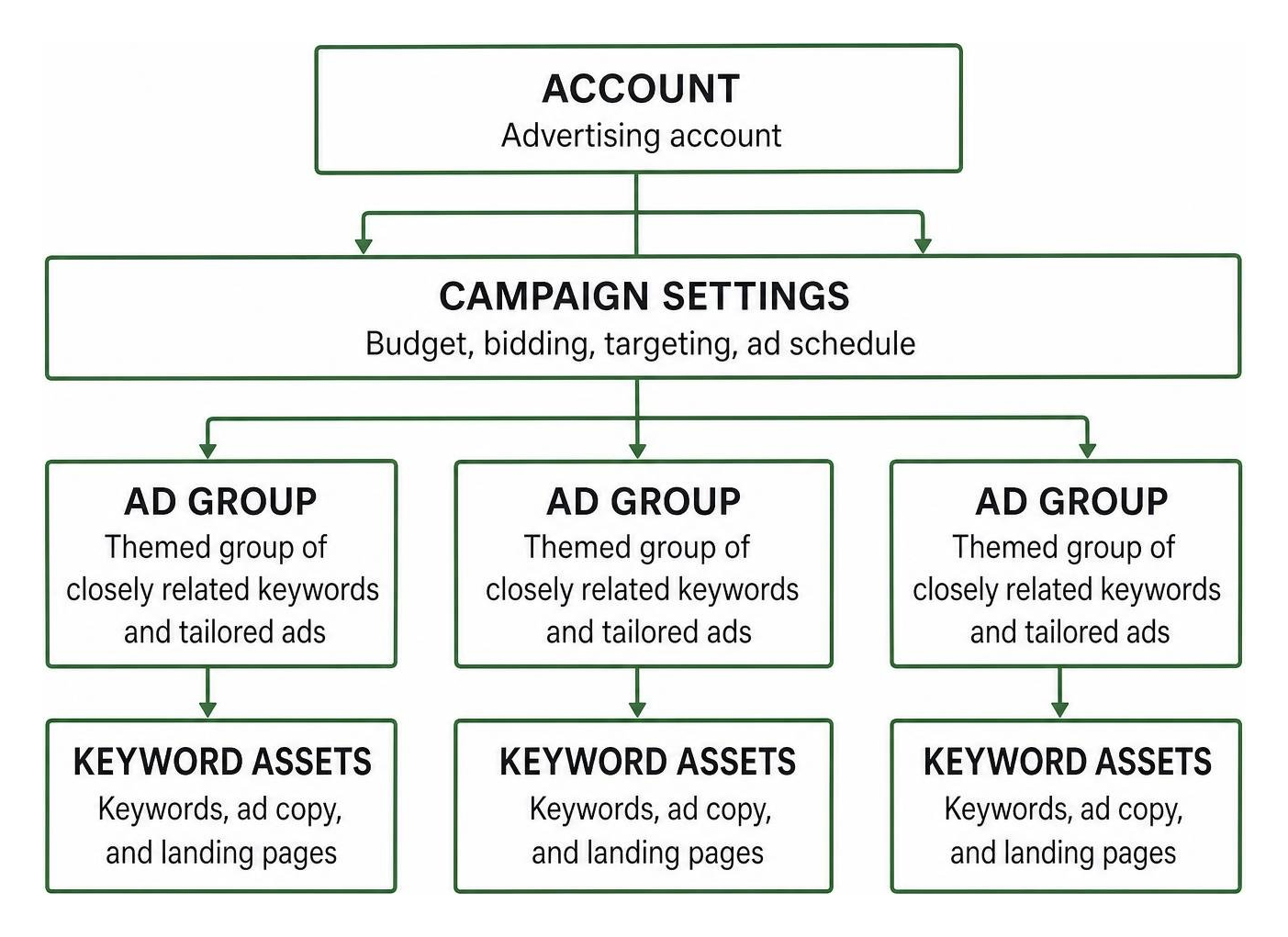
- Establish a Logical Account Hierarchy: Organize your account into dedicated campaigns divided by broad business goals, product categories, or geographic regions. Within each campaign, create tightly themed ad groups that contain closely related keywords and tailored ad copy.
- Configure Geographic and Language Targeting: Set your location settings to the specific areas where you can fulfill services or ship goods. Use radius boundaries around your physical facilities or select explicit cities and states while excluding non-service regions.
- Set Daily Budgets and Bidding Rules: Decide on a comfortable daily spend limit (calculated as your monthly budget divided by 30.4 days). Choose between manual bidding for direct cost control or automated smart bidding options (such as Maximize Conversions or Target CPA) once your account begins recording consistent conversion data.
- Schedule Your Ad Delivery (Dayparting): If your business depends on inbound phone calls during standard business hours, configure ad scheduling to show ads exclusively during the hours your sales team is available to answer.
Keyword Research and Match Type Selection
Keyword research uncovers the exact words and phrases your ideal customers type into search boxes. Using keyword research platforms, identify search terms that show clear commercial intent rather than purely educational browsing.
When building keyword lists, apply match types to control how closely a user’s search query must match your target keyword:
- Exact Match
[keyword]: Triggers ads only when a search query matches the exact meaning or close intent of your phrase. This offers the tightest control and highest relevance. - Phrase Match
"keyword": Triggers ads when a search query includes the core meaning of your keyword, even if extra words are added before or after. - Broad Match
keyword: Triggers ads for searches related to your keyword, including synonyms, related topics, and variations. While broad match maximizes reach, it requires careful monitoring to prevent off-target clicks.
To protect your budget from unqualified traffic, build robust negative keyword lists. Negative keywords tell search engines which queries should never trigger your ads. For example, if you sell premium, high-end commercial accounting software, adding negative terms like “free,” “open source,” “jobs,” and “classes” ensures your ads are hidden from non-buyers.
Crafting Compelling Ad Copy and Assets
Modern search engines rely heavily on Responsive Search Ads (RSAs). Instead of static text snippets, RSAs allow advertisers to supply up to 15 unique headlines and 4 descriptions per ad. The platform’s machine learning systems then test different headline and description combinations in real time to identify which variations earn the highest engagement for specific user queries.
To write high-converting ad copy:
- Highlight Unique Value Propositions: Clearly communicate what sets your business apart, such as transparent pricing, 24/7 service, certifications, or custom solutions.
- Include Clear Calls to Action (CTAs): Tell users exactly what step to take next, such as “Request an Estimate,” “Schedule a Consultation,” or “Order Online Today.”
- Avoid Policy Violations: Maintain professional editorial standards by avoiding all-caps text, excessive punctuation, and misleading claims.
- Leverage Ad Assets (Extensions): Enrich your ad listings with sitelinks to specific sub-pages, callout assets highlighting key benefits, direct phone numbers, and structured snippets detailing your services. Ad assets expand your visual footprint on the SERP, which naturally improves click-through rates.
Ensure your ad copy aligns directly with the destination landing page. If your ad highlights a promotional discount or a specific service package, send users to a dedicated page focused exclusively on that offer rather than a generic homepage.
Proven Best Practices for Optimizing Search Performance
Continuous optimization is what separates profitable advertising campaigns from underperforming ones. Once your ads go live, managing them requires active monitoring and data-backed refinements.

- Implement Granular Conversion Tracking: Set up tracking tags through your site container to measure primary conversion actions, such as completed checkout forms, quote requests, phone calls, and demo bookings. Without accurate conversion tracking, it is impossible to evaluate whether your spend is generating a profitable return.
- Prune Search Terms Routinely: Monitor the Search Terms Report to see the actual queries entered by users that triggered your ads. You can streamline this workflow by automating search query reports, which makes it easy to spot irrelevant queries and add them to your negative keyword lists.
- Monitor Competitor Movements: Search landscapes are dynamic. Competitors regularly adjust their bids, copy, and positioning. Routinely analyzing competitor search strategies helps you spot emerging keywords, promotional shifts, and messaging gaps in your local market.
- Re-Engage Past Site Visitors: A large portion of initial site visitors will leave without taking action. By configuring audience remarketing, you can re-engage users who previously visited your product pages with targeted follow-up messaging as they continue searching across the web.
Frequently Asked Questions About Search Advertising
How much budget is needed to start search advertising?
There is no fixed minimum spending requirement to start search advertising. Small, localized businesses can begin testing search campaigns with daily budgets between $10 and $30 per day.
However, your starting budget should reflect the average cost per click in your industry. In highly competitive sectors (such as legal, finance, or enterprise software), higher CPCs mean a larger daily testing budget is needed to generate enough statistical click volume to evaluate conversion rates effectively.
How many ads can appear at the top of Google search results?
Google SERPs are designed to display up to four sponsored text ads above the organic listings, with additional ad placements appearing at the very bottom of the page.
Whether your ad appears in those top four positions depends on your Ad Rank, Quality Score, minimum bid thresholds, and the overall competitiveness of the search term. Ads that include well-configured assets (like sitelinks and location extensions) frequently earn greater visual prominence within those top four spots.
How quickly do search ad campaigns generate leads?
Search ad campaigns deliver site traffic almost immediately after ads are reviewed and approved—often within a few hours of activation.
However, generating consistent, high-converting leads typically involves a ramp-up period of two to four weeks. During this early phase, campaign managers gather search term data, refine negative keywords, test ad copy, and allow automated bidding algorithms to optimize performance based on real conversion feedback.
Conclusion
Paid search advertising remains one of the most reliable, accountable, and direct ways to connect with high-intent prospects when they are ready to buy. By mastering the core mechanics of second-price ad auctions, optimizing your Quality Score, structuring your campaigns effectively, and continuously refining your keyword lists, you can build a predictable engine for business growth.
At The it Crowd, we build and manage data-driven search campaigns that integrate smoothly with web development, SEO, and creative branding. Backed by our proprietary AI infrastructure (“The Hive”) and our track record as the best search engine marketing firm in Dallas, our team helps businesses turn clicks into lasting customer relationships.
Ready to scale your business with paid search? Explore our expert search marketing solutions today.

