
TL;DR
- A pitch claiming “we get your brand” means nothing on its own. Here’s how to evaluate an agency’s case studies instead, before you sign anything.
- Real brand discovery leaves a trail: audience segmentation across more than one buyer type, documented baselines, and a strategy that was actually built for this client.
- Ask for the thinking behind the results. That’s what separates a strategic partner from a well-rehearsed pitch.
Picture the conference room. Three agencies, three decks, three variations on the same slide: “We really get your brand.” By the third pitch of the week, a marketing director at a mid-sized company can recite the line before the presenter finishes typing it. Here at The it Crowd, we’ve sat on both sides of that table enough times to know the phrase alone tells you nothing about real brand understanding.
Agencies aren’t lying when they say it. The phrase has just become table stakes—the marketing equivalent of “nice to meet you”—recited whether or not anyone behind it actually did the work.
But get the read wrong and the cost isn’t abstract: a quarter of stalled momentum, a budget line that doesn’t come back. How you actually tell if an agency understands your brand doesn’t happen in the room. It happens in the case studies, if you know how to read one.
Why “We Get Your Brand” Doesn’t Mean Anything Yet
Every agency says it, in the same tone, in the same slide-deck moment. That’s exactly the problem: a claim everyone makes stops functioning as information and starts functioning as noise, no matter how sincerely it’s delivered. None of it proves brand understanding on its own.
The Reassurance That Isn’t
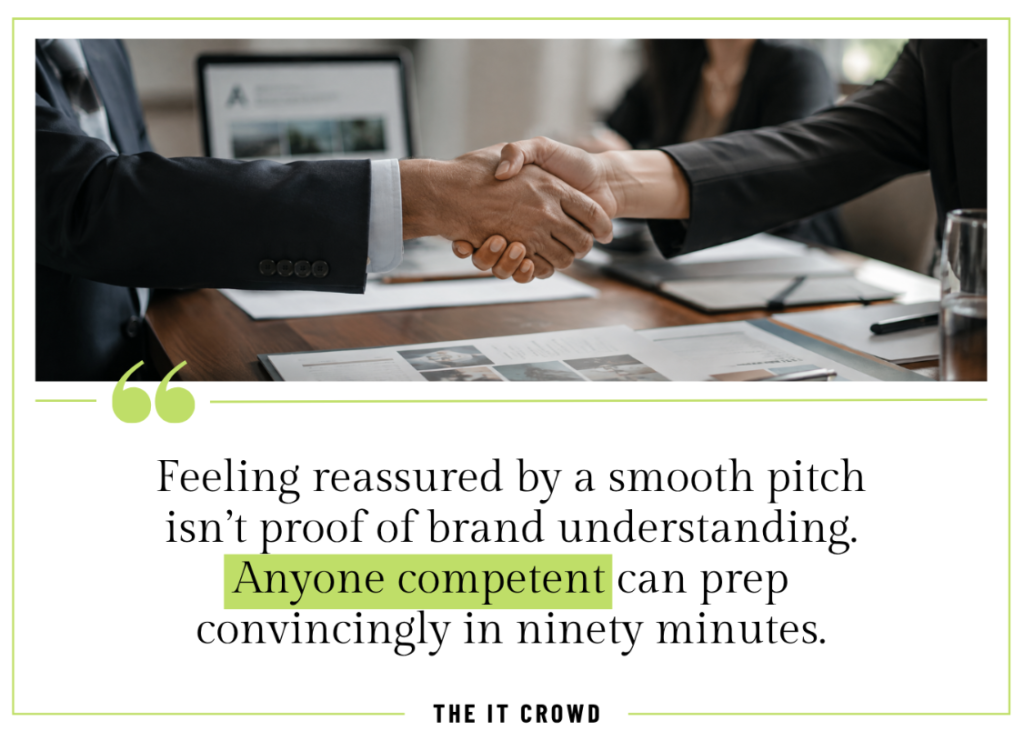
Most people leave a strong pitch feeling reassured. The team nodded at the right moments, used your own language back at you, name-dropped your competitors correctly. It read like proof.
It wasn’t. Repeating a client’s positioning back to them takes research. It doesn’t take understanding, and anyone competent can prep for ninety minutes.
What’s actually on the table is bigger than one pitch: companies whose customers clearly grasp their core identity capture close to double the share of wallet of ones who don’t, per Gallup’s brand alignment research. That gap is what a convincing but empty pitch puts at risk, and it’s the reason brand equity shouldn’t be gambled on a good first impression.
The Understudy Problem
An understudy learns every line, hits every mark, and can get through the show without a single dropped cue. What they haven’t done is live inside the part long enough to make a choice nobody told them to make. Audiences can’t always say what’s missing—but they can sense it.
That’s what generic content actually looks like up close: writing that could belong to any competitor with the names swapped, because nobody bothered to find out what makes this client different in the first place. The pitch can’t settle that question. The case study can, if you know what to look for in one.
What Does a Real Brand Discovery Process Actually Look Like?
A real brand discovery process produces evidence of specific choices: what a client’s audience actually expects from anyone in their category, where the client differs from competitors making similar claims, and which of those differences were worth keeping versus smoothing away. If a case study can’t show any of that, discovery didn’t happen. Research did, but research alone doesn’t build a strategy.
What the Walk-Through Misses
A real estate listing photographs the staged rooms and the fresh coat of paint. It doesn’t show the wiring behind the wall or the water stain someone covered up last week. Buyers who know better ask to see behind the surface, because a listing is built to look finished, not to tell the truth about what’s actually there.
That’s what qualitative client interviews are for: unscripted conversations that go past the polished brief a client hands over on day one. A case study built on a fifteen-minute intake call and a brand questionnaire is the listing photos. One built on actual conversations with the people who lived through the account is the inspection, and the difference shows up in the work months later.
The Competitive Frame Test
HBR’s brand positioning framework, developed by Kevin Lane Keller, Brian Sternthal, and Alice Tybout, argues strong positioning needs more than a list of differentiators. As they put it, “points of differentiation alone are not enough to sustain a brand against competitors.” An agency also needs to understand the client’s competitive frame of reference and the points of parity customers already expect before deciding where differentiation should begin.
A case study that holds up shows that thinking somewhere in the work: where the agency decided the client belonged before it decided what to say about them. That’s target audience understanding with a paper trail behind it, and a paper trail is what separates a documented content strategy from a lucky guess.
Reading Past the Results: What the Case Study Should Actually Show
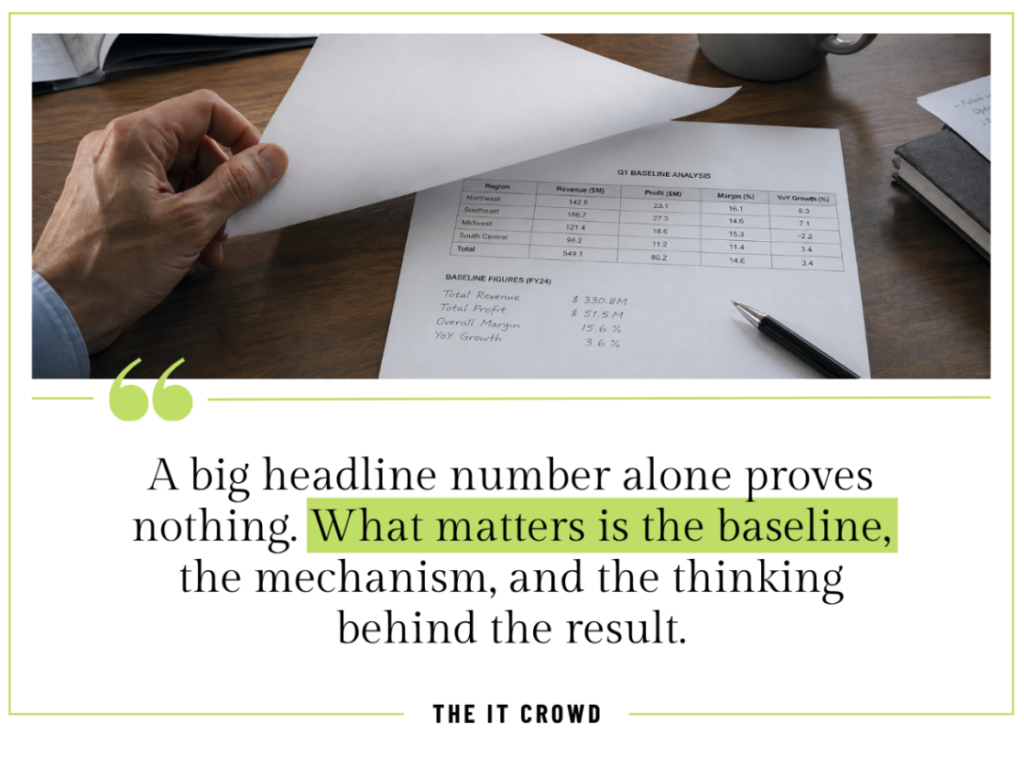
Here’s the harder question: does the case study explain what changed, or does it just report a number and hope momentum covers the gap?
Most case studies open with a headline metric and work backward, if they work backward at all. The credible ones show their math, and they tend to share a few things in common. A headline number by itself proves an agency can format a slide. It proves nothing about the decisions that got them there. Look for:
- Baseline performance metrics – A percentage means nothing without the number it started from. “Increased engagement 40%”—from what, exactly, and over what stretch of time?
- Target audience understanding for more than one segment – One flattering result from one audience is a coincidence until it repeats again, with a different buyer who wants something else entirely.
- A visible custom marketing strategy – Evidence the plan was built for this client’s category and constraints, not adapted wholesale from whatever worked for the last account.
- A named mechanism – What specifically changed, and why that specific thing moved the number, laid out clearly enough that you could explain it back to someone else.
When you look at the outcome, ask what improved. When you look at the thinking, ask what they understood.
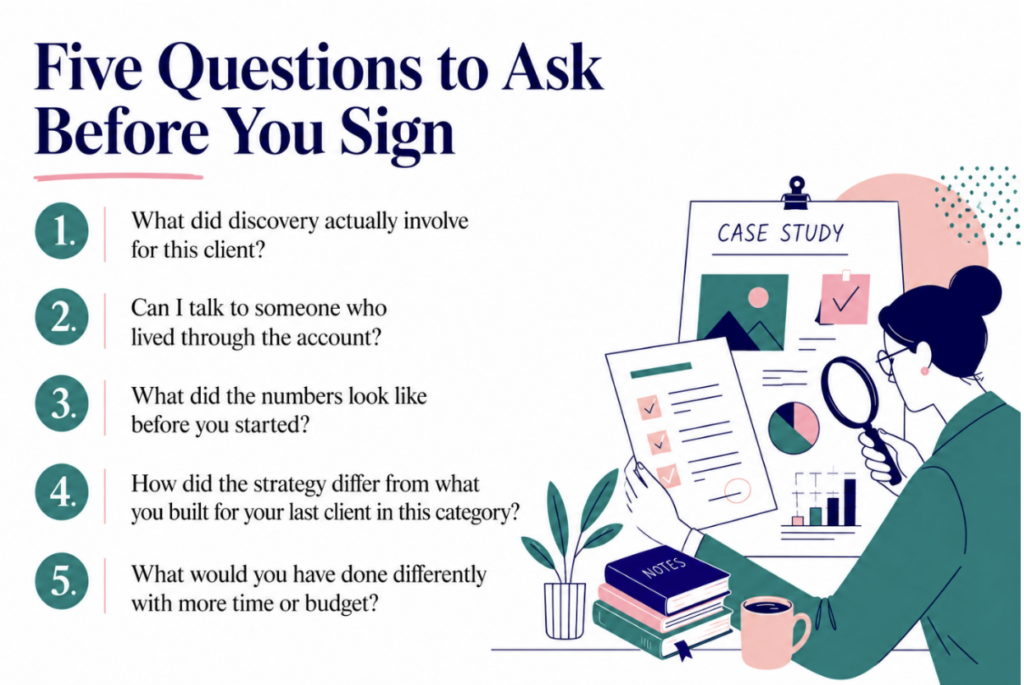
Five Questions to Ask Before You Sign
the agency selection process most buyers skip: the actual interrogation. Ask these five directly, in the room or over email, and watch how specifically they get answered.
- What did discovery actually involve for this client? A named process beats a vague reference to “getting to know the brand.”
- Can I talk to someone who lived through the account? Not the case study’s headline contact. Someone who worked the engagement week to week and remembers what went sideways.
- What did the numbers look like before you started? If nobody remembers the baseline, nobody was tracking one, and that tells you something about how the whole engagement was run.
- How did the strategy differ from what you built for your last client in this category? A templated answer here is the clearest tell available, and it usually comes fast.
- What would you have done differently with more time or budget? Agencies doing real work have an answer ready. Ones running a script change the subject.
Pair this list with a hard look at whether the agency is actually built for B2B growth, or just built for the pitch. These questions don’t require confrontation, only follow-through, and follow-through is most of what marketing agency evaluation actually is.
Why This Is Still a Business Decision, Not a Gut Call
Picture the debrief after four pitches. Everyone in the room liked the same agency, though nobody can quite explain why beyond a feeling that this one just got it.
That feeling is real, but it’s also not enough on its own. The people accountable for the decision—whether that’s one founder or a full B2B buying committee—need something sturdier to point to than a good feeling in the room.
Third-party evidence tends to outweigh a supplier’s own claims about itself. Gartner’s research on B2B buying behavior puts the gap at roughly 1.4 times in favor of the third-party source, with analyst Rick LaFond noting that “buyers want to feel confident throughout their purchase journey.” That’s the role a credible case study should play: not decoration for the pitch, but evidence that helps a buyer verify it.
Getting this wrong costs months: a fresh discovery process, a colder restart, a budget line spent twice. If you want a fuller framework for making the call, we’ve mapped it out when picking the right strategic marketing partner for growth.
What This Looks Like at The it Crowd
When we took on wilsonbauhaus, the work spanned four institutional verticals that don’t think alike: healthcare facilities directors, university procurement officers, government buyers, corporate ones. Two of those verticals are fully live now; two are still rolling out on a monthly cadence, which is its own quiet proof that a documented content strategy is not a one-time deliverable.
Before a word of copy got written, meeting recordings were transcribed into reference material, and old client emails got pulled in too: unscripted messages that go beyond the tidied-up brief clients usually hand over. The visual side ran the same way. Rather than starting from a fresh photo shoot, the existing material got studied and expanded into a full library, different angles, different environments, all submitted with disclosure and published only after approval.
Beth Wimer, wilsonbauhaus’s CEO, put it this way: “Most agencies need several rounds before the output actually sounds like you. The it Crowd got there faster than anyone we’ve worked with, and they did it consistently across four completely different audiences.”
That range—one voice translated four different ways without flattening into generic—is what discovery is supposed to produce. It’s also exactly what a case study should show its work on doing.
A pitch with no case study behind it is a promise with no collateral: confident, well-rehearsed, and unverifiable. A pitch backed by a case study that shows its discovery process, names its baseline, and demonstrates range across more than one audience is something else entirely: evidence you can actually act on.
If you’re deep in an agency selection process right now and want a second set of eyes on what you’re being shown, that’s a conversation we’re glad to have. No pitch deck required.

