

Master the Art of Brand Awareness with Breakthrough Campaign Ideas
Marketing Strategies for Brand Awareness That People Remember
To build brand awareness, make your business easy to recognize and easy to remember when a customer needs you. Start with a clear promise and consistent visuals. Then publish useful content, show up where your audience already spends time, and build trust through partnerships and word-of-mouth. Add paid ads only when you know which message and audience you want to reach.
Track more than clicks. A short customer survey can test whether people recognize or recall your brand. Branded searches and direct website visits can show whether more people are looking for you by name.
I’m Lindsey Huettner, owner of The it Crowd. For more than 19 years, I’ve helped businesses connect branding, content, SEO, and paid media into marketing strategies for brand awareness that they can measure.
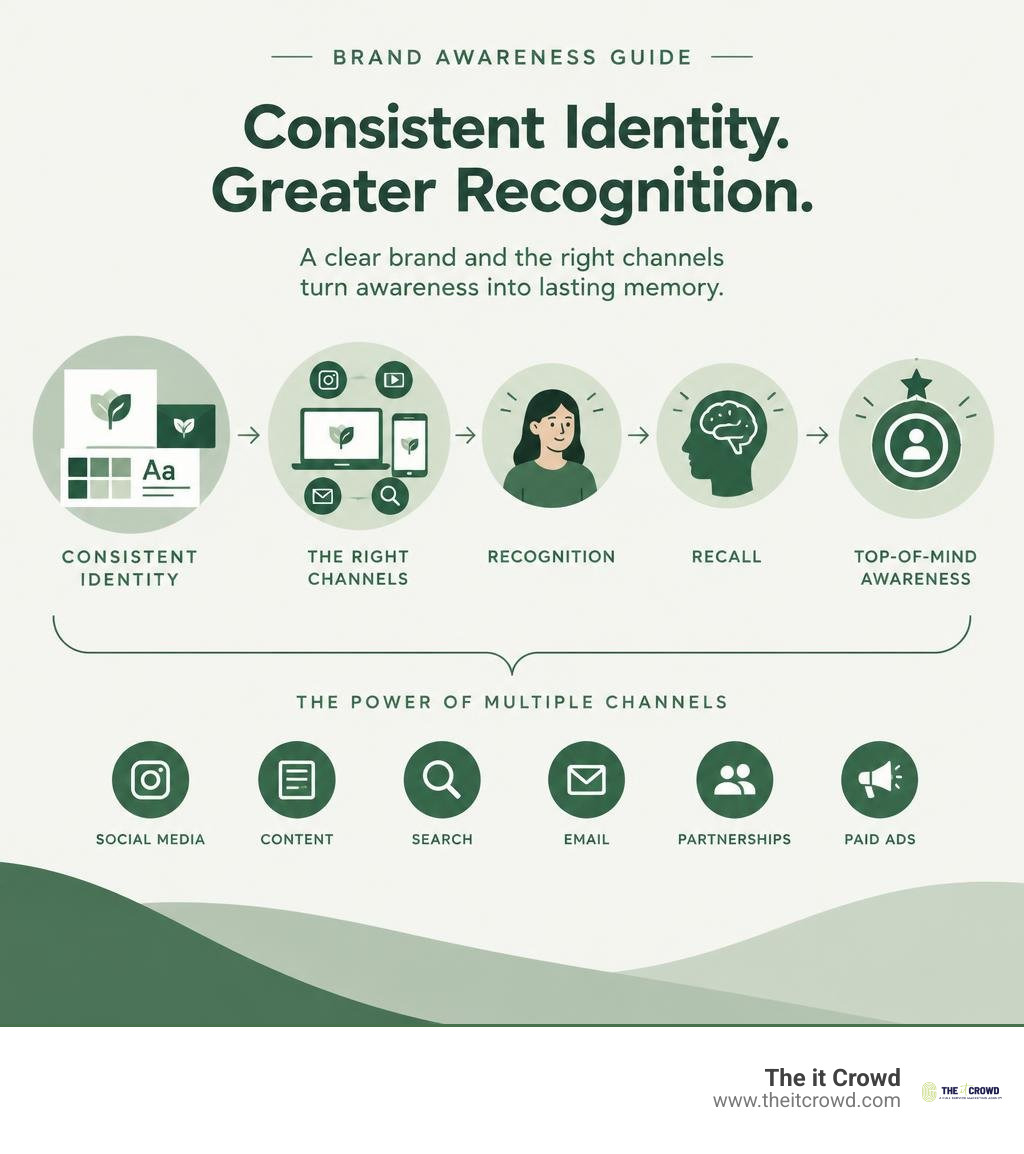
Aligning Brand Identity and the Marketing Mix
Before spending a dollar on ad placements or launching a splashy social campaign, your business must establish a rock-solid foundation. Brand awareness is not just about raw noise; it is about building durable memory structures in the minds of your target audience. If your identity is muddy, pumping budget into marketing channels will only accelerate how quickly people forget you.
True brand building begins by harmonizing your core identity with strategic marketing frameworks. At The IT Crowd, we emphasize foundational brand positioning that anchors what makes your business irreplaceable. When paired with a cohesive branding and corporate identity, your business presents an unmistakable face to the world across every customer touchpoint.
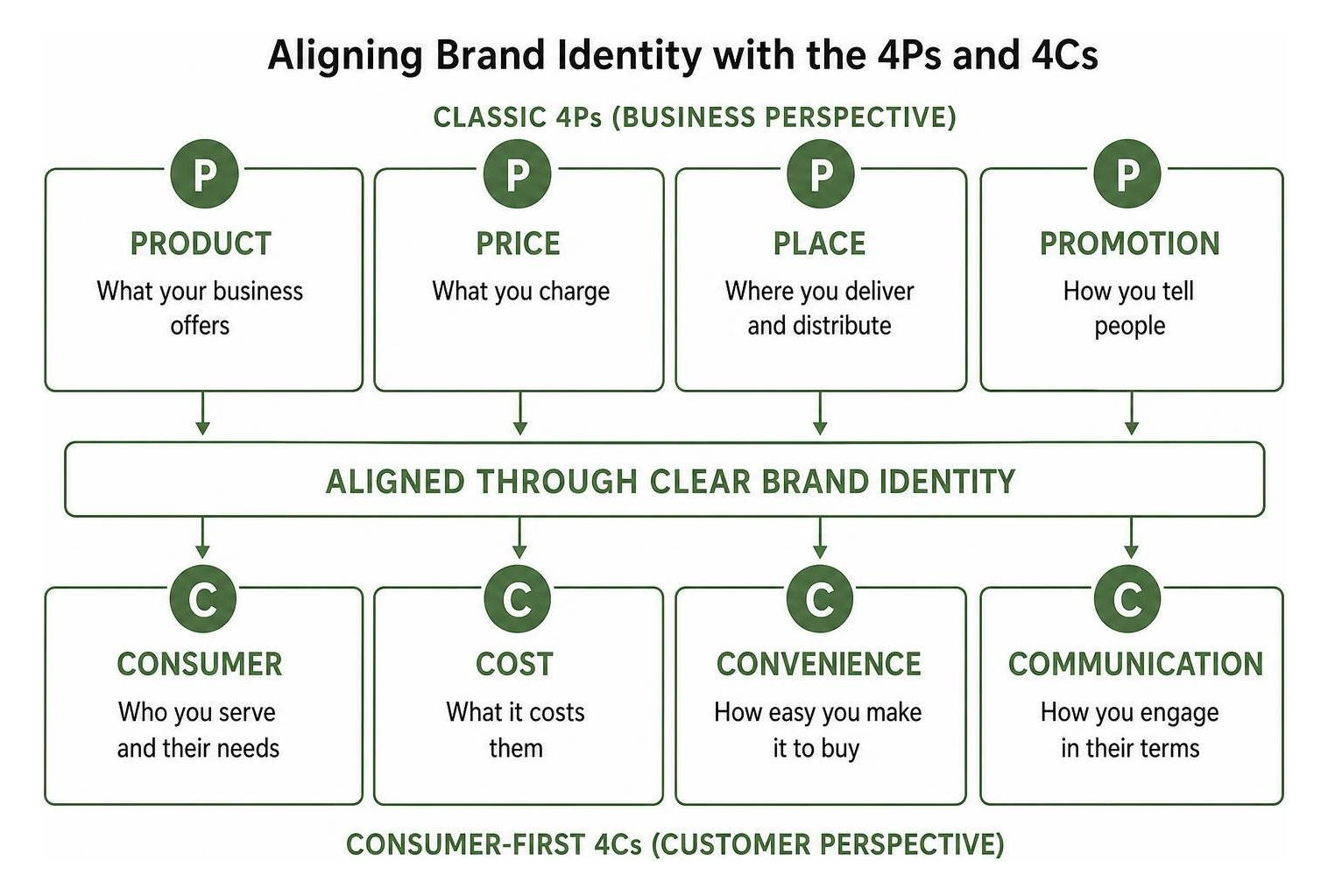
The 4Ps and 4Cs Framework for Brand Visibility
The traditional marketing mix—Product, Price, Place, and Promotion—originated in the 1960s to structure operational go-to-market decisions. However, modern awareness campaigns require translating these operational levers into consumer-centric realities, known as the 4Cs: Consumer, Cost, Convenience, and Communication.
Aligning these models ensures that what you sell matches how buyers actually discover and evaluate solutions.
| Marketing Dimension | Classic 4Ps (Product-Centric) | Modern 4Cs (Consumer-Centric) | Impact on Brand Awareness |
|---|---|---|---|
| Offering | Product: Features, capabilities, and specifications. | Consumer Wants & Needs: Solving real pain points and functional desires. | Positions your brand as an empathetic problem solver rather than a feature list. |
| Value Perception | Price: Retail cost, profit margins, and discounting structures. | Cost to Satisfy: Total investment, including time, effort, and perceived risk. | Eliminates friction and establishes your market tier (budget, mid-market, premium). |
| Access | Place: Physical storefronts or distribution channels. | Convenience: Ease of discovery, mobile access, and seamless purchase flows. | Reduces cognitive load so consumers encounter you where they already hang out. |
| Interaction | Promotion: Broadcast advertising, PR bursts, and direct sales. | Communication: Two-way dialogue, educational storytelling, and community engagement. | Builds brand recall through repeated, meaningful interactions instead of one-way sales pitches. |
Visual Assets, Voice, and Messaging Architecture
Memory is visual, verbal, and emotional. Think of the world’s most recognizable organizations: McDonald’s golden arches, Nike’s swoosh, or Coca-Cola’s dynamic ribbon. These are distinct brand assets that trigger instant recognition in fractions of a second.
To build these assets for your own brand, you need:
- Distinctive Visual Assets: Consistent primary and secondary color palettes, clear typography standards, and recognizable layout motifs across digital and print collateral.
- An Unmistakable Brand Voice: A defined tone—whether witty, authoritative, or deeply empathetic—that never wavers between blog posts, ad copy, and customer support.
- A Strategic Messaging Architecture: A structured framework featuring 2–4 core messaging pillars tied directly to customer triggers.
When your visual and verbal elements remain consistent across platforms, you reduce cognitive friction. Potential clients do not have to re-learn who you are every time they see your content.
Proven Marketing Strategies for Brand Awareness Across Multiple Channels
A sustainable brand awareness engine does not rely on a single channel. Relying exclusively on paid ads creates an expensive dependency, while relying entirely on organic algorithms leaves you vulnerable to sudden platform shifts.
The most effective blueprint blends owned, earned, and paid channels into an integrated ecosystem. As detailed in the Brand Awareness Strategy guide, balancing organic community touchpoints with structured amplification generates compounding brand equity.

High-Impact Content Marketing Strategies for Brand Awareness
Content is the bedrock of organic discovery. According to the Content Marketing Institute, content marketing drives brand awareness for 87% of B2B marketers. Furthermore, research shows that a week after reading educational content, 73.3% of consumers rate a brand as trustworthy—a 9% increase compared to their initial impression.
To turn content into a genuine brand builder, focus on high-impact formats:
- Educational Deep-Dives: Comprehensive guides and industry breakdowns position your team as definitive experts.
- Podcasting & Audio: Long-form conversations build an intimate relationship with listeners that short-form text cannot match.
- Generative Engine Optimization (GEO): As search evolves with AI engines like ChatGPT and Google Gemini, structuring your content for AI retrieval ensures your brand is cited as a primary authority.
- Short-Form Video: Distilling complex concepts into punchy 60-second explainers meets modern consumption habits—especially when the average person spends 2 hours and 21 minutes a day on social media.
Pairing high-impact content strategy and planning with advanced SEO and geo content optimization ensures your knowledge base ranks at the top of search engine results pages and AI summaries alike.
Earned Media, PR, and Strategic Partnerships
Earned media creates third-party validation that money cannot buy directly. When an industry journalist, complementary business partner, or respected creator endorses your work, their established trust transfers to your brand.
You do not need a massive PR agency to earn high-value coverage. Effective zero-budget awareness plays include:
- Non-Competing Co-Marketing: Co-host webinars, publish joint research reports, or swap newsletter features with brands that share your target audience.
- Digital PR via Original Data: Survey your customer base or analyze proprietary platform trends. Journalists love quoting original statistics.
- Creator Collaborations: Partnering with niche creators who hold deep credibility in your sector builds genuine goodwill.
- Strategic Alliances: Invest in building authentic brand partnerships to tap into established audiences looking for adjacent solutions.
As outlined in the Brand Awareness Strategy playbook, systematic co-marketing and earned PR often outperform paid ad traffic because the initial touchpoint comes with built-in credibility.
Targeted Paid Advertising and Awareness Campaigns
While organic channels build long-term equity, paid media provides rapid reach and control. Instead of treating paid ads strictly as bottom-of-funnel direct-response tools, use them to guarantee message distribution.
Key awareness ad strategies include:
- Pre-Roll Video Ads: In-stream video generates powerful recall. Studies demonstrate that video ads can achieve up to 33% unaided recall after a single view, outperforming static feeds.
- Top-of-Funnel Social Reach: Run Meta and LinkedIn campaigns optimized for broad target-audience reach and video completion rather than immediate conversions.
- Retargeting Loops: Build audience pools of individuals who engaged with your top-of-funnel educational assets, serving them secondary brand stories to solidify memory.
- Frequency Capping: Avoid ad fatigue by capping delivery at 3–5 impressions per user per week.
Leveraging targeted paid social advertising alongside scalable awareness ad formats allows you to introduce your narrative to high-value prospects without draining your budget.
Navigating Channel Execution for Different Business Models
Not all awareness campaigns are built alike. A direct-to-consumer apparel brand requires an entirely different emotional trigger and channel mix than an enterprise cyber-security platform. Aligning your distribution channels with your buyer’s psychology is essential. Utilizing a multi-channel lead generation approach ensures you show up consistently across every stage of the evaluation process.
Tailoring B2B vs B2C Marketing Strategies for Brand Awareness
The fundamental difference between B2B and B2C brand building lies in decision velocity, risk profile, and buying structure:
- B2C Awareness: Focuses on single-buyer emotional resonance, rapid checkout convenience, and lifestyle alignment. Tactics lean heavily toward short-form visual storytelling, viral social activations, and micro-influencer reviews.
- B2B Awareness: Addresses multi-stakeholder buying committees where professional risk is paramount. Tactics require educational whitepapers, executive thought leadership on LinkedIn, proprietary research, and podcast sponsorships.
| Dimension | B2B Brand Awareness Strategy | B2C Brand Awareness Strategy |
|---|---|---|
| Primary Audience | Multi-stakeholder committees, C-suite, managers | Individual consumers, households |
| Core Value Driver | ROI, risk reduction, efficiency, trust | Emotion, lifestyle fit, status, convenience |
| Top Channels | LinkedIn, industry podcasts, search, webinars | Instagram, TikTok, YouTube, creator partnerships |
| Key Content Formats | Original research reports, case studies, deep guides | Short-form video, lifestyle imagery, user-generated content |
| Primary Awareness KPIs | Branded search volume, executive reach, pipeline influence | Share of voice, follower growth, direct web traffic |
Critical Mistakes That Derail Brand Awareness
Building awareness takes patience. Unfortunately, many businesses self-sabotage their growth by treating brand building like a quarterly performance hack.
Review these common marketing mistakes that undermine brand visibility:
- Premature Rebranding & Visual Amnesia: Changing logos, color schemes, or brand taglines every six months destroys hard-earned visual memory structures. Consistency beats novelty.
- Optimizing Exclusively for Clicks: Measuring top-of-funnel brand content using bottom-of-funnel direct-response metrics leads to sensationalized clickbait that damages brand trust.
- Ignoring Category Entry Points (CEPs): Creating entertaining content that fails to connect to the specific real-world moments when a customer actually needs your service.
- The “One-and-Done” Campaign Trap: Running a 30-day awareness push and going silent for the rest of the year. Memory fades quickly; steady, baseline consistency is mandatory.
- Trying to Be Everywhere at Once: Spreading resources across six social networks, a podcast, a YouTube channel, and print ads without the operational capacity to maintain quality on any of them.
Setting Measurable Objectives and the 90-Day Action Plan
A common criticism of brand awareness is that it is “unmeasurable.” That is simply untrue. While you cannot track awareness with the same linear attribution as a paid search click, you can track clear indicators of market presence.
Combining rigorous market research and competitor analysis with a complete marketing strategy lets you set empirical benchmarks and track compounding awareness quarter over quarter.
Tracking Free and Low-Cost Brand Awareness Metrics
You do not need six-figure enterprise monitoring software to track brand awareness. You can build a comprehensive awareness dashboard using free and accessible tools:
- Google Search Console (Branded Query Volume): Monitor impressions and clicks for your exact company name and product variations. A steady upward curve indicates rising market recall.
- Google Analytics 4 (Direct Traffic): Track users typing your URL directly into their browser or opening bookmarks. Rising direct traffic is a direct proxy for brand recall.
- Social Listening & Share of Voice: Track untagged brand mentions, hashtag usage, and comment sentiment using free social search alerts or lightweight monitoring tools.
- Unaided Recall Surveys: Include a simple, open-ended question on your onboarding forms: “When did you first hear about us?” or “What other brands did you consider before choosing us?”
The 90-Day Zero-to-Awareness Launch Roadmap
If you are starting from zero awareness, execute this phased 90-day plan to build sustainable market visibility:
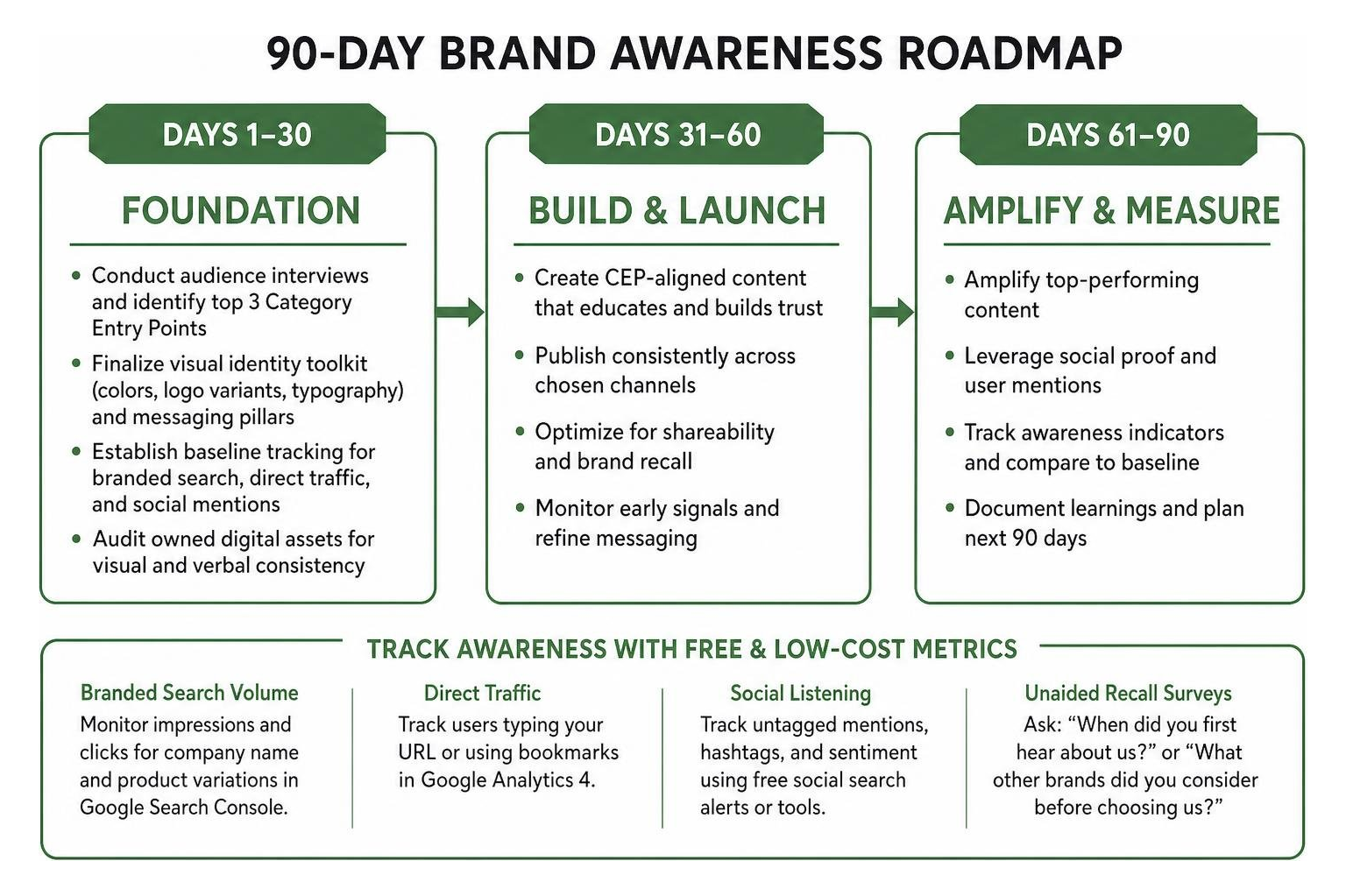
Days 1–30: The Foundation Phase
- Conduct audience interviews and identify your top 3 Category Entry Points.
- Finalize your visual identity toolkit (colors, logo variants, typography) and messaging pillars.
- Establish baseline tracking for branded search volume, direct traffic, and social mentions.
- Audit all owned digital assets (website, social profiles, email templates) for visual and verbal consistency.
Days 31–60: The Distribution & Content Engine
- Launch your primary owned content channel (e.g., in-depth weekly articles or technical video guides).
- Begin active daily engagement on your chosen primary social platform (e.g., LinkedIn for B2B, Instagram/TikTok for B2C).
- Initiate outreach to 5 non-competing partner brands for co-marketing or guest-expert features.
- Set up baseline retargeting pixels across your web properties.
Days 61–90: Amplification & Community Activation
- Deploy targeted awareness ads (pre-roll video or sponsored content) driving to your best-performing educational assets.
- Publish your first co-marketing project or original data study.
- Review 60-day baseline metrics in Google Search Console and GA4 to identify top-performing topics.
- Refine publishing frequency and double down on the single organic channel delivering the strongest community engagement.
Frequently Asked Questions About Brand Awareness
What is the difference between brand recognition, brand recall, and top-of-mind awareness?
These three metrics represent ascending levels of consumer memory retrieval:
- Brand Recognition (Aided Awareness): The consumer can identify your brand when presented with a list of names, logos, or packaging. (e.g., “Which of these five CRM logos do you recognize?”)
- Brand Recall (Unaided Awareness): The consumer spontaneously names your business when prompted by a product category. (e.g., “Name three project management software tools.”)
- Top-of-Mind Awareness: Your brand is the very first name that comes to mind when a category or problem is mentioned. (e.g., “What brand comes to mind first when you think of athletic footwear?” -> “Nike.”)
How do Category Entry Points (CEPs) influence brand awareness?
Category Entry Points are the situational cues, internal thoughts, and buying environments that prompt a consumer to look for a solution. For example, a CEP for a meal-kit delivery service might be “It is 6:00 PM on a Tuesday, I have no groceries, and I want a healthy meal.”
By linking your brand assets directly to these specific moments in your content and ad creative, you ensure that your brand is retrieved from memory when that exact need arises.
How long does it take to see measurable results from a brand awareness campaign?
While initial micro-indicators (such as social engagement, video completion rates, and referral traffic) appear within the first 30 to 45 days, meaningful brand recall compounds over time.
Expect to see noticeable shifts in branded search volume, direct website visits, and customer survey mentions between months 3 and 6 of consistent execution. True top-of-mind category dominance requires ongoing, multi-year consistency.
Conclusion
Building lasting brand awareness is not about chasing ephemeral viral trends or burning capital on disconnected ad bursts. It is an intentional, compounding process that bridges sharp positioning, distinctive visual memory structures, educational content, and steady multi-channel distribution.
When your brand shows up with clarity and consistency, you lower buyer hesitation, shorten sales cycles, and build sustainable market equity that endures across market shifts. Review our breakdown of effective branding dos and don’ts to refine your visual and verbal foundation, or connect with our team at The IT Crowd to turn your market expertise into a high-visibility brand engine.

