

A marketing audit is a structured review of what your campaigns, content, and channels are actually producing, measured against what you set out to do in January.
Picture a CMO in June, staring at a dashboard full of steady traffic, a packed content calendar, three campaigns still technically “live.” Everything looks busy. Then someone in a leadership meeting asks which of it turned into revenue this quarter. The room goes quiet. No one has looked closely enough to have an answer.
That silence is the moment a plan stopped being a strategy and became a routine.
August is when the silence gets uncomfortable enough to act on. Eight months into the year, most marketing plans have quietly drifted from the strategy that shaped them.
What this article covers:
- Why marketing plans drift between January and August
- What a real audit measures
- A practical checklist for finding what’s actually working
- What to do once you know
Why Plans Drift by Q3
In January, every campaign has a reason. A channel gets chosen because it fits the audience, a piece of content gets greenlit because it maps to a specific goal, a budget line gets approved because someone can point to what it’s supposed to produce.
By August, the reasons have been replaced by defaults. The campaign that launched in Q1 is still running on last quarter’s momentum, with no one having circled back to check it. The content calendar fills a slot because the slot exists. Approvals that once required a rationale now happen because the last version was approved too.
None of this looks like failure from the inside. Dashboards still show activity, meetings still happen. Forbes Business Council points to baselining metrics as one of the quieter signs something has stopped working: numbers that hold steady instead of moving, in either direction. A campaign nobody can explain, a channel funded out of habit, content built because “we always do one of these.” Together, they mean the strategy stopped steering the plan months ago.
That gap between what was decided and what’s running is what a reckoning closes: a full stop, where every campaign has to explain itself again or lose its place on the calendar.
That gap between what was decided and what’s running is what a reckoning closes.
What a Real Audit Measures
Traffic and impressions used to be the default proof of a healthy marketing plan. That default no longer holds. As the shift toward AI-driven search has shown, a page can rank well and still go unseen, cited nowhere, driving nothing. Visibility and conversion quality now say more than volume ever did.
How to audit your marketing strategy starts with the right questions, not the usual metrics. In The Marketing Audit Handbook: The Art of Asking the Right Questions, Dawid J. Malherbe frames the audit process around targeted questions rather than a standard scorecard, questions built to surface a company’s actual strengths, weaknesses, market position, and strategic gaps. The approach matters because measurement becomes habitual. Teams keep reporting the same metrics long after customer behavior, search platforms, and buying journeys have moved on.
A real audit replaces the reflex with a shorter, sharper set of questions:
- Is the brand showing up in AI-generated answers, not just search rankings?
- Are the leads converting, or just arriving?
- Is branded search growing, meaning people are searching for the business by name?
- Can any given lead be traced back to the channel that actually produced it?
None of these live on a standard dashboard. All of them tell you more than a traffic report does.
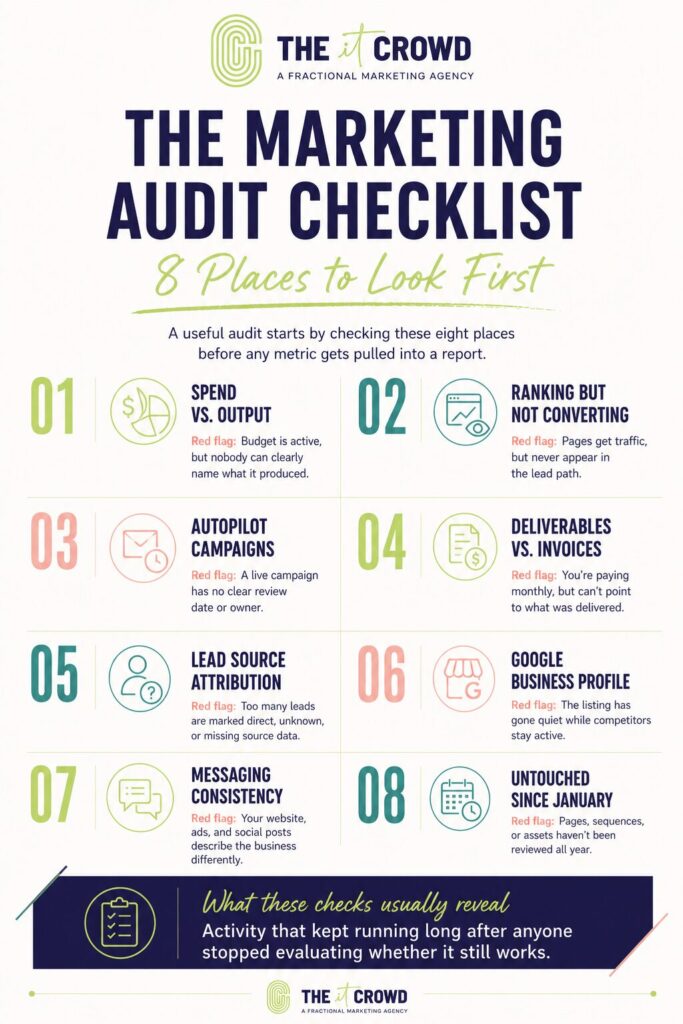
The Marketing Audit Checklist: 8 Places to Look First
A useful audit doesn’t start with a spreadsheet. It starts with eight specific places, checked in order, before any metric gets pulled into a report.
- Channel-by-channel spend vs. output.
List every channel getting budget and what it produced last quarter, side by side. A red flag: a channel that’s absorbed the same spend for two quarters running with no one able to name what came out of it. Example: paid social has taken 20% of the budget since March, but the only report anyone can produce is a follower count. - Content that’s ranking but not converting.
Pull the pages getting traffic and check what happens after someone lands there. A red flag: a blog post in the top five organic results with a bounce rate north of 80%. Example: a “how to” guide ranks well for its keyword, gets steady visits, and has never once appeared in a lead’s attribution path. - Campaigns running on autopilot.
Find every campaign still live and ask who last reviewed its performance and when. A red flag: a campaign nobody can date the last review of. Example: an email nurture sequence built in February is still sending in August, untouched, to a list that’s grown by 40% since launch and no longer matches the segment it was written for. - Agency or vendor deliverables vs. invoices.
Line up what’s being paid for against what’s actually landed. A red flag: a monthly retainer with no corresponding monthly output to point to. Example: a $3,000/month SEO retainer with no report, no keyword movement, and no one on the team who’s seen a deliverable in 90 days. - Lead source attribution gaps.
Trace a handful of recent leads back to their actual origin channel. A red flag: leads logged as “direct” or “unknown” at a rate that’s climbing, not shrinking. Example: a third of last month’s leads have no source field filled in, which means a third of the budget’s real performance is invisible. - Google Business Profile and local signals.
Check when the GBP listing was last updated with new photos, posts, or review responses. A red flag: a listing that’s gone 30+ days without activity. Example: a review from six weeks ago sits unanswered while a competitor’s profile shows a response within the day, and the ranking gap between the two has started to widen. - Messaging consistency across channels.
Compare the value proposition on the website, in ad copy, and in the last three social posts. A red flag: three different descriptions of what the business actually does. Example: the homepage leads with “strategic partner,” the ad copy leads with “affordable pricing,” and the two have never been reconciled in a single meeting. - What hasn’t been touched since January.
Look for the pages, sequences, and assets nobody has opened all year. A red flag: anything untouched since the plan was written. Example: a pricing page built in Q1 still reflects a service lineup that’s since changed twice, and no one has flagged the mismatch.
Each of these takes minutes to check and tends to surface the same pattern: activity that was never re-examined after it started, running now purely on the strength of its own momentum.
What to Do With What You Find
Every audit ends the same way: a list of things to cut, things to scale, and things to fix. The order matters less than actually sorting into the three.
A Dallas manufacturing client came into a review last year convinced their blog wasn’t working. It was ranking well and converting nothing, the exact pattern this checklist is built to catch. The fix wasn’t to cut it. Three of the posts were pulling steady search traffic but ending on a generic contact link instead of the specific case study that matched what the reader had just read. Swapping the CTA turned that traffic into the agency’s strongest quarter of inbound leads from organic search.
Not everything earns that kind of second look. A campaign with no clear owner and no clear result gets cut outright. A channel that’s underperforming but has a plausible reason (new audience, recent launch) gets one more quarter and a specific target attached to it.
Fixing is for something with a real audience and a broken link in the chain. Cutting is for something running on habit alone.
Key Takeaways
- Marketing plans drift quietly between January and August. Approvals get replaced by defaults, and campaigns keep running because they ran last quarter, not because anyone re-checked them.
- Traffic and impressions no longer prove a strategy is working. Visibility, conversion quality, and lead attribution say more than volume does.
- A real audit runs through eight checkpoints: spend vs. output, content that ranks but doesn’t convert, autopilot campaigns, vendor deliverables vs. invoices, attribution gaps, GBP activity, messaging consistency, and anything untouched since January.
- Every finding sorts into one of three actions: cut what’s running on habit, scale what’s working but under-leveraged, or fix what has a real audience with a broken step in the chain.
- An audit’s real output is a plan that can explain itself again.
Where This Leaves August
Every plan built in January was reasonable at the time. The reckoning tests whether it’s still true, eight months and one full quarter of habit later.
Some of what’s running will hold up. Some will need a fix as small as a swapped CTA. Some will need to be cut outright, and a strategy that never sheds anything has stopped being managed and started being maintained.
The decision needs to be made on purpose, before Q4 planning starts and this quarter’s habits become next year’s assumptions.
If your last real audit is hard to remember, that’s usually the clearest sign one is due. Let’s talk about what yours would turn up.

