

An Essential Guide to Finding a Reliable Digital Marketing Agency
What a Digital Marketing Agency Should Do for Your Business
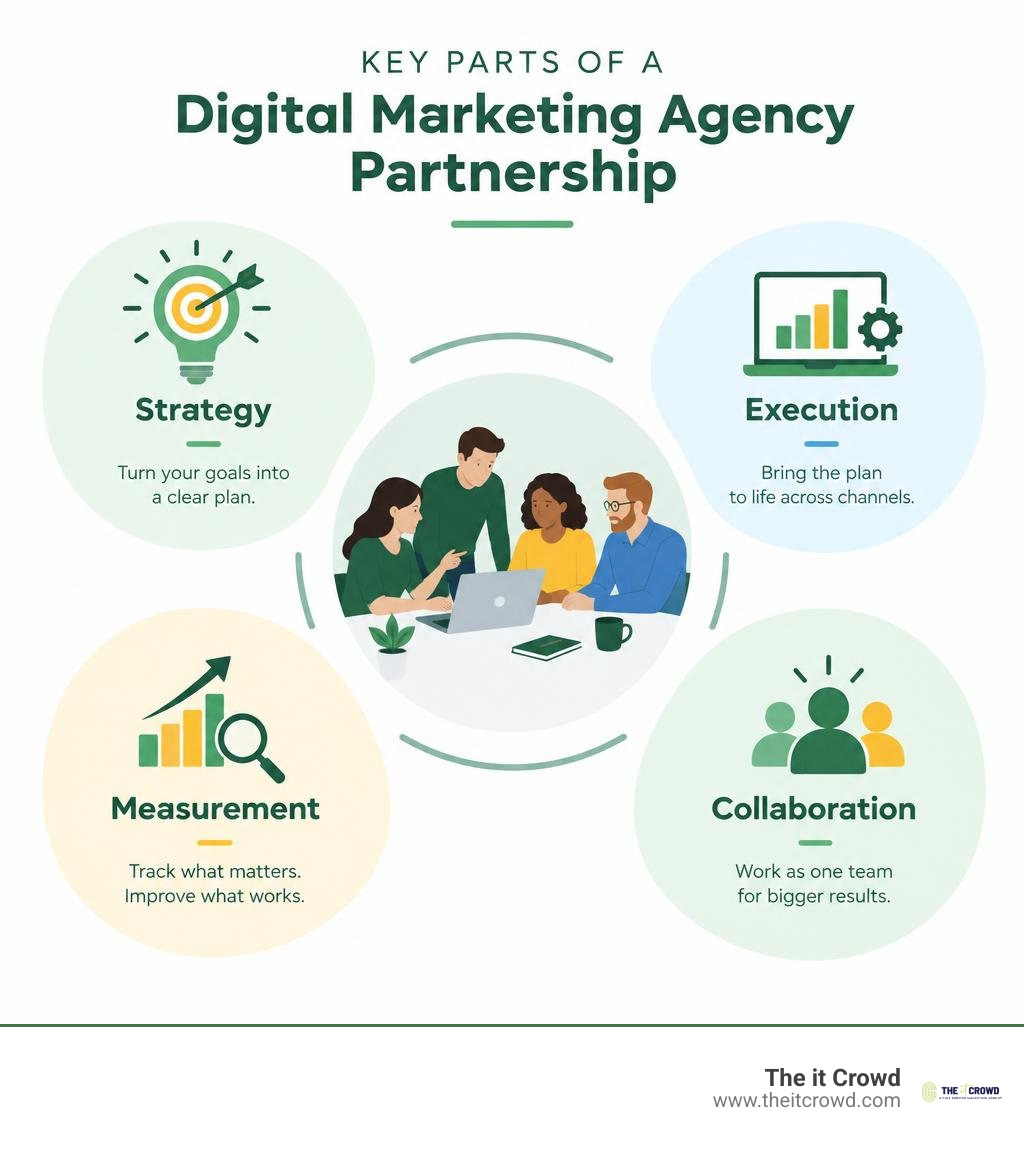
A digital marketing agency helps a business attract the right people and turn their interest into sales. It may handle branding, search, content, paid ads, and automation. To find a reliable partner, ask how those services will work together, who will do the work, and which results the agency will track.
For a growing business, the goal is not more marketing activity for its own sake. It is a clear plan that connects your message, budget, and team to measurable goals, such as qualified leads and revenue.
I’m Lindsey Huettner, owner of The it Crowd, a Dallas digital marketing agency. After more than 19 years in marketing and business ownership, I’ve learned that a good partnership starts with a shared plan, so let’s look at what an agency should provide.
As we navigate 2026, the digital landscape moves faster than ever. The global digital marketing software market is projected to expand from $77.4 billion in 2024 to $153.8 billion by 2030, reflecting a steady compound annual growth rate of 12.1%, according to industry research. Businesses are no longer looking for isolated tactics; they need connected systems. For example, adopting marketing automation alone drives an average 451% increase in qualified leads. To capture those gains, you need a partner capable of aligning every channel toward sustainable growth.
Core Services Provided by a Digital Marketing Agency
A modern agency delivers comprehensive marketing solutions rather than isolated campaigns. When cross-channel execution operates seamlessly under one roof, client retention rates jump by 3.5 times compared to fragmented, single-channel setups. When branding, organic search, paid media, and automated workflows communicate with each other, your business builds a compounding competitive advantage.
Multi-Channel Strategy and Brand Positioning
Every effective campaign begins with strategic clarity. We build your foundational narrative by analyzing market opportunities, defining your target audience, and developing a complete marketing strategy tailored to your specific commercial goals.
This process requires establishing strong branding and corporate identity alongside a clear messaging architecture. About 86% of consumers prefer an authentic and honest brand personality on social media and digital channels. When your positioning aligns with customer expectations across every touchpoint, your value proposition becomes impossible to ignore.
Search Visibility, Technical SEO, and Content Marketing
Organic search remains one of the most reliable sources of sustainable pipeline growth. In fact, SEO leads boast an average 14.6% close rate, compared to just 1.7% for traditional outbound leads. Furthermore, 70% of marketers report that SEO outperforms PPC for generating long-term sales revenue.
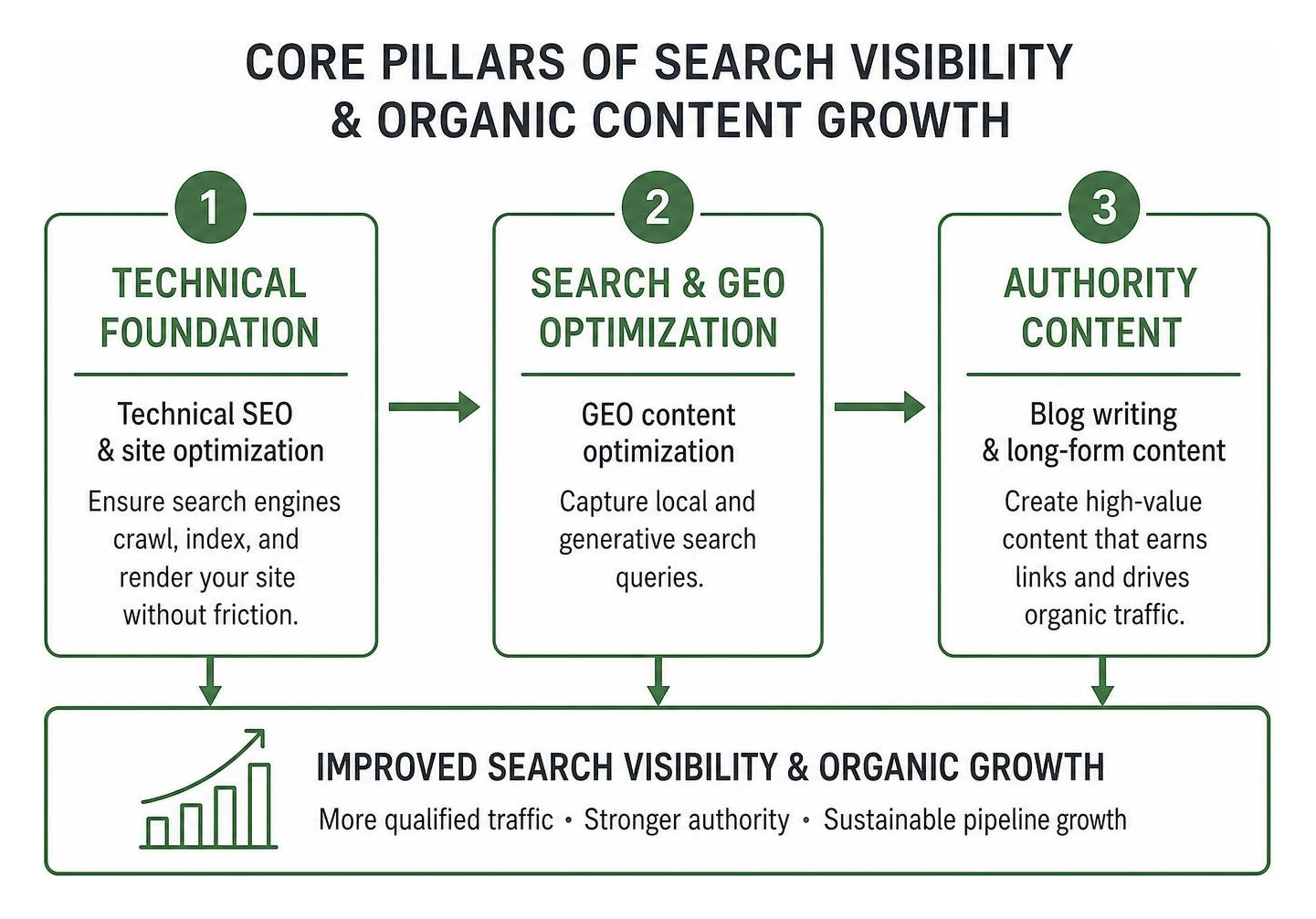
To earn top search engine rankings, we combine back-end architecture with authoritative editorial assets. This process includes:
- Implementing technical SEO and site optimization to ensure search engines crawl, index, and render your site without friction.
- Deploying advanced GEO content optimization to capture local and generative search queries.
- Crafting high-value blog writing and long form content, capitalizing on the fact that businesses that blog receive 97% more inbound links than those that do not.
Paid Media, Demand Generation, and Performance Advertising
While organic channels build long-term equity, performance advertising captures immediate high-intent demand. Strategic ad spend allocation balances quick customer acquisition with profitable margins.
By developing targeted pay per click PPC campaigns across Google Search and Google Display, we intercept buyers precisely when they express commercial intent. In parallel, our paid social advertising targets precise demographic segments on platforms like LinkedIn, Meta, and YouTube. Through comprehensive paid media planning and placement, we ensure every dollar spent drives qualified traffic into your pipeline.
AI Workflow Automation
Marketing efficiency in 2026 relies heavily on intelligent systems. Modern execution requires automated routing, predictive lead scoring, and structured data pipelines. Through custom AI workflow design and automation, we help businesses eliminate manual bottlenecks. These systems instantly qualify incoming inquiries, trigger dynamic nurture sequences, and sync engagement metrics with your sales pipeline without demanding extra manual effort from your staff.
Key Benefits of Partnering with an External Marketing Team
Hiring an external marketing team gives you immediate access to a full suite of senior specialists without the overhead of building an entire internal department from scratch.

| Factor | In-House Marketing Team | External Agency Partnership |
|---|---|---|
| Skill Breadth | Limited to specific internal hires | Complete access to strategists, developers, copywriters, and media buyers |
| Technology Stack | High per-seat software licensing costs | Enterprise analytics, SEO, and automation tools included |
| Scalability | Slow hiring and onboarding cycles | Rapid capacity adjustments based on campaign demand |
| Overhead & Costs | Salaries, benefits, training, equipment | Predictable monthly retainer with zero internal overhead |
| Strategic Perspective | Risk of internal echo chambers | Cross-industry benchmarks and proactive testing frameworks |
How a Digital Marketing Agency Integrates with In-House Teams
An external team should never operate in an isolated silo. We work alongside internal marketing directors, product leads, and executive teams through collaborative roadmaps. By handling technical heavy lifting, continuous campaign optimization, and creative production, we allow internal teams to focus on core operations, product development, and customer retention.
Industry Tailoring and Scalable Growth Strategies
Marketing strategies cannot rely on generic templates. B2B organizations often require lengthy multi-stakeholder nurturing sequences, detailed whitepapers, and cold outreach. In contrast, B2C brands thrive on rapid paid social testing, localized SEO, and lifecycle email engagement (which delivers an impressive average return of $36 for every $1 spent). A dependable agency adapts its growth frameworks directly to your target deal sizes, sales cycles, and industry dynamics.
Pricing Models and Campaign Timelines for Digital Marketing
Budget predictability and transparency are vital for a healthy agency relationship. Understanding common investment models helps you set realistic expectations for your marketing spend.
Understanding Pricing Structures and Investment Models
Agency pricing models generally fall into three standard categories:
- Flat Monthly Retainers: A fixed monthly fee covering defined deliverables, ongoing optimizations, and strategic oversight across channels.
- Milestone-Based Billing: Structured project fees tied to clear deliverables, often applied to website redesigns or brand positioning projects.
- Ad Spend Management Percentages: A tiered management fee scaled according to your gross monthly advertising spend, aligning media performance with execution complexity.
Realistic Timelines for Measurable Digital Marketing Results
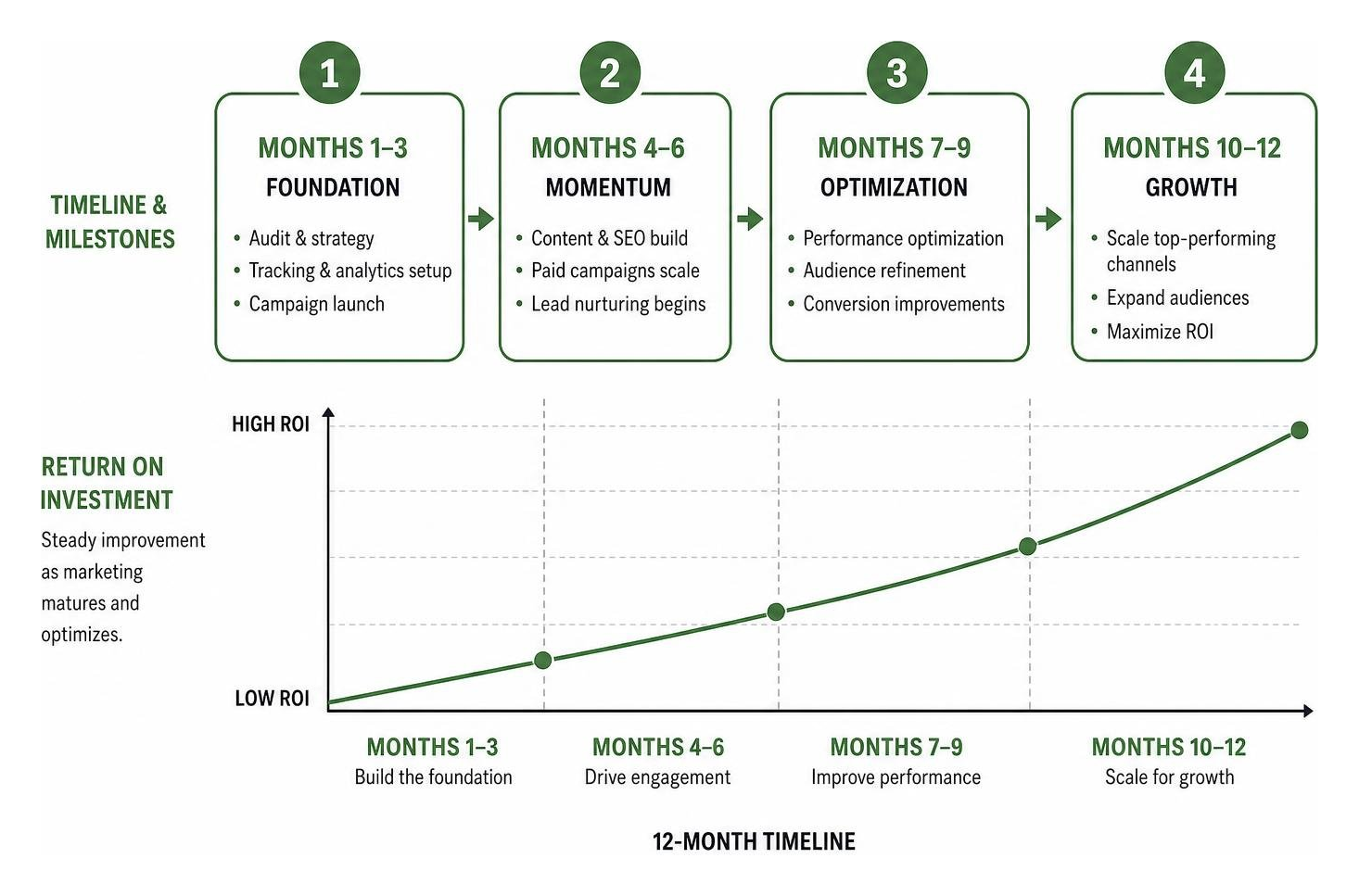
Digital marketing results develop over realistic operational phases:
- Months 1 to 2 (Setup & Fast Traction): Paid search and paid social campaigns launch, capturing immediate intent and driving initial qualified leads while baseline analytics are configured.
- Months 3 to 4 (Optimization & Conversion Gains): On-page improvements, messaging adjustments, and website optimization lift sitewide conversion rates and drop cost per acquisition.
- Months 6 and Beyond (Compounding Authority): Technical SEO adjustments, comprehensive content libraries, and backlink growth begin generating steady organic traffic that compounds over time.
Measuring Success: Critical KPIs and Performance Tracking
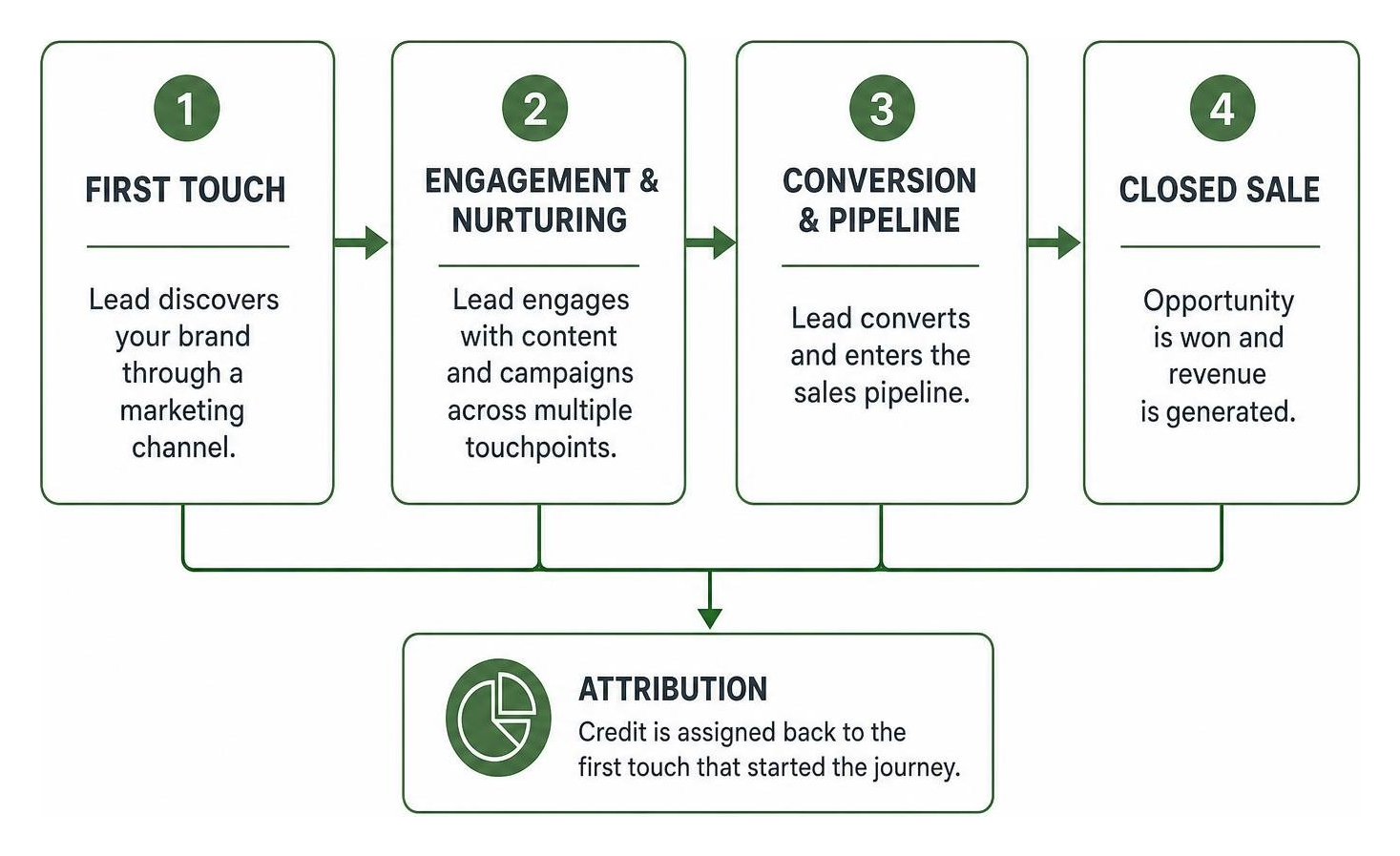
Marketing without clear data leads to wasted budgets. A dependable agency implements transparent attribution models that connect digital interactions directly to closed revenue.
Essential Metrics Across Organic and Paid Channels
To evaluate performance accurately, businesses must track metrics that reflect genuine financial return rather than superficial vanity numbers:
- Qualified Lead Volume & Sales Pipeline Value: The raw number and dollar value of prospective clients matching your exact customer profile.
- Customer Acquisition Cost (CAC): Total sales and marketing investment divided by the number of new customers acquired.
- Return on Ad Spend (ROAS): Gross revenue generated directly from paid media campaigns relative to total ad spend.
- Organic Traffic Growth & Search Revenue: High-intent search visits that turn into scheduled demos, consultations, or direct transactions.
Staying Ahead of Algorithm Updates and AI Trends
Search engine algorithms and AI-powered discovery engines change constantly. A proactive agency runs continuous technical audits, monitors search intent shifts, and refines schema markup. By maintaining clean, AI-ready web architectures and high-quality thought leadership, we ensure our clients maintain search prominence regardless of platform volatility.
Overcoming Common Agency Challenges and Selecting the Right Partner
Working with an outside partner can present challenges if expectations are not established early on. Communication gaps, vague scopes of work, and misaligned metrics can slow progress down.

How to Evaluate and Choose the Right Digital Marketing Agency
When evaluating prospective partners, look for strategic depth rather than sales pitches. Use this checklist during your evaluation:
- Review verified client case studies that show measurable revenue and traffic gains.
- Confirm full-funnel capabilities so you do not have to juggle multiple disconnected vendors.
- Learn how to choose the right marketing agency in Dallas by reviewing our transparent partnership criteria and scoping guidelines.
Navigating Misalignment and Ensuring Campaign Accountability
Accountability requires clear service-level agreements and regular reporting cadences. A reliable agency provides clear dashboards, walks through performance data during regular reviews, and adjusts strategies based on live pipeline feedback.
Frequently Asked Questions About Digital Marketing Agencies
How much does hiring an agency typically cost per month?
Most comprehensive agency retainers range from $3,000 to $15,000 per month, depending on campaign scope, channel variety, and technical requirements. Standalone project engagements or specialized paid media management are structured based on deliverables and ad spend volume.
How do agencies adapt to search algorithm shifts and AI updates?
Agencies stay ahead by combining technical site audits with authoritative, experience-led content. Aligning technical architecture with structured data standards ensures your site earns consistent visibility across traditional search results and generative AI platforms.
How quickly should a business expect a positive ROI from campaigns?
Paid media channels can produce qualified inquiries within the first few weeks of campaign launch. Organic SEO, content marketing, and brand authority efforts typically gain significant momentum within 3 to 6 months, delivering compounding financial returns over time.
Conclusion
Choosing the right marketing team is an investment in your company’s long-term commercial growth. When you unite branding, technical SEO, high-converting paid media, and intelligent automation into a single cohesive strategy, your business creates a reliable engine for sustainable customer acquisition.
At The it Crowd, we combine cross-channel marketing expertise with proprietary AI infrastructure to help growing businesses scale with confidence. Discover how partnering with a premier digital marketing agency can streamline your marketing operations and accelerate your revenue today.

