

You approved the last three social media captions. You rewrote two ad headlines before breakfast. You’re cc’d on every campaign brief, every creative revision, every budget tweak. And somehow, growth still feels out of reach.
Sound familiar?
CEOs don’t actually crave control. They crave confidence. And in 2026, the leaders who understand this distinction are the ones outpacing their competition. For founders, marketing directors, and growth-stage executives, organizational bottlenecks rarely come from a lack of resources. They come from a leadership model that was never designed to scale.
This article exists to challenge that model. We are dismantling five of the most damaging marketing agency myths that keep brilliant executives supervising tactics instead of steering growth. At The it Crowd, we call the shift strategic marketing autonomy, and it is one of the most underrated upgrades a CEO can make.
Your reset begins now.
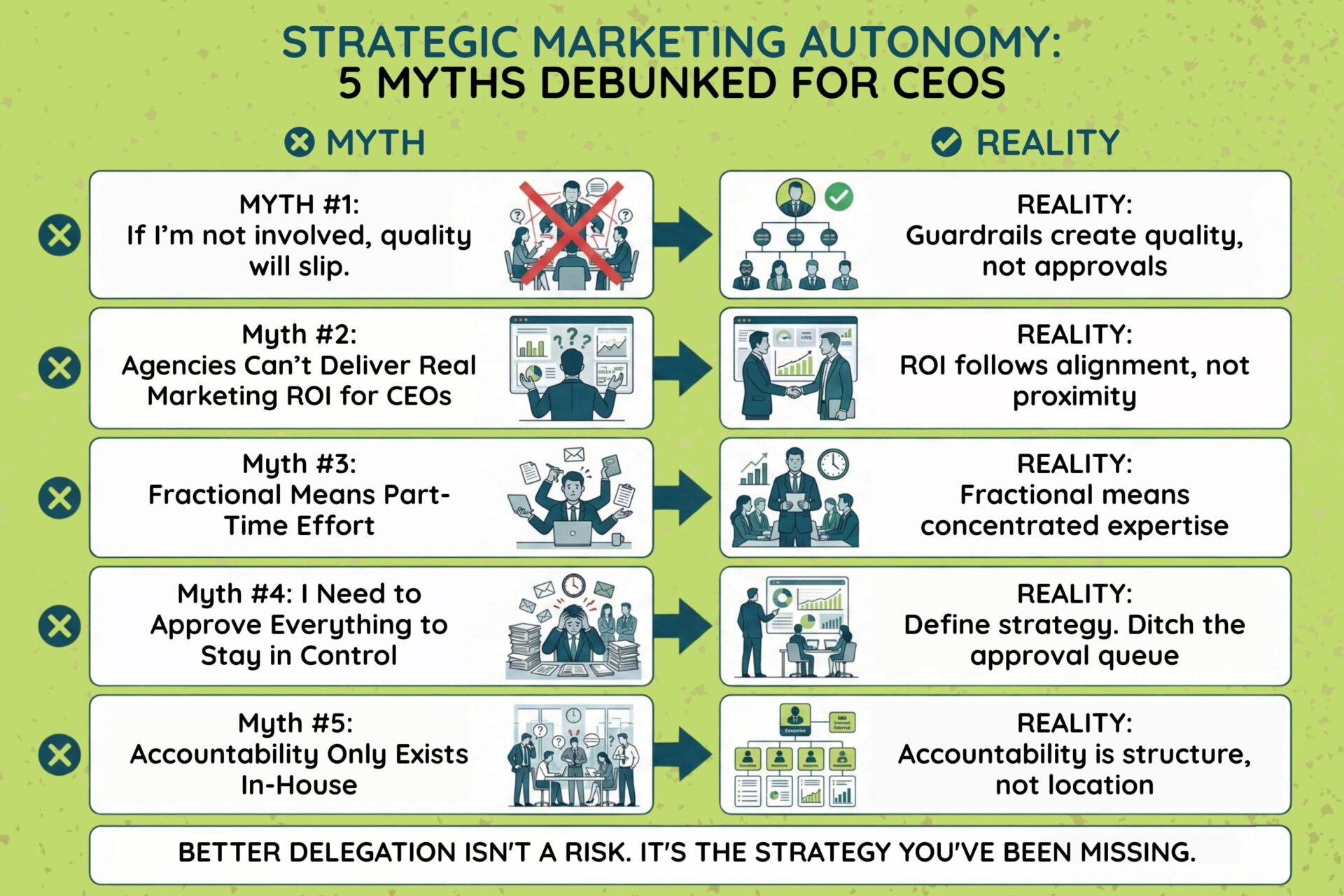
Myth #1: “If I’m Not Involved, Quality Will Slip”
Reality: CEO marketing oversight is valuable, but blanket involvement is expensive. Most CEOs believe their involvement protects quality. The data disagrees. Harvard Business Review estimates that poor management and excessive oversight drain approximately $3 trillion from the global economy annually by slowing decision velocity and crushing employee initiative.
So where should a CEO actually sit in the process? HBR’s graduated levels of delegation offer a useful framework for delegating marketing strategy without losing strategic clarity:
- Level 1: Research and Report (You decide)
- Level 2: Research and Recommend (They propose, you approve)
- Level 3: Research and Act (They act, but tell you immediately)
- Level 4: Decide and Inform (They act and tell you periodically)
- Level 5: Full Autonomy (They own the outcome entirely)
Most growth-stage CEOs are operating at Level 1 or 2 across the board. Marketing agency transparency and clearly defined guardrails make Levels 4 and 5 not just possible, but preferable.
The takeaway: Guardrails create quality. Approvals create gridlock.

Myth #2: “Agencies Can’t Deliver Real Marketing ROI for CEOs”
Reality: ROI frustration is almost never an agency problem. It is a clarity problem. When goals are vague, KPIs become indistinguishable from vanity metrics. The real culprit is a measurement culture that prioritizes activity over revenue.
In Marcus Sheridan’s book They Ask, You Answer, he advocates for a culture of absolute transparency: answering every difficult customer question, including pricing and competitor comparisons, openly and publicly. This approach builds trust at scale. When executed with unfiltered visibility, it produces measurable lifts in qualified pipeline and lifetime value.
The it Crowd applied this principle in partnership with Ascent, an enterprise software company specializing in field service management solutions. By combining honest, value-forward content with precision execution, the results were compelling. Polls and open-reply prompts supplied qualification data that fed follow-up sequences and partner handoffs directly. Motion creative increased time-on-email and supported “proof over promises” demos that accelerated purchase decisions.
By prioritizing financial literacy, leaders can use marketing attribution modeling to replace gut-feel reporting with structured visibility. When an agency can be brutally honest with your market—and you trust them to be—ROI stops being a mystery.
The takeaway: Measurable ROI follows alignment, not proximity.

Myth #3: “Fractional Means Part-Time Effort”
Reality: In 2025 and 2026, C-suite turnover hit record-breaking levels, with the Wall Street Journal describing it as “a grand experiment in leadership.” Boards are moving faster, showing less patience, and increasingly favoring specialized, agile roles over generalist permanent hires to navigate AI disruption and market volatility. Fractional leadership isn’t a compromise—it is the market’s answer to that pressure.
Rule of thumb: fractional means concentrated expertise, not diluted commitment. A true strategic growth partner brings strategic direction, channel prioritization, performance governance, and execution orchestration without the overhead of a full-time hire. Fractional marketing leadership, at its best, is designed to build scalable marketing operations with staying power well beyond any single campaign or quarterly push.
The takeaway: Fractional doesn’t dilute ownership. It concentrates it.
Myth #4: “I Need to Approve Everything to Stay in Control”
Reality: Approving everything doesn’t make you in control. It makes you a bottleneck with a calendar.
In the DFW business landscape, where growth-stage companies are scaling faster than ever, the CEOs winning market share are not the ones buried in approval queues. They are the ones who defined their decision rights once and then got out of the way.
The transformation looks like this: a founder who once delayed campaigns by two weeks waiting for copy approvals now operates on a defined cadence, reviews performance dashboards weekly, and has watched time-to-market acceleration become a genuine competitive advantage.
Strategic marketing autonomy is built on predefined thresholds–budget limits, messaging guardrails, and a clear operating cadence that keeps execution moving without requiring executive sign-off at every turn.
The takeaway: Control shifts from approving tactics to defining strategy.
Myth #5: “Accountability Only Exists In-House”
Reality: Proximity has never been a substitute for structure. An in-house team without a governance framework is just as capable of missed deadlines, murky ownership, and vanishing ROI as any external partner.
Consider two scenarios. Company A has an internal marketing team. No documented strategy, no defined KPI ownership, no reporting cadence. Campaigns launch on instinct and results are reviewed whenever someone remembers to look. Company B partners with an external agency supported by a full marketing accountability framework: documented roles, an accountability matrix that clearly assigns ownership across every channel and deliverable, and monthly revenue alignment reviews.
Company B wins. Every time.
True accountability is structural, not geographical. It lives inside clearly defined governance structure, transparent reporting cadences, and role clarity that leaves no room for “I thought someone else was handling that.”
At The it Crowd, accountability is baked into the engagement model from day one.
The takeaway: Accountability is architecture, not a zip code.
Is Your “Hands-On” Management Style Actually a Growth Ceiling?
DFW was built by Wildcatters: rugged individualists who managed every well by sheer force of will. That grit built a city. But it cannot build a scalable company.
The leaders who transformed this region into Silicon Prairie—attracting Toyota, Charles Schwab, and Tesla—didn’t do it by approving every decision. They did it by becoming Architects instead of Operators.
Ask yourself honestly:
- Does marketing pause when you’re unavailable?
- Are you reviewing tactics instead of steering strategy?
- Has your strategic planning cycle ever been derailed by your own approval queue?
If the answer is yes, your involvement isn’t protecting growth. It’s capping it.
Strategic marketing autonomy is the pipeline. You’ve been managing the well.
4 Steps to Implementing a Marketing Accountability Framework
Transitioning from micromanagement to structured delegation doesn’t require a complete organizational overhaul. It requires four deliberate decisions.
Step 1: Define Your North Star Metrics
What does growth actually look like for your business? Start with lifetime value (LTV), customer acquisition cost (CAC), and revenue forecasting tied to real pipeline activity. Vanity metrics measure motion. North Star metrics measure momentum. Build your entire reporting structure around the latter, and revisit it every quarter.
Step 2: Build Your Accountability Matrix
Imagine being able to step away for a two-week vacation without your marketing engine grinding to a halt or requiring a constant stream of “quick” check-in calls. An accountability matrix buys you that freedom by defining exactly who owns what—across every channel and deliverable—long before the first campaign even launches.
Step 3: Set Your Communication Cadence
Have you ever felt like you’re always either over-informed or completely in the dark about your marketing performance? A structured cadence fixes that. Monthly strategy reviews, weekly performance updates, and quarterly revenue assessments keep leadership informed without creating noise or unnecessary back-and-forth.
Step 4: Conduct Your “Hands-Off” Audit
Identify every marketing task currently sitting on your plate and categorize it: delete, delegate, or defer. This is where The it Crowd’s full-service capabilities become the practical answer. We handle the marketing so you can handle the business.

Strategic Marketing Autonomy Is a Leadership Upgrade
Steve Jobs said it best: “It doesn’t make sense to hire smart people and tell them what to do; we hire smart people so they can tell us what to do.”
Yet the pattern persists. Call it “Founder Override Syndrome”—the reflex to review, approve, and second-guess every marketing decision, even after delegating it. It is one of the most common and costly growth ceilings in business.
CEOs don’t scale by managing tasks. They scale by clarifying direction, trusting structure, and embracing agency-led growth as a legitimate leadership strategy.
Autonomy is not abdication. It is architecture. The Delegation Reset isn’t a loss of control, but the upgrade your growth has been waiting for.
Ready to move from supervising marketing to steering growth? Let’s talk.

