

In 2026, founders, CEOs, and marketing directors are overwhelmed in a very specific way, and much of that busyness is self-inflicted. McKinsey finds that executives spend nearly 40% of their time making decisions, yet a majority admit that time is poorly used.
Approval loops, vendor check-ins, and tactical to-dos have a way of filling calendars that should be reserved for vision and growth. This is the marketing oversight trap, and it is far more common than anyone in the boardroom wants to admit.
The corner office did not sign up to be a creative director. Yet here we are: Founders editing ad copy, CEOs sitting in campaign briefings, and marketing directors solving the wrong problems with the right intentions. Executive decision fatigue is real, and the marketing bottleneck it creates quietly holds growth hostage.
The good news? True delegation fixes this. Not outsourcing (a distinction worth understanding) but true delegation of both strategy and execution to a partner who owns the outcomes. That difference is exactly what this article unpacks.
TL;DR: The Shift from Oversight to Ownership
Growth does not stall because CEOs lack ambition. It stalls because they are still running the marketing engine instead of steering the company.
What Delegation Actually Means
Marketing delegation is the transfer of both strategic authority and execution ownership to a trusted growth partner, freeing leadership to focus on company direction rather than campaign decisions. Delegating marketing leadership is not about stepping back; it is about stepping into the role your business actually needs.
Why It Matters Right Now
Growth stalls when founders stay in tactical mode. The sections ahead cover the warning signs, the economics, and the practical roadmap for handing over outcomes rather than just to-dos, because managed marketing and led growth are two very different destinations.
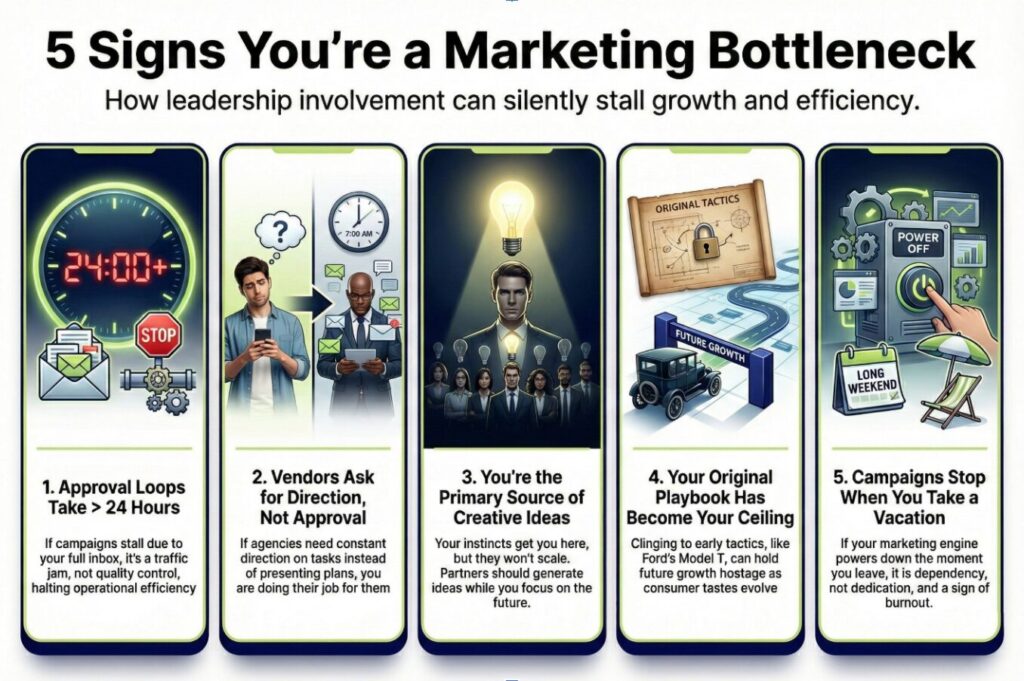
5 Signs You’re a Marketing Bottleneck
Here are five signs that your involvement has quietly crossed the line from leadership into obstruction.
1. Marketing approval loops take more than 24 hours.
If campaigns are stalling because your inbox is full, that is not quality control. That is a traffic jam with your name on it. Operational efficiency vanishes when the entire pipeline stalls on one person’s calendar.
2. Vendors ask you what to do instead of telling you the plan.
Picture this: it is 7 a.m. on a Tuesday, and your phone already has three messages from your agency asking for direction on a campaign that should have launched last week. That is not a partnership. That is you doing their job before you have had coffee.
3. You are the primary source of creative ideas.
Your instincts got you here. They will not scale you to the next stage. Marketing ownership transfer means trusting a partner to generate and execute the ideas while you focus on where the business is going.
4. Your original playbook has become your ceiling.
Henry Ford controlled over 50% of global car production by 1923, thanks to his single-minded vision for the Model T. But as consumer tastes evolved, his loyalty to the original product became a bottleneck so severe that General Motors overtook him. CEO loyalty to original marketing tactics works the same way; what got you traction early can hold your future growth hostage.
5. Campaigns stop if you take a vacation.
The clearest sign of founder burnout is a business that cannot function without you. If your marketing engine powers down the moment you leave for a long weekend, that is dependency, not dedication.
Redesigning Responsibility: Handing Over Outcomes, Not Just To-Dos
If you hire someone to mow your lawn and then spend Saturday supervising which direction they push the mower, congratulations. You still mowed your lawn.
So why are you doing this with your marketing?
General George S. Patton said it best: “Never tell people how to do things. Tell them what to do and they will surprise you with their ingenuity.” That is how fractional leadership solves growth bottlenecks. You hand over the outcome, not the task list. Here’s what that looks like in practice:
- You own the vision. They own execution and strategy decisions.
- You set the goals. They build the roadmap.
- You approve the direction. They handle the details.
This is marketing team empowerment at scale. The it Crowd does not require daily permission to execute. We take ownership of the “how” so you can stay focused on the “why.”
The Bottleneck Tax: What CEO Oversight Actually Costs
Let’s talk about what your time is actually worth, because the numbers are worse than most CEOs want to admit.
Think of your leadership time like prime real estate. Every hour spent reviewing social media captions is an hour not spent closing partnerships or building product vision. Inefficient decision-making costs the average large firm $250 million annually in wasted labor. For mid-market CEOs, that translates to a “bottleneck tax” draining the bottom line every time a campaign waits for approval.
The opportunity cost of leadership time is real. When Wilson Bauhaus Interiors engaged The it Crowd, growth accelerated only after the CEO stepped away from tactical execution and into full strategic leadership. The result? Faster campaigns, better growth scalability, and operational efficiency that showed up on the P&L.
Proper delegation is not a lifestyle choice. It is a financial decision.
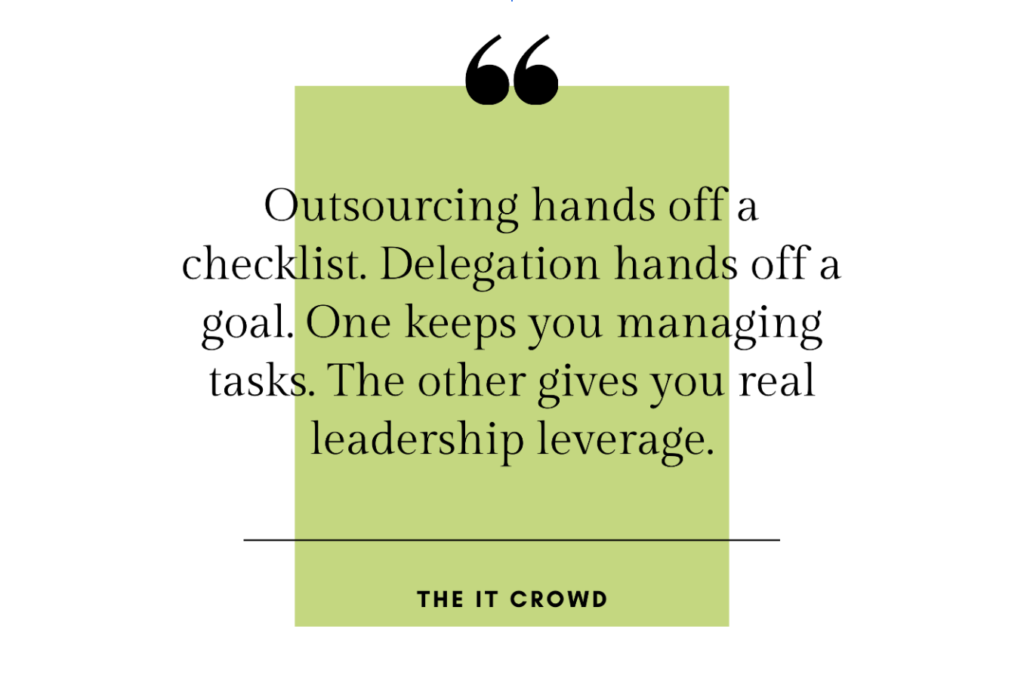
Alt text: Quote: “Outsourcing hands off a checklist. Delegation hands off a goal. One keeps you managing tasks. The other gives you real leadership leverage.” –The it Crowd
Peace of Mind as a Competitive Advantage
True leadership has never been about knowing every detail of every campaign. It has always been about ensuring everything happening inside your business points toward the same vision.
Here’s a good rule of thumb: if a task requires your login credentials but not your judgment, it belongs on someone else’s plate. When you stop being the bottleneck, the marketing engine finally gets to run at full speed.
The it Crowd exists to take the wheel on strategy and execution, so you can take the wheel on growth. Ready for your Delegation Reset? Book a Growth Audit. Let’s see what your business looks like with the brakes off.

