

Picture this: your marketing team celebrates a surge in social media engagement while your CFO quietly questions the budget. Sound familiar?
Here’s the uncomfortable truth about marketing effectiveness in 2026—most businesses are drowning in data but starving for clarity. We track clicks, count conversions, and celebrate campaigns, yet struggle to answer the simplest question: is this actually working?
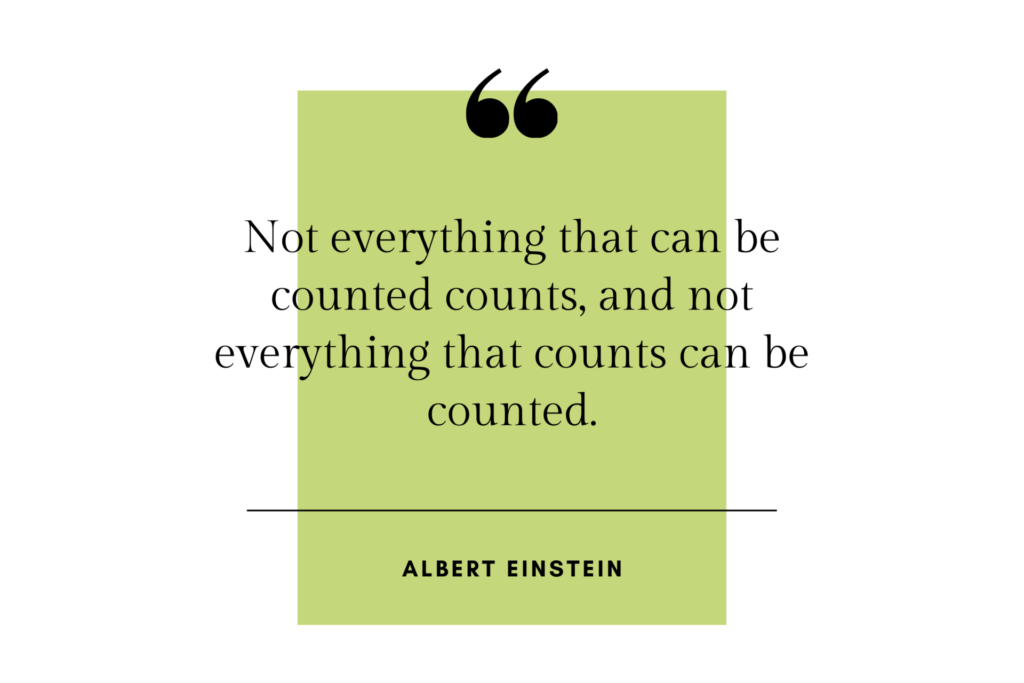
Albert Einstein once said, “Not everything that can be counted counts, and not everything that counts can be counted.” The metrics we obsess over rarely reveal whether marketing is actually driving business growth.
At The it Crowd, we’ve watched countless companies mistake activity for achievement. The difference between vanity metrics and valuable insights isn’t just semantic—it’s the gap between guessing and growing.
So how do you know if your marketing is truly moving the needle? Let’s cut through the confusion.
Quick Overview
This article walks you through measuring marketing impact in ways that actually inform business decisions. Here’s what we’ll cover:
- The vanity metrics trap: Why followers and impressions feel good but rarely connect to revenue, and which growth metrics actually matter
- How to measure marketing ROI properly: Building frameworks that track the complete customer journey, not just isolated touchpoints
- Five practical decision rules: Simple tests to evaluate whether your marketing investments are working or just looking busy
- Real accountability in action: How transparency and sales alignment transform marketing from a cost center into a measurable growth driver
- What to expect from your marketing partner: The systems and insights that make ROI measurement easier and actionable
What Are Vanity Metrics—and Why Do They Feel So Convincing?
Most people think vanity metrics are useless numbers that only inexperienced marketers care about. That’s not quite right. Vanity metrics aren’t worthless. They’re just incomplete.
Here’s a thought experiment: imagine you’re presenting quarterly results to your board. You show 10,000 new followers, 500,000 impressions, and a 15% engagement rate increase. The room nods politely. Now imagine showing that marketing generated 47 qualified leads, closed 12 deals worth $340,000, and reduced customer acquisition cost by 22%. Which presentation gets you more budget?
Vanity metrics—likes, followers, page views, impressions—feel good because they’re easy to track and typically trend upward. They prove you’re doing something. But they don’t prove you’re doing something that matters.
True growth metrics answer a fundamentally different question. Vanity metrics tell you how many people saw your content. Growth metrics tell you how many people took action because of it, and whether that action connected to revenue.
Metrics That Matter vs. Metrics That Just Look Good
Let’s talk about what we call “applause metrics”—numbers that make you feel good in the moment but don’t pay the bills. Website traffic, social media followers, email list size, and content downloads all fall into this category. They’re not meaningless, but they’re not marketing KPIs worth optimizing for on their own.
Here’s what actually deserves your attention: cost per acquisition, customer lifetime value, conversion rate by channel, lead-to-customer rate, and revenue per marketing dollar spent. These metrics connect directly to business outcomes and help you set realistic performance benchmarks.
Consider the AARRR framework (Acquisition, Activation, Retention, Referral, Revenue). A company might celebrate acquiring 1,000 new email subscribers, but if only 50 activate by engaging with content, 10 become customers, and 2 refer others, that acquisition number tells an incomplete story.
As AI reshapes how we measure success, companies are moving beyond vanity metrics toward predictive indicators—signals that forecast future revenue rather than celebrate past activity. The question isn’t “how many people saw this?” but “how many people this reached will eventually buy?”
How to Measure Marketing ROI in a Way That Supports Real Decisions
The right measurement framework reveals which marketing investments actually drive revenue and which ones simply look impressive on paper.
Connect Data to Business Outcomes
Effective marketing performance measurement starts with linking your activities to actual business results. Understanding how website visits convert into customers matters more than tracking visits alone. Focus on the metrics that directly influence your bottom line.
Set Up Proper Tracking Systems
Build measurement infrastructure that captures the complete customer journey. Use tools like Google Analytics 4 (GA4) or Adobe Analytics to track user behavior from initial awareness through to conversion, giving you reliable data about what’s actually working.
Look Beyond Surface-Level Metrics
Social media engagement might show thousands of impressions, but what matters is whether those impressions lead to conversations with qualified prospects. Email open rates look great in reports, but click-through rates and subsequent actions tell you if your message resonates. The difference between vanity metrics and valuable insights often comes down to asking: “And then what happened?”
Build Attribution That Shows Marketing Impact on Revenue
Establish clear attribution models that follow the customer journey across touchpoints. Track metrics like cost per qualified lead, customer acquisition cost, and lifetime value. This transforms marketing from a cost center into a measurable growth driver.
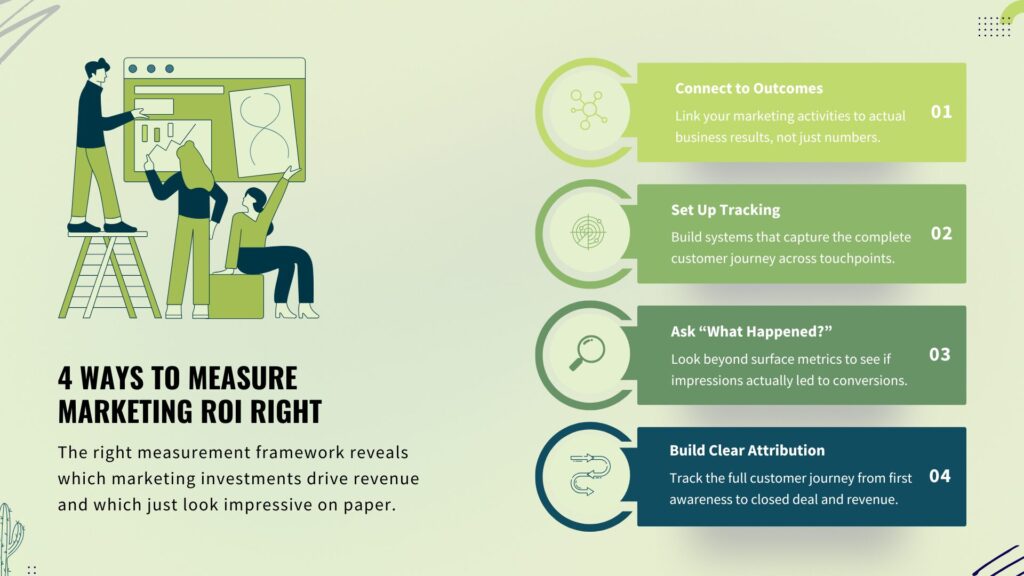
ROI clarity doesn’t require perfecting all four steps simultaneously. It comes from moving through them in order—connection first, then capture, then interpretation, then attribution.
5 Practical Ways to Tell If Your Marketing Is Actually Working
A LinkedIn’s marketing research revealed a troubling gap: while 70% of digital marketers claim they measure ROI, many measure it long before a sales cycle concludes. It’s like checking your investment portfolio an hour after buying stocks and declaring victory.
So how do you establish real marketing accountability?
- The Revenue Connection Test: Can you trace your content marketing strategies directly to closed deals? If not, you’re missing the complete picture.
- The Conversation Quality Rule: Are inquiries getting more qualified over time? Better leads mean your messaging attracts the right audience.
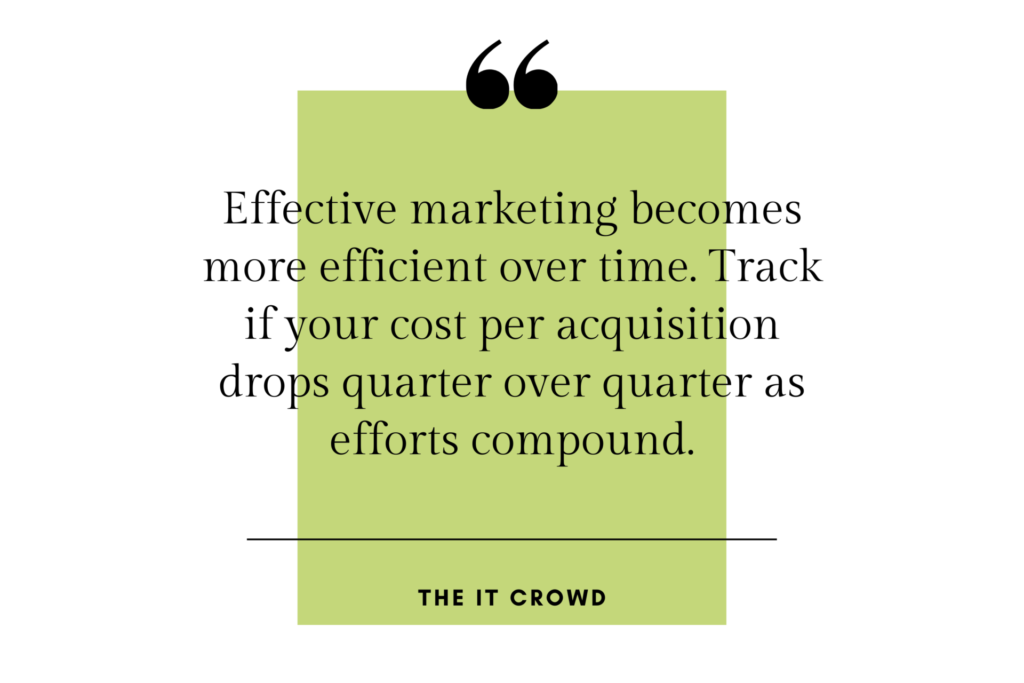
- The Cost-Per-Acquisition Trend: Is it costing you less to acquire customers quarter over quarter? Effective marketing becomes more efficient as it compounds.
- The North Star Metrics Check: Are your foundational metrics—customer lifetime value, retention rate, net revenue retention—improving? These north star metrics reveal whether marketing attracts customers who actually stick around.
- The Attribution Consistency Test: Do multiple touchpoints show improvement, or just one isolated metric? Real growth shows up across the entire customer journey, not in a single vanity number.
How The it Crowd Approaches ROI with Radical Transparency
Our commitment to ROI-driven marketing starts with honest conversations about what success actually looks like for your business. We don’t chase vanity metrics or celebrate activity without outcomes.
Take our work with Celanese on their BlueRidge™ sustainability initiative. Rather than focusing on impressions or downloads, we measured what mattered: internal adoption hit 80% within 60 days, the brand rollout timeline was cut by over 50%, and the sales deck was deployed across four global markets during launch. These results created measurable efficiency gains and accelerated revenue opportunities.
We build this clarity into every engagement through transparent reporting frameworks powered by first-party data. You’ll always know which content drives qualified conversations, which channels generate your best customers, and how marketing investments connect to pipeline growth. No jargon. No smoke and mirrors. Just clear accountability for the outcomes that move your business forward.
Why Measuring ROI Is Easier When The it Crowd Is Your Partner
So, what should a good marketing partner help you see, understand, and decide?
A true partner shows you exactly how marketing connects to revenue. We track pipeline contribution, following how content, campaigns, and conversations convert into business opportunities. Our approach creates everlasting thumbprints—measurable impact that compounds over time.
We prioritize sales and marketing alignment from day one, ensuring your teams speak the same language about lead quality and revenue goals. This means clearer communication and smarter strategic decisions.
With The it Crowd, you’re not left deciphering dashboards alone. We translate data into decisions, showing you where to invest more and which strategies deserve scaling. Measurement becomes momentum and metrics become meaning.
Marketing ROI FAQ: The Questions Leaders Should Be Asking
Why does growth feel so slow even when we’re doing everything right?
Marketing attribution models often create attribution gaps during long sales cycles. A prospect might read your content in January and convert in September. Without proper tracking, that journey looks like luck rather than strategy.
How do we know which channels actually work?
Track the entire customer journey, not just last-click conversions. A LinkedIn post might introduce someone to your brand, while an email sequence closes the deal. Both matter.
What if our data shows conflicting results?
Focus on patterns over isolated metrics. One strong month doesn’t prove success; consistent improvement across quarters does.
How often should we review our marketing ROI?
Monthly for tactical adjustments, quarterly for strategic decisions. Real patterns emerge over time, not week to week. Focus on trends, not single data points.
Clarity Is the Real Competitive Advantage
If you only remember one thing from this article, let it be this: the fanciest dashboard in the world means nothing if you can’t connect it to actual decisions.
Real competitive advantage comes from knowing—truly knowing—which marketing efforts drive revenue attribution, including those tricky offline conversions that happen in sales calls and handshake deals. They’re less sexy than viral posts, but infinitely more profitable.
Want help cutting through the noise and building measurement that actually informs strategy? Let’s talk about what clarity could look like for your business.
