

Your agency is busy. Emails answered, assets delivered, boxes checked. So why does the revenue chart look like a shrug?
Here’s the uncomfortable truth: execution without thinking is just expensive busywork. Paying for hands when you need a brain—that is the real budget leak nobody talks about.
Think of it like the red pill and blue pill moment in The Matrix. Once you see the difference between a marketing vendor who simply executes and a true strategic partner who challenges, builds, and grows with you, you cannot unsee it. Choosing to stay with an order taker is choosing the blue pill. Comfortable. Familiar. Deliberately limited.
The it Crowd was built for founders and COOs who are ready for the red pill. We trade task lists for strategy and activity reports for outcomes that actually compound into growth.
What this Means for You: TLDR for Busy Leaders
- Vendors execute. Strategic partners think, challenge, and build toward revenue-focused marketing outcomes that actually compound over time.
- A yes-man agency is not harmless. Unchallenged bad ideas compound quietly until they show up in your margins.
- Generic strategy templates do not fit mid-sized businesses. Custom frameworks built around your market and positioning do.
- Marketing accountability means tying every tactic to a business result. If you cannot draw that line, it’s just a hobby.
- You have outgrown your current setup. The signs are already there, and you probably already know it. The it Crowd exists for exactly this moment.

What’s the Real Cost of a “Yes Man” Vendor?
A vendor who says yes to everything is not a partner. They’re a liability with a project management login. Every unchallenged bad idea, every recycled tactic, every “sure, we can do that” without a single “but have you considered…” compounds quietly until it shows up somewhere painful: increasing customer acquisition cost, stalled pipelines, shrinking margins.
The numbers back this up. The Association of National Advertisers’ Q2 2025 Programmatic Transparency Benchmark found that $26.8 billion in global media value is lost every year to programmatic inefficiencies alone.
In an interview with Inc., Mark Cuban said: “Wherever I see people doing something the way it’s always been done, the way it’s ‘supposed’ to be done, following the same old trends, well, that’s just a big red flag to me to go look somewhere else.”
Your outsourced marketing team should be the ones waving that flag. Not ignoring it.
Why Your Strategy Should Not Come from a Template
Using a marketing template for a mid-sized business is essentially like wearing a rental tuxedo to a high-stakes gala. It technically covers you. It just does not fit.
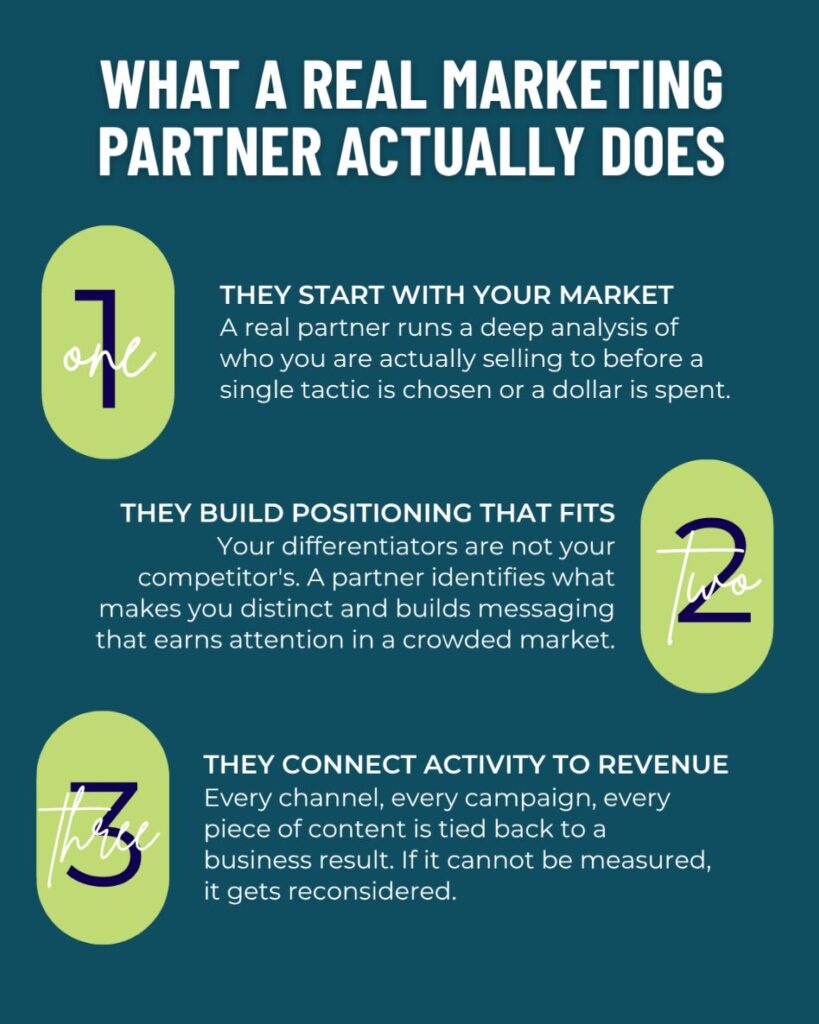
A real partner builds differently. Here is what that actually looks like in practice.
They start with your market, not a mood board.
Ever wondered why your campaigns generate traffic but not revenue? Generic frameworks skip total addressable market analysis entirely. A custom integrated marketing strategy maps exactly who you are selling to, where they are in the funnel, and what it takes to move them forward.
They define positioning that is actually yours.
No brand positioning strategy should look like your competitor’s. A partner digs into your specific differentiators and your customers’ real language, then builds messaging that earns attention rather than blending into the background.
They connect the dots.
Without proper attribution, you are paying for activity and hoping it becomes revenue. A real partner builds frameworks that tie every channel to actual pipeline, so you always know what is working and what is quietly draining your budget.
5 Signs You Have Outgrown Your Current Setup
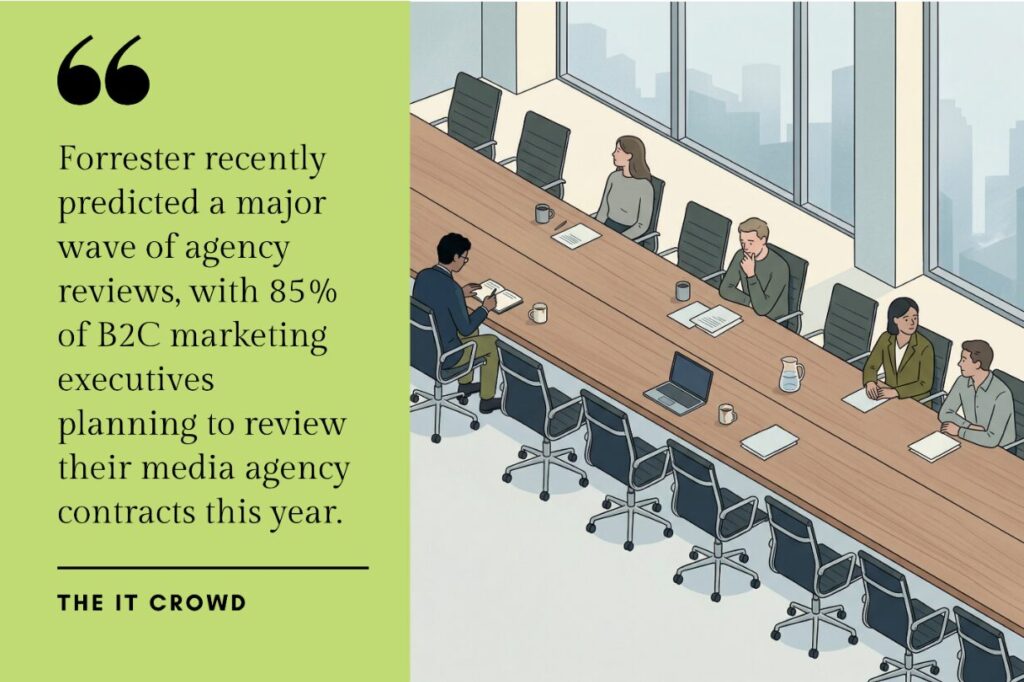
Forrester recently predicted a major wave of agency reviews, with 85% of B2C marketing executives planning to review their media agency contracts this year. If you are in that group, here’s a quick audit.
The Vanity Metric Spiral
Your reports are full of impressions and click-through rates, but nobody can connect them to revenue. That is not data-driven decision making. That is decorative math.
The Frozen Funnel
Your agency is still thinking in linear funnels while your customers are looping, revisiting and referring. If the flywheel has never come up, nobody is paying attention.
The Template Trap
Your strategy looks suspiciously like last quarter’s strategy. And the quarter before that. Familiarity is not a plan. You need a new agency.
The Reactive Reporting Pattern
You ask questions and they answer them. Insights are never volunteered. You are paying for a search engine, not a strategist.
The Scope Creep Standoff
Every new idea becomes a new invoice and every pivot triggers a negotiation. A real partner builds for growth without nickel-and-diming you at every turn.
How The it Crowd Flips the Script on Execution
Most agencies will tell you they are strategic. Some of them are even telling the truth. The difference is what happens after the strategy deck gets presented and everyone goes back to their desks.
At The it Crowd, cross-functional alignment is not a buzzword on a slide. Proper alignment of sales, marketing, and operations is how the work actually gets built. Budget allocation and resource planning happen before the campaign, not during the cleanup. Competitive positioning analysis shapes the creative direction from the start, not as an afterthought.
Here’s what that looks like in practice. A client comes in with a healthy budget and a scattered media mix. Instead of nodding along and spending it, we audit the allocation, identify where money is generating noise rather than pipeline, and rebuild the plan around actual growth levers. No sacred cows. No legacy tactics kept alive out of habit.
(Spoiler: it is rarely more banner ads.)
That is what “everlasting thumbprints” means. Growth that does not wash off.
Case Study: From Stagnant to Scaling
Sometimes the biggest growth lever is looking like what you already are.
Omega Point had the expertise. The track record. The client roster that made competitors nervous. What they did not have was a brand presence that said any of that. Their visual identity was fragmented, inconsistent, and quietly costing them credibility at every touchpoint.
We came in as Omega Point’s growth marketing partner and rebuilt from the ground up. A cohesive, scalable design system. A full library of brochures, one-pagers, and social graphics engineered to match their authority. The impact showed up where it counts: paid media performance climbed, production cycles shortened, and their marketing strategy finally had visuals worth backing with budget.
Total visual consistency. Zero amateur vibes.
The result was a brand that stopped undermining its own sales leads.
Next up: what that kind of shift actually looks like on the bottom line.
Moving Beyond the Task List to Real ROI
Here’s the problem. Most marketing reports answer the question nobody actually asked. Clicks went up. Great. Did revenue go up with them?
COOs and founders are not losing sleep over impressions. They care about lead quality, brand equity, and whether the budget is compounding or evaporating over time. That distinction is everything.
At The it Crowd, every engagement is built around outcomes, not outputs. That means:
- Search engine optimization tied to qualified traffic, not just rankings
- Paid media (PPC, LinkedIn Ads, Google Ads) evaluated on pipeline contribution, not click-through rates
- Content marketing strategy measured by influence on deals, not downloads
The rule of thumb: if you cannot draw a straight line from the tactic to a business result, it is a hobby—not a strategy.
Good marketing does not just get noticed. It gets results that show up where it matters.
Demand More from Your Agency
In the film Moneyball, the Oakland Athletics did not win by playing the same game as everyone else. They won by demanding better information and making smarter bets. Your marketing should work the same way: with rigor, intention, and zero tolerance for vanity metrics.
Stop settling for vendors who execute without thinking. You deserve a partner who challenges your assumptions, protects your budget, and builds toward something that lasts. That’s strategic marketing autonomy—and it is more achievable than you think.
The difference between good marketing and great marketing isn’t budget. It’s intention.
If that resonates, we’d love to hear about your biggest marketing headache.

