
Social platforms are rewriting the rules again. In 2026, the biggest shift will not be who has the most followers, but who can hold attention the longest. Algorithms now value retention, authenticity, and conversation more than reach alone.
If you understand how this works, you can design content that earns visibility across LinkedIn, Instagram, TikTok, and emerging short-form channels. This article builds on your earlier insights from What the Algorithm Wants This Holiday Season and How Search Algorithms Are Changing Again in 2026.
Why attention now outranks reach
Data from SocialInsider’s 2025 benchmark report shows that post reach grew 8 percent year-over-year, but average watch time per post jumped 36 percent. That metric now drives most ranking models.
Platforms see longer watch or scroll sessions as proof of user satisfaction. Your content must therefore keep viewers engaged beyond the first second.
The it Crowd’s analytics team reports the same pattern: short, fast edits perform worse than consistent series that build a story over several posts. Frequency helps, but retention wins.
How the 2026 social algorithms rank posts
1. Completion rate
TikTok, Instagram Reels, and YouTube Shorts measure how many viewers finish your video. A 70 percent completion rate outperforms any viral spike.
Practical steps:
- Keep videos under 45 seconds for top-of-funnel awareness.
- Start with motion or a human face in the first 0.3 seconds (TikTok Creative Center).
- End with one clear call-to-action, not multiple asks.
2. Comment depth
LinkedIn’s Feed Team confirmed in 2025 that comment threads with replies rank higher than single reactions (LinkedIn Engineering Blog).
Encourage genuine responses:
- Ask one open question that connects to shared experience.
- Reply within 15 minutes when comments appear.
- Mention specific users to extend the thread naturally.
3. Posting rhythm
Algorithms look for predictability. Accounts that post consistently gain higher average visibility over three months. In The it Crowd’s managed calendars, weekly cadence posts earned 22 percent more impressions than irregular bursts.
You can apply the same logic:
- Choose a pattern—three posts per week or one every 48 hours—and keep it steady.
- Plan “content families” so topics evolve instead of reset each week.
4. Native content preference
External links still reduce reach. All platforms want users to stay inside the app (Meta for Business).
Instead of posting links, summarize key points in-app and guide readers to comments for more detail.
If you must link out, make it rare and pair it with a value statement like “see full breakdown in our year-end SEO report.”
5. Engagement mix
Likes matter less. Shares, saves, and comments carry stronger weight.
Use the 30 / 30 / 40 balance: roughly 30 percent of engagement from saves, 30 from shares, 40 from comments. This balance signals well-rounded interest.
What these shifts mean for brand content
Social algorithms are moving from reach-based evaluation to trust-based evaluation. They track:
- The ratio of retained viewers to total viewers.
- How quickly you respond to engagement.
- How often viewers return to your posts within 30 days.
Brands that publish surface-level content lose traction fast. Instead, plan for series-based storytelling where each post adds value.
The it Crowd integrates this structure into monthly social calendars. Each campaign follows a simple pattern: hook, proof, value, and next step. That rhythm mirrors the platform’s engagement algorithm and keeps both humans and data models interested.
Practical framework for 2026 social success
- Define one measurable goal per channel.
Example: increase average video watch time from 45 percent to 65 percent by Q1 2026. - Segment formats by intent.
- Educational clips: 15–30 seconds.
- Proof or case study reels: 30–60 seconds.
- Conversation posts (LinkedIn text or carousel): 150–200 words.
- Maintain tone alignment with search and web content.
The algorithm checks consistency across channels. Keep your brand voice identical to your website tone described in How Search Algorithms Are Changing Again in 2026. - Monitor and react weekly.
Use built-in analytics to track completion rate, comments, and saves. Adjust titles and hooks rather than captions first. (Hootsuite Social Media Trends 2025) - Recycle high-performing topics.
If one post drives strong discussion, expand it into a short series instead of moving on. Algorithms value follow-up continuity.
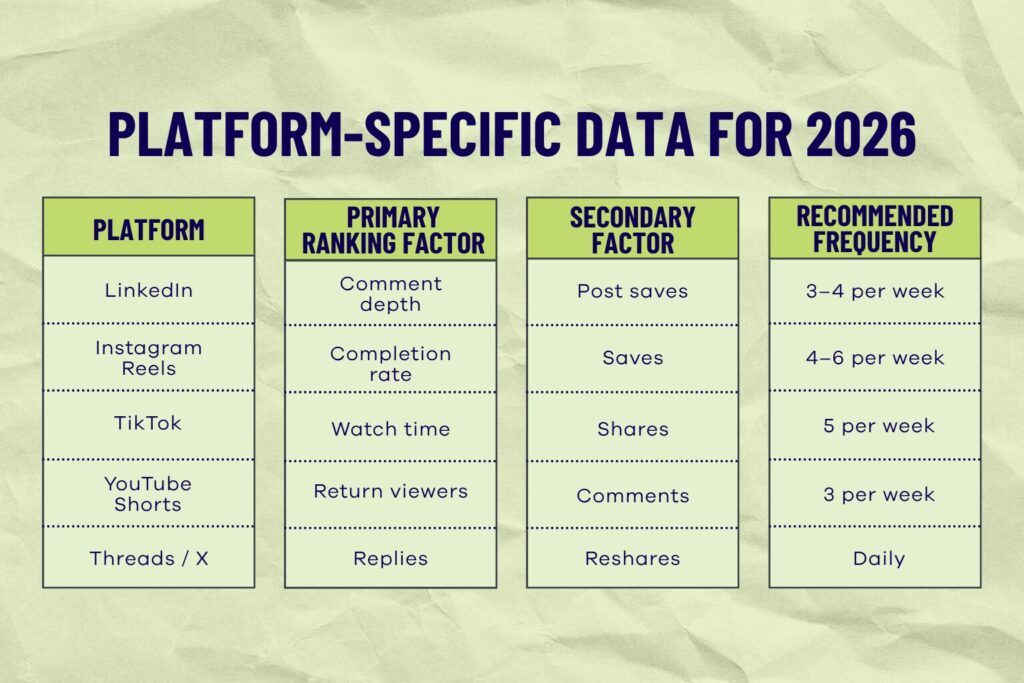
These numbers reflect 2025 creator reports from Sprout Social and Later.com benchmarks. Use them as starting points.
How to combine social and search performance
Search and social now reinforce each other. When users discover your brand through short-form content, search algorithms pick up those mentions and backlinks.
Cross-reference keywords from your search strategy in captions, alt text, and profile bios. This creates a unified signal between your web presence and social footprint—exactly the alignment described in What the Algorithm Wants This Holiday Season.
Example workflow:
- Post a 15-second tip video summarizing a key point from a recent blog.
- Add a caption using the same phrase that appears in your page title.
- Track new branded keyword searches in Google Search Console after 7 days.
This loop strengthens both your engagement metrics and your discoverability.
Mistakes to avoid
- Posting external links without context.
- Re-uploading the same video with different captions.
- Ignoring comment replies for more than 24 hours.
- Switching tone between channels.
- Prioritizing frequency over value.
Each mistake breaks the consistency signal that algorithms depend on.
Metrics that define success in 2026
- Retention rate: Target 65–70 percent average watch time.
- Response time: Reply to comments within 1 hour.
- Save ratio: At least 1 save per 25 views on Instagram (Influencer Marketing Hub report).
- Return audience: Aim for 20 percent repeat viewers monthly.
Track these instead of follower count or reach. They provide a clearer picture of real influence.
Where The it Crowd fits
The it Crowd helps brands decode these changes by building content strategies around algorithm logic. Each campaign starts with data from social analytics dashboards and converts those insights into creative calendars.
Their process focuses on one principle: clarity beats volume. The same structure that improves search visibility also drives retention in social feeds.
You can explore their case studies and workflow samples through The it Crowd Resource Hub. It includes templates for content pacing, engagement tracking, and visual consistency.
Preparing for 2026
Social algorithms will continue to reward long-term engagement over temporary reach. Your strategy should balance immediate visibility with sustained conversation.
Review your posts weekly, keep your audience talking, and maintain consistent brand tone across every channel.
By combining the retention methods outlined here with the clarity rules from How Search Algorithms Are Changing Again in 2026 and the structural insights from What the Algorithm Wants This Holiday Season, you create a single pattern that every algorithm can read and trust.
That alignment is what keeps your content visible when the rules shift again next year.
