

Every mid-sized enterprise reaches a tipping point where marketing stops feeling strategic and starts feeling chaotic. You’re running campaigns, tracking metrics, and burning budget—but are you actually moving closer to your goals?
Marketing shouldn’t feel like herding caffeinated cats. Yet in 2026, many businesses find themselves drowning in options: dozens of platforms, countless tactics, and conflicting advice about what works. The challenge isn’t doing more marketing; it’s knowing which marketing matters.
As Antoine de Saint-Exupéry observed, “A goal without a plan is just a wish.” A custom marketing strategy transforms wishes into roadmaps by cutting through signal vs. noise and prioritizing marketing clarity over guesswork.
This article breaks down what that clarity actually looks like and how it leads to measurable ROI. You’ll discover why strategy outperforms scattered effort, how to build an approach tailored to your business, and what implementation really requires when resources are finite.
Key Takeaways: The Anatomy of a Marketing Win
This article at a glance:
- Strategy creates ROI, not just activity. Shifting from scattered tactics to an integrated brand and performance approach can lift revenue ROI by 25% to 100%, delivering measurable marketing results that compound over time.
- Mid-sized companies face unique challenges. You’re too complex for improvised tactics but too lean for specialized teams, creating a systems problem that requires strategic solutions.
- Five elements define effective strategy: buyer journey mapping, full-funnel approach, channel selection, message consistency, and operational integration working in concert.
- Clarity beats volume every time. Strategic marketing means knowing exactly where investment goes, what it produces, and how each tactic advances specific business goals.
Why Does Marketing Feel So Chaotic for Growing Companies?
If you’re leading marketing for a mid-sized enterprise, you’ve likely experienced the paradox: your company is growing, your budget is increasing, yet marketing somehow feels more chaotic than ever.
Here’s why. Small businesses can succeed with scrappy tactics. Enterprise organizations have specialized teams for every channel. But mid-sized companies occupy the awkward middle: you’re expected to deliver enterprise results with startup agility, which often means juggling email campaigns, social media, paid ads, content creation, and event planning simultaneously.
It’s like conducting an orchestra where everyone is playing different songs. Without a unifying strategy, even well-executed tactics pull in competing directions. Many campaigns fail before they launch because they’re built on assumptions rather than audience-first marketing principles.
This marketing rut isn’t a skill problem; it’s a systems problem. Effective marketing problem-solving requires stepping back to ask what you’re trying to achieve before deciding how to reach them.
What a Custom Marketing Strategy Actually Is
Consider how one brand, Odorono, created the modern deodorant industry in the early 1900s.
The product existed, but sales were stagnant. The turning point wasn’t a better formula or flashier advertising but redefining the problem. Instead of selling antiperspirant as a convenience, marketer James Young convinced Americans that body odor was a social catastrophe they didn’t even know they had. Sales jumped 112% in one year.
Effective strategy often begins with defining the real problem and the stakes, not picking tactics.
A custom marketing strategy isn’t about hiring an agency to dust off a template and swap in your logo. At mid-market scale, “custom” means building around your specific goals, your actual audience, your sales reality, and your internal capacity.
As Michael E. Raynor observed in The Strategy Paradox, “Good strategies are not necessarily fragile, but they are intricate, with many interdependent, tightly linked components.” Your strategy should fit your business the way a tailored suit fits your frame.
The Anatomy of a Win: 5 Elements Every Strategy-First Plan Needs
Theory is clean. Practice is messy. When The it Crowd works with mid-sized enterprises to build custom marketing strategies, we start with questions: Where does revenue actually come from? Which customer segments convert at higher rates? What happens between first contact and closed deal?
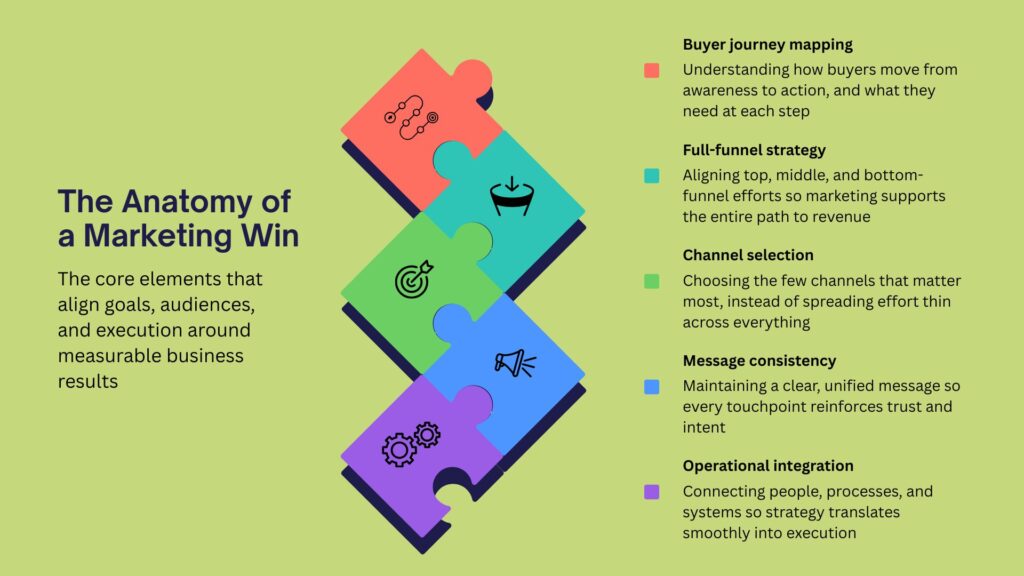
A real strategy looks like a detailed blueprint with five essential elements:
- Buyer journey mapping — Understanding not just who your customers are, but how they move from problem recognition to purchase decision. Most businesses discover their assumptions about this journey are partially wrong.
- Full-funnel strategy — Top-of-funnel tactics build awareness. Middle-funnel content educates and nurtures interest. Bottom-funnel conversion mechanisms—whether sales calls, demos, or direct purchases—turn interest into revenue.
- Channel selection — Each stage requires different messaging, channels, and metrics tailored to where prospects are in their journey.
- Message consistency — An integrated marketing strategy ensures your brand messaging remains consistent whether someone encounters you through LinkedIn, a podcast ad, or a sales conversation.
- Operational integration — Your content marketing supports your paid campaigns. Your email nurture sequences reinforce what prospects learned from your website.
When every component works in concert, your marketing moves people predictably toward decisions that benefit both them and your business.
How The it Crowd Replaces Guesswork with Clarity
Imagine running a business where every marketing dollar feels like a gamble. You’re spending, but you can’t quite trace how spend connects to revenue. That uncertainty breeds hesitation, which breeds paralysis.
The it Crowd approaches custom strategy differently. We don’t pitch solutions before understanding your reality. We start by mapping your current state: what’s working, what’s draining budget, where gaps exist. From there, we build strategy-led campaigns that connect directly to business objectives, not vanity metrics.
This is transparent marketing in practice. You see exactly where your investment goes and what it produces. Marketing accountability isn’t something we promise; it’s how we operate. Every recommendation ties to measurable outcomes.
We create everlasting thumbprints not through magic, but through methodical clarity that replaces assumptions with evidence. That’s the difference between marketing that feels risky and marketing you can genuinely rely on.
Case Study: From Marketing Noise to Measurable Momentum
Sometimes the problem isn’t what you’re offering, but how you’re saying it.
The Challenge
When ExpoHome Improvement approached The it Crowd, they had competitive offers but messaging that blended into the Texas home remodeling noise. Their ads worked, but they didn’t connect. As one team member put it, “We have the right offers, the right people, and the right quality—the branding just wasn’t showing it.”
Our Approach
We developed two creative directions rooted in emotional appeal and trust-building: “Bold & Nameplay” and “Heartstrings.” From playful TV concepts like “Duck HOA” to heartfelt print pieces featuring “Life Happens Here. Let’s Make It Beautiful,” every element reinforced a voice that was warm, confident, and family-first.
The Results
Landing page conversions increased 42%. Social engagement lifted 36%. Perhaps most telling: customers began directly referencing taglines like “Your Home Shouldn’t Fight You” in inbound calls, which improved lead quality and accelerated pipeline velocity.
Strategic messaging doesn’t just reduce customer acquisition cost. It fundamentally changes how prospects perceive value.
Bringing Your Strategy to Life: Implementation and Execution
Most businesses believe that doing more marketing delivers better results. But in 2026, the evidence tells a different story. Think of marketing like planting a garden: scattering more seeds everywhere rarely produces a better harvest than carefully cultivating the right plants in the right soil.
A well-designed marketing execution plan creates better returns because it aligns every dollar with strategic intent. According to research published in WARC, companies that shift from a performance-heavy approach to a more balanced, integrated brand + performance approach see their revenue ROI lift by roughly 25% to 100%, with a median increase around 90%. That’s not incremental improvement; that’s transformative growth.
The difference lies in how ROI-focused marketing distributes resources. Rather than chase immediate conversions at the expense of long-term brand equity, an integrated strategy recognizes that brand-building and performance tactics amplify each other. Strategy doesn’t just organize your marketing; it multiplies its impact.
FAQ: Smart Questions Leaders Ask About Custom Marketing Strategy
How long does it take to see results from a custom marketing strategy?
Most mid-sized enterprises notice initial improvements within 60-90 days, with significant ROI gains emerging over 6-12 months as efforts compound.
What if our team lacks experience with campaign benchmarking?
Start with industry-standard marketing KPIs, then refine based on your goals. Many businesses partner with agencies or consultants during the transition.
Do we need sophisticated marketing attribution models?
Not immediately. Begin with straightforward tracking that connects activities to outcomes. As your strategy matures, layer in more sophisticated attribution.
Can we adjust our strategy mid-execution?
Absolutely. The best strategies remain flexible, allowing you to respond to market changes while staying anchored to core objectives.
Ready to Build Your Custom Marketing Strategy?
Creating a custom marketing strategy doesn’t require perfection—it requires commitment to understanding your audience and aligning your efforts with clear objectives.
Start by auditing what you already have. Your existing systems contain valuable insights about customer behavior and campaign performance. First-party data has become your most reliable asset, making privacy-first marketing both an ethical imperative and a competitive advantage.
If you’re feeling overwhelmed by the options or unsure where to begin, that’s normal. Strategic marketing combines art and science, intuition and analysis. The key is taking that first step: defining what success looks like for your business, understanding who you’re trying to reach, and building a plan that connects the two.
We’d love to hear about your marketing challenges and goals. Reach out to The it Crowd, and let’s explore what a custom strategy could look like for your business.
