

Your campaigns look great. The creative is sharp. The targeting is refined. So why aren’t you seeing results? The problem isn’t what you’re creating. It’s what you haven’t diagnosed yet.
You’ve seen it before: a campaign launches with energy and ambition, only to flatline weeks later. The team scrambles with new visuals, revised copy, another platform. But nothing sticks. The real issue? It was never about the creative.
Behind every underperforming campaign is a hidden structural failure. A misaligned strategy. A broken customer journey. Flawed data no one questioned. These invisible forces kill performance long before the first ad goes live, yet most teams never diagnose them. Instead, they ask the wrong question: “What should we create?” when they should be asking, “What should we solve?”
What this article covers:
- Why marketing problems go misdiagnosed
- The five diagnostic gaps that drain performance
- How to identify root-cause issues before touching creative
- What a diagnostic marketing partnership actually looks like
The Invisible Problems That Kill Good Marketing
The damage happens upstream, where no one’s looking.
Consider a SaaS startup pouring budget into paid ads. The creative is sharp, the targeting refined. Yet conversions stay flat. The real problem? Their homepage lists eight different value propositions, leaving visitors confused about what the product actually does. No amount of ad spend fixes unclear positioning.
This is what The it Crowd sees repeatedly: misaligned strategy, vague audience definitions, broken attribution models, internal silos blocking execution. As Forbes writes, “Without clear positioning about what you offer… every marketing dollar you spend will be less efficient.”
These failures don’t announce themselves. They quietly drain performance until teams overcorrect with more content, more platforms, more creativity—none of which address the underlying issue. This is why marketing fails.
Why “Marketing Problems” Are Usually Business Problems in Disguise
Marketing is a downstream function. When business clarity exists, marketing amplifies it. When clarity is missing, marketing inherits the chaos.
In Good Strategy/Bad Strategy, Richard Rumelt writes, “The kernel of a strategy contains three elements: a diagnosis, a guiding policy, and coherent action.” Without these, marketing becomes guesswork dressed as execution.
This is the gap most teams miss. They treat stagnant campaigns as creative failures when the real culprits live upstream: unclear value propositions, diffused brand positioning, internal miscommunication, product-market misalignment. These are business problems, not marketing strategy issues.
Creative output cannot compensate for business ambiguity. It can only expose it. When leadership can’t articulate what makes the company different, no amount of refined messaging will create coherence. The foundation determines the outcome.
The Cost of Misdiagnosis: When Teams Fix the Wrong Problem
Solving surface symptoms wastes resources. Marketing diagnosis determines whether those resources create impact or just activity.
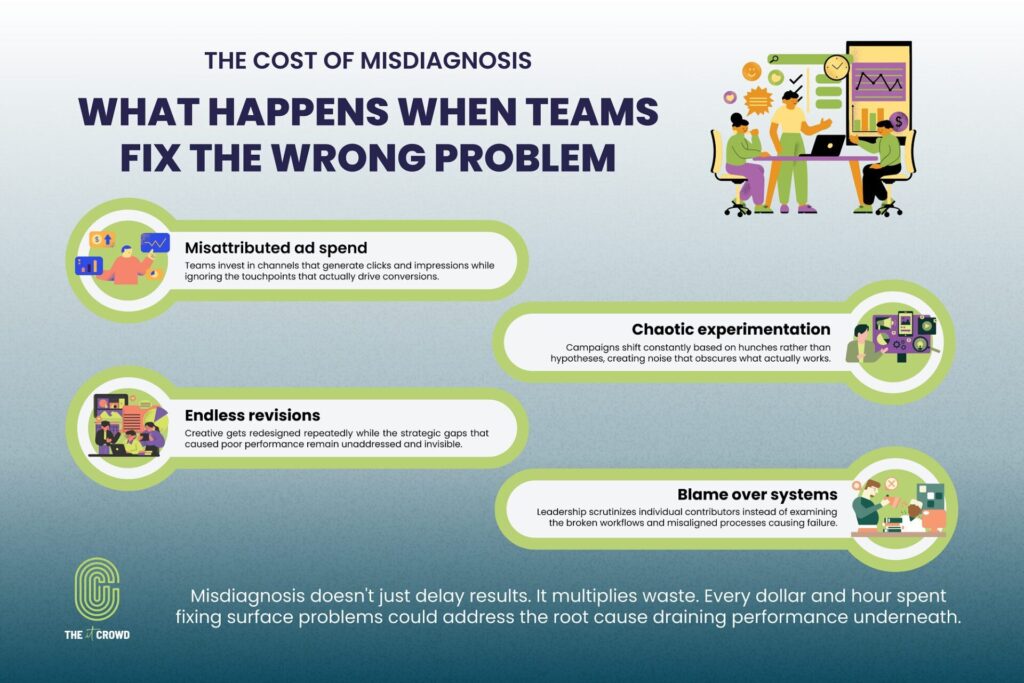
When teams assume the problem is creative, marketing performance suffers through:
- Misattribution of ad spend: Budgets flow toward platforms that look active rather than channels that actually convert.
- Chaotic experimentation: Testing everything without hypotheses produces noise, not insights.
- Endless revisions: Teams rewrite copy and redesign assets while core issues remain untouched.
- Blame over systems: Individuals get scrutinized while broken processes stay invisible.
Misdiagnosis doesn’t just delay results. It compounds failure. Resources get allocated to symptoms while root causes drain performance unchecked. Teams spiral through surface fixes, never addressing the structural problems underneath.
The Five Most Common Diagnostic Gaps Behind Underperforming Marketing
What separates stagnant campaigns from high-performing ones? Usually, it’s one of five diagnostic gaps.
- Unclear or outdated audience insights: A B2B company targets “decision-makers” without distinguishing between CFOs who prioritize cost savings and CTOs who value innovation. Generic messaging reaches no one effectively.
- Weak or inconsistent brand messaging: Your website promises “enterprise-grade security” while your sales deck emphasizes “ease of use.” Prospects get confused about what you actually stand for.
- Faulty or incomplete data: Attribution models credit the last click, ignoring the podcast interview and three blog posts that built trust beforehand. Budget flows to the wrong channels.
- Customer journey gaps: Visitors land on your pricing page from organic search but find no context about what you offer. They leave within seconds.
- Internal process gaps and siloed decision-making: Marketing launches a campaign while product delays the feature it promotes. Misalignment creates campaign underperformance before the first impression loads.
These gaps form the scaffold of most marketing failures.
How to Diagnose a Marketing Problem Before Touching the Creative
Many brands never perform a true root-cause analysis marketing teams rely on to diagnose hidden issues. They skip straight to execution, hoping new creative will compensate for unclear strategy. It won’t. Here’s how to diagnose systematically.
1. Identify whether the problem is strategic, operational, or creative.
Start by categorizing. Is the issue about what you’re saying, how you’re executing it, or how it looks? Most teams jump to creative when the real failure lives in strategy or operations.
2. Validate whether your audience profile is current.
Markets shift. A SaaS company that defined its ideal customer two years ago may now be speaking to an outdated persona. Review recent data and verify assumptions against reality.
3. Audit your messaging for clarity and consistency.
Read your homepage, sales deck, and recent campaign copy side by side. Do they tell the same story? If three different narratives emerge, your audience receives mixed signals.
4. Analyze your data for accuracy, completeness, and attribution gaps.
Check whether your analytics actually track the full customer journey. Many attribution models ignore mid-funnel touchpoints, creating blind spots that distort decisions.
5. Look for funnel friction.
Map each step from awareness to conversion. Dead pages, confusing CTAs, forms that ask for too much information. Small friction points compound into major drop-offs.
6. Review internal processes.
Who approves what? How are decisions made? Where do delays occur? Marketing execution suffers when internal workflows create bottlenecks.
7. Inspect your tech stack for broken integrations or outdated tools.
A CRM that doesn’t sync with your email platform means segmented campaigns become impossible. Tools should enable execution, not obstruct it.
8. Reassess goals and KPIs.
Are you measuring what actually matters? Vanity metrics like impressions feel productive but rarely correlate with revenue. Align KPIs with business outcomes.
9. Map your customer journey from awareness to retention.
Understand how prospects discover you, evaluate you, buy from you, and stay with you. Gaps in any stage create leaks that no creative can plug.
10. Look for operational bottlenecks that distort timelines or strategy.
Delayed approvals, last-minute revisions, unclear ownership. These process failures force rushed execution that compromises quality.
When the Creative Is the Problem (But Rarely the Whole Story)
Sometimes the creative truly underperforms, but usually because something upstream failed first.
Consider Pepsi’s Refresh Project in 2010. The execution was brilliant: 80 million votes, massive social engagement, innovative cause marketing. Yet Pepsi’s market share dropped, and the brand fell from second to third place in the U.S. The creative succeeded while the strategy failed.
The issue wasn’t the campaign quality but the strategic misalignment. A youth-oriented soda brand positioning itself as a social change agent felt inauthentic. The messaging contradicted the product’s identity.
Creativity works best when informed by clean inputs and correct strategic hypotheses. Exceptional execution cannot rescue fundamentally misaligned positioning.
How Diagnostic Marketing Works in Practice: Ascent Case Study
The it Crowd’s work with Ascent Business Systems shows diagnostic marketing in practice. Ascent needed to communicate value in a crowded software market and drive adoption of a new texting feature. Rather than jumping to creative, The it Crowd started with discovery.
We audited list health, reviewed existing campaigns, and identified five structural gaps: fragmented assets, under-explained features, buyer hesitation around change, limited audience variants, and no reporting rhythm. Only after diagnosing these root causes did we build strategy.
The result was an “honesty-first” narrative, four distinct outreach tracks tailored to specific audiences, and motion assets designed for clarity. Engagement improved. Partners received enablement tools. Sales gained proof-first visuals.
This is the shift from “make content” to “find the problem.” Diagnostic partnerships prioritize clarity, alignment, and accurate analysis before creative execution.
Essential Takeaways: Diagnosis Before Execution
- Marketing failures start upstream, not in creative execution. Conduct a comprehensive marketing audit before assuming the problem lies in your assets or messaging.
- Strategic misalignment creates waste. No amount of creative volume compensates for unclear positioning or faulty data.
- Diagnostic gaps drain performance silently. The best campaigns emerge from accurate problem identification, not faster production.
- Effective partnerships diagnose first, execute second. Root-cause analysis reveals where resources should flow, not where activity feels busiest.
Moving Forward with Marketing That Actually Works
The strongest marketing programs aren’t built on creative volume. They’re built on clarity, alignment, and accurate diagnosis.
Before your next campaign launches, ask one question: “Are we solving the right problem?” If the answer requires guesswork, you’re not ready to execute.
Start with discovery. Audit your messaging, validate your data, map your customer journey. Identify where structure fails before asking creative to compensate. The gaps you find today determine the performance you see tomorrow.
The it Crowd offers complete marketing strategy and consulting services through The Strategist, helping businesses diagnose root causes, align internal processes, and build campaigns that address real problems instead of surface symptoms.
If your marketing feels stuck, the issue likely lives upstream. Let’s find it together.
Schedule a consultation to start your diagnostic partnership.

