
Search engines keep evolving. If your site still treats keywords, links, and rankings exactly the way it did five years ago, you risk falling behind. The shift into 2026 brings clearer signals, deeper understanding, and more direct traffic risks. You must adapt how you write, structure, and publish content if you want your site to stay visible and valuable.
Why the change matters now
In May 2024, Google AI Overviews—originally known as Search Generative Experience—started showing AI-generated summaries at the top of search results (blog.google). By 2025 that feature expanded. Google reports that users are asking longer, more specific questions that require step-by-step reasoning (developers.google.com).
For your brand, this means the old “rank first on page one” formula is weaker when users can see the answer without clicking. During the 2024 holiday season, AI-referral traffic grew 1,300 percent year-over-year (The Verge). You cannot assume traffic behavior will remain stable in 2026.
What’s different in 2026 search algorithms
Enhanced intent understanding
Search engines no longer match keywords—they interpret meaning. If someone searches “how to launch a SaaS product in Asia,” the engine reads location, product type, and launch phase.
To adjust, write with natural language and answer questions directly in headings and early paragraphs. Use phrases such as “what steps should a SaaS company take in Asia in 2026.”
This shift aligns with generative search optimization or G-SEO, which merges structured data and AI context (arxiv.org).
Structural clarity and rich data signals
Content must show who, what, when, where, and how. Without structure you miss AI summary boxes. Google’s own documentation says to create unique, helpful content that satisfies real users (developers.google.com).
Do this:
- Apply schema markup for how-to, FAQ, article, and review types.
- Keep URLs short and descriptive.
- Display publish dates, author names, and update notes.
- Use accurate alt text for every image.
Structured clarity now influences AI ranking. The it Crowd’s guide on GEO explains how precise metadata helps search engines connect meaning between words and visuals.
Reduced click-through and zero-click risk
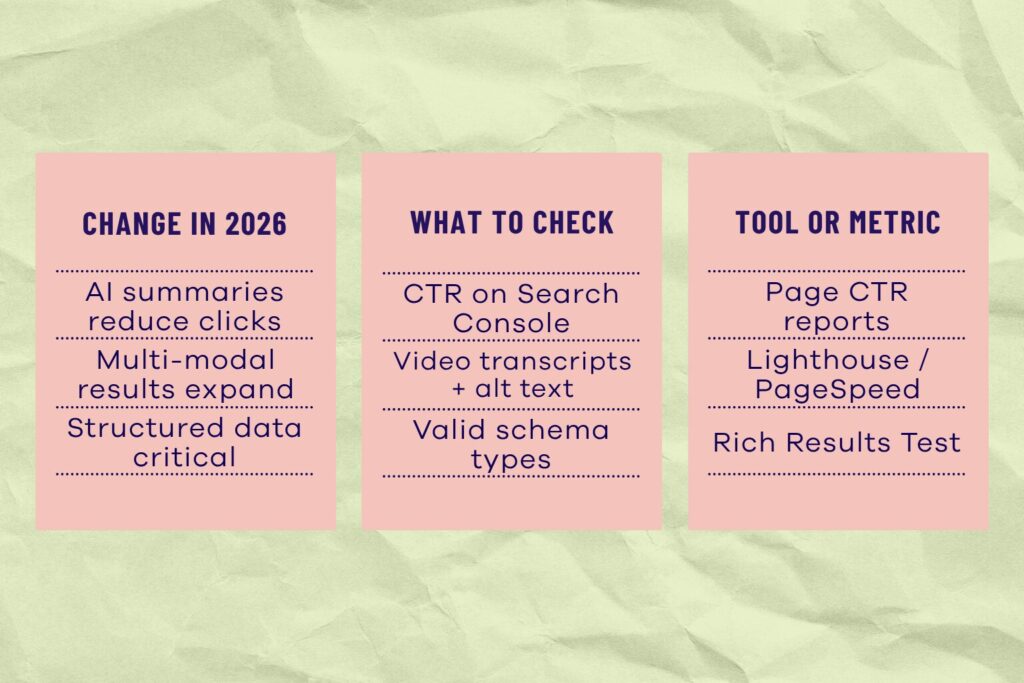
AI Overviews often replace traditional listings. Studies show these summaries take more than 70 percent of visible screen space on mobile results (Wikipedia).
To counter this:
- Create deeper resources like calculators, downloadable toolkits, or use cases.
- Write titles that spark curiosity and promise clear benefits.
- Monitor high-impression pages with CTR below 2 percent and update snippets.
Multi-modal and interactive readiness
Search is expanding beyond text. Google Lens and voice queries now mix visuals and speech (Wikipedia).
Prepare by:
- Uploading transcripts for all videos and podcasts.
- Optimizing image captions and schema.
- Writing conversational copy that fits voice queries.
- Adding interactive content that extends dwell time.
Practical steps you can apply this month
- Audit your existing key pages
- Identify your top 20 pages by impressions.
- Check schema markup and fix errors.
- Review title tags under 60 characters with your main keyword up front.
- Test mobile speed; aim for first content paint under 3 seconds.
- Rewrite for intent clarity
- Add one direct question in a subheading and answer it immediately.
- Include specific data or a cited source.
- Avoid filler or repetition.
- Refresh meta descriptions
- Keep them around 155–160 characters.
- Focus on the problem solved, not just keywords.
- Add related internal links
- Link updated pages to relevant guides, such as The it Crowd’s local SEO article.
- Use descriptive anchor text like “see how GBP updates improve visibility.”
- Create a quick reference section

6. Schedule semi-annual reviews
-
- Set reminders for June and December 2026.
- Track Google updates, EEAT guidelines, and AI search experiments.
How this changes your content strategy
You need a disciplined structure built on:
- Depth – One page per problem, fully answered.
- Intent clarity – Every headline written as a question a user might ask.
- Data consistency – Refresh key stats quarterly.
- Authority – Cite credible sources, add author expertise, and cross-link case studies.
- Conversion readiness – Include a clear next step or CTA visible without scrolling.
A 2024 Backlinko study found that refreshed long-form content earned 27 percent higher ranking improvements than older static pages. Consistency signals life to the crawler.
The it Crowd’s role in future-ready SEO
The it Crowd works with clients to align technical SEO and content intent. The process starts with a GEO audit that checks metadata, schema, and content tone for AI compatibility. From there, content teams rewrite articles with context-aware structure and measurable outcomes.
Each audit includes:
- Page-speed and crawlability report
- Schema validation and repair list
- Intent mapping of existing pages
- Performance tracking through Search Console and Analytics
You can explore more about this framework in The it Crowd’s Resource Hub, which outlines their structured approach to search visibility and multi-channel consistency.
Key metrics you must monitor
- CTR for high-impression pages – Pages with CTR under 2 percent need rewritten titles and better summaries.
- Structured data errors – Keep error count at zero through monthly checks.
- Zero-click rate – If more than 25 percent of impressions lead to zero clicks, adjust content type or title strategy.
Tracking these three numbers shows whether your updates align with how algorithms now rank content.
Mistakes to eliminate
- Ignoring schema markup or using outdated types.
- Publishing keyword-stuffed posts without clear intent.
- Reusing content blocks across multiple pages.
- Delaying mobile optimization.
- Forgetting to review old articles at least once per year.
Each of these mistakes weakens your authority and reduces trust signals.
Suggested quarterly workflow
December 2025: Complete technical audit, apply schema, update titles.
January – March 2026: Track CTR and bounce rate changes.
April – June 2026: Refresh statistics and visuals; test mobile layouts.
July 2026 onward: Review EEAT criteria and adjust author pages.
Following this simple quarterly rhythm gives Google clear proof that your site is active and well-maintained.
What this means for your brand
Search visibility in 2026 depends on showing consistency, credibility, and context. Algorithms will continue learning from how users engage with your site. Your task is to make that engagement as easy and satisfying as possible.
That means structured data, verified expertise, useful internal links, and measurable improvements over time. Brands that maintain these habits stay visible even as search interfaces change.
The it Crowd helps teams reach that level through data-driven audits, intent-based content planning, and long-term reporting that connects SEO to real business growth. Their approach focuses on precision rather than volume, proving that clear structure still wins in an AI-driven search era.
Your site can start these adjustments now. By January 2026, algorithms will reward the brands that already communicate clearly. Start your audit, update your metadata, and keep your structure honest and useful—the rest will follow.

